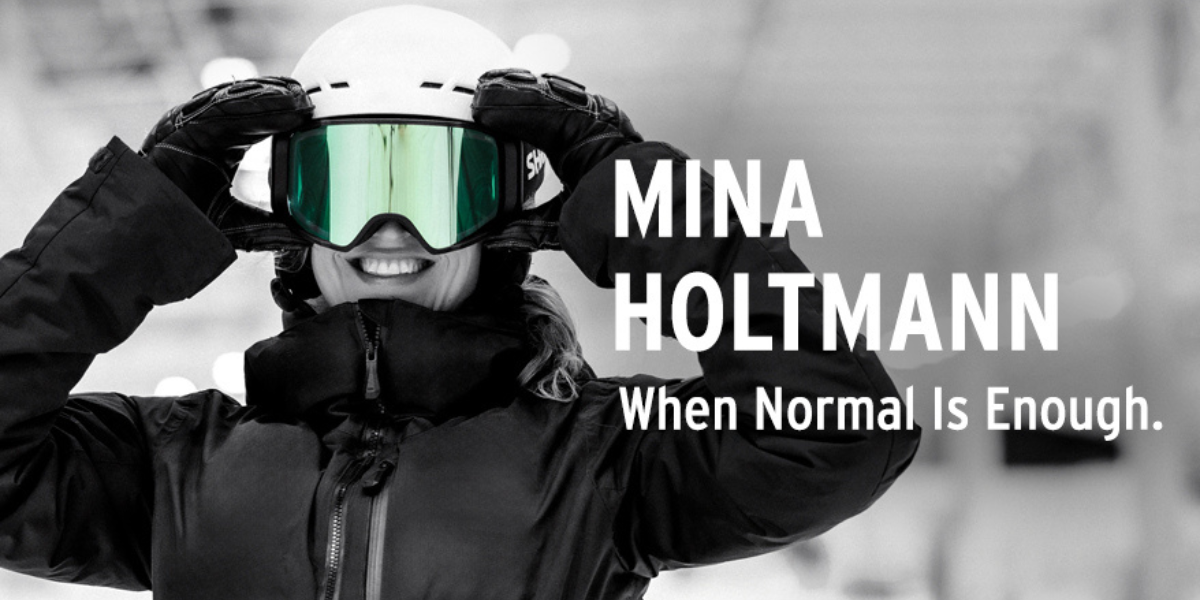
“Sometimes it is small changes that help us, and it does not take long to be on the right path again. Our team and I went back to basics, and things turned around for me in just one camp.” — Mina Fürst Holtmann
In the final stretch before the Olympic Winter Games, Mina Fürst Holtmann’s season was heading in the wrong direction. Results were slipping. Performances lacked clarity. Confidence, once automatic, felt harder to access. From the outside, the downward trend was visible. From the inside, it felt even heavier.
Then, on the biggest stage in ski racing, she delivered the most powerful performance of her season. On the Olympic slopes of the Tofane in Cortina d’Ampezzo, Holtmann skied with authority, controlled, composed, and fluid. Turn after turn, she looked free. Not cautious. Not tentative. Not surviving.
Powerful. Effortless. Intentional. She finished just 0.12 seconds from a medal. When everything had been trending downward, she did not collapse under Olympic pressure. She fought back. But the turnaround did not come from pushing harder.
It came from resetting.
Stopping the Spiral
After a difficult stretch of races, Holtmann knew something had to change.
“What changed in me after a difficult stretch of races that made me deliver on the biggest stage is that I had to stop and look inwards,” she explains. “I had ended up in a ditch that I didn’t know how to get out of. I was spiraling a lot around skiing, in addition to some personal issues I had to resolve. All of that had been weighing down on me for a long time.”
The weight wasn’t only competitive. It was mental. Emotional. Accumulated. With the Olympics approaching, she knew simply participating would not be enough. “In order to be able to ski the Olympics and not just be there and finish, I had to change something.”
Following a race weekend in Špindlerův Mlýn, Holtmann and her team made a deliberate decision: pause, reset, simplify. They returned home. Took a break. Then entered their Olympic pre-camp with clarity.
“We got calm, proper training. My coaches and I sat down and simplified everything. We went back to basics and focused on one task and one task only.” No overhaul. No radical change. Just clarity.
“That made things turn around for me.”

Trusting That Normal Is Enough
For elite athletes, the instinct during a slump is often to force solutions — to train harder, push more, search for something extra. Holtmann recognized that trap.
“I know from experience that if I try too hard to ski fast, I only ski slow,” she says. “I think many athletes recognize themselves in that it is hard to trust that normal is enough. Me included.”
The message she carried into Cortina was simple: Normal is enough. Trust the training. Trust the process. Trust the fundamentals. Focus on one task.
The fight was not about aggression. It was about discipline. It was about confidence in what already existed. Under Olympic pressure, she did not try to become someone else.
She returned to herself.
Responding With Control Under Pressure
“I think a lot of athletes react in powerful and controlled ways to difficulties and bumps in the road,” Holtmann reflects. “Every one of us has to confront ourselves to evolve, move forward, and perform better. It is something natural in us athletes to learn from our mistakes because we want to, and the alternative is worse.”
Her Olympic performance was not born from desperation. It was born from acceptance. Being slightly under the radar allowed her freedom. Freedom to simplify. Freedom to focus. Freedom to trust.
The run in Cortina was not the product of doing more. It was the result of doing it right.

A Reminder of Who She Already Is
Perhaps the performance was not a lesson, but a reminder.
“It reminded me that I am a great skier and can be involved in the top.”
In a sport measured in hundredths, 0.12 seconds can feel cruel. But in a broader perspective, it represents something stronger: resilience under pressure and the courage to simplify when complexity takes over. Sometimes the strongest fight is the one that looks calm from the outside.
And sometimes, normal is enough.
About the Author: Press Release