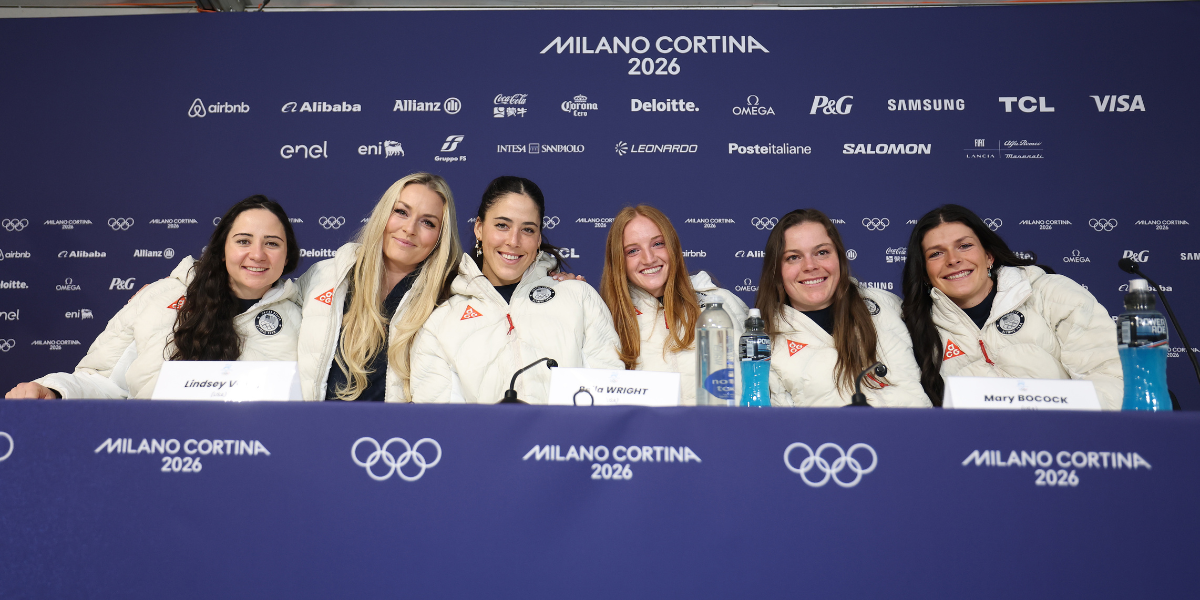
USA women’s Olympic speed team / Getty
“All I need is the Dolomites”: U.S. women’s speed team on why Cortina feels like the perfect stage
CORTINA D’AMPEZZO, Italy — Ask the Stifel U.S. Ski Team’s women’s speed group what they think of Cortina, and you don’t get a polite travel brochure answer. You get something closer to a love letter — with a warning label.
“This is the most perfect downhill track,” Isabella Wright said. “It has a bit of everything. There’s amazing gliding, amazing technical turns, some fun jumps — but I think overall the beauty of this place is really what solidifies it for me.”
That mix of old-school speed, rhythm, terrain and consequence is exactly why Cortina’s Olympia delle Tofane course has lived for decades in ski racing lore — and why this Olympic return to a “legacy venue” has the Americans unusually comfortable. They know the hill. They know how it changes. They know it can reward bold skiing — and punish anything sloppy.
“Cortina, it looks really pretty,” Breezy Johnson said, “but it will bite you in the ass.”
A course that asks for everything
Wright’s description landed like a thesis statement for the week: the track doesn’t lean into only one skillset. The top-end glide matters. So does line choice through technical turns. So does commitment over terrain and jumps — with enough speed that every decision gets amplified.
“I was asked a couple years ago what I feel we would need for the Olympics… and for me, I always said all I need is the Dolomites and to run down this track,” Wright said. “It truly is just so special to be here.”
Keely Cashman, who prides herself on technical fundamentals, leaned into the same idea — especially for Super-G, where Cortina can ski more “technical” than people expect.
“I love a technical course. I love racing in Cortina,” Cashman said. “This track is super positive for all of us.”
Even Mary Bocock — the first-time Olympian with the least history on the hill — framed Cortina as an advantage, not a mystery. “Last year this was my very first super G World Cup race ever,” she said. “So it’s the only speed track so far that I’ve been on before.”
Beauty, history — and a hill that keeps receipts
If the course is the main character, the setting is the co-star. The Americans kept circling back to the Dolomites, the town, and the feeling that Cortina is a place you want to be — even when the track is demanding.
“Whether whatever happens at the race, you just love being in the Dolomites, walking through town,” Jacqueline Wiles said. “Everyone has fur coats on. You kind of have that old Italian mobster feel. The food’s amazing… The dry grippy snow… is always a blast to be on.”
Johnson took the “legacy venue” angle even further, predicting that familiarity will raise the bar for everyone.
“Because Cortina is [a] Olympic legacy venue… it’s most athletes’ favorite venue,” she said. “I think the downhill is going to be the most competitive alpine event that has ever taken place.”
In other words: nobody gets to hide behind uncertainty. Everyone arrives with pages of notes, years of split times, and a mental highlight reel of what this hill requires.

The snow “feels like home,” and Italy tastes like Italy
Several athletes said the surface and weather feel familiar — especially for racers who grew up on Western snowpacks.
“The snow… kind of feels like the west coast snow,” Cashman said. “It’s usually really sunny out, so it kind of feels like home.”
Bocock and Wright also joked that growing up at Snowbird means they won’t complain about snow.
“We love powder skiing,” Bocock said, with Wright backing her up: “This is true.”
Off the hill, the team sounded like a group enjoying the Italy part of Italy.
“Obviously being in Italy, we love all the pizza and pasta,” Bocock said. “We’ve been eating a lot of that… We love tiramisu.”
Favorite sections: iconic speed vs. technical joy
Ask racers to name their favorite sections and you learn a lot about how they ski.
Wiles didn’t hesitate: “Definitely going down to Tofana Schuss. I think that’s probably the most iconic and the most fun.”
Cashman immediately countered — not because it isn’t iconic, but because it’s so iconic.
“That is my least favorite section,” Cashman said. “Because it’s so fast and you’re just going straight…”
Her favorite is the more Super-G-flavored part of the track — the turns after the big jump that feed into a technical section. Johnson also highlighted a sequence the team calls “zigzag,” describing the kind of terrain where you’re “switch[ing] in the air” through linked features — the sort of thing that feels effortless only when you’re right on top of it.
Wright, fittingly, refused to choose: “I think my favorite part of the course is the whole entire course here.”
A calmer Olympic week — with one big catch
The Americans also noted a practical advantage: this Olympic setup in Cortina is unusually smooth for ski racing.
“The setup is the best that I’ve had at the Olympics,” Johnson said. “Our coaches are right near us, our technicians are right near us, our ski rooms, so it’s really very easy for us to get everything done.”
The trade-off is distance. With venues spread out, the “Olympics” part can feel far away — fewer chances to watch other sports, fewer spontaneous interactions. But for speed racers, that can also mean fewer distractions and more focus.
And then there’s the catch that keeps coming up whenever racers talk about Cortina: you can feel incredible here — right up until you don’t.
Johnson put it plainly: “I know that I can ski really well here… but I also know that Cortina… will bite you.”
That’s the Cortina bargain. The Dolomites give you the view. The town gives you the vibe. The track gives you everything — speed, rhythm, jumps, turns, history — and demands that you respect it for 90 seconds.
Or it takes the respect from you.
About the Author: Peter Lange