
The World Cup According to Grande: Are we Measuring Success or a Streak?

 Are we measuring success or measuring hot-streaks?
The down-side of being an Olympic sport is that most people like to judge success or greatness by counting medals. NBC and all media outlets reinforce that mentality by running the “medal count” as often as they talk about a single medal. And while I cannot blame them for that point of view, I also cannot endorse it as valid. I preface the rest of the article by stating this will be mostly about the men’s alpine team. It is where my experience was when working for the US Ski Team and it is where my most intimate knowledge lies. This will not keep me from mentioning Lindsey and Julia and the smokescreen they create by winning so many medals. Or that almost 50% of the women’s World Cup points this past season came in the Downhill discipline ONLY. That is a scary number. Even more so is that 78% of the total World Cup points scored by the Women’s Team were scored by Lindsey and Julia. Almost 91% of the total World Cup points scored by the Women’s Alpine Team were scored by Lindsey, Julia and in Downhill races. So before I launch into the rest of this article and the dangers of judging success with Olympic medals, I would mention that if I were the Women’s Alpine Team, I would be working hard to address the further development of my SL and GS team and my Europa Cup group. Hmmm.
Looking at the last 3 Olympics, I would suggest that the 2002 Olympics were viewed as a pleasant surprise with Bode getting 2 Silver Medals; the 2006 Torino Olympics was viewed as an abject disaster and 2010 at Vancouver as a rousing success. So keep that in mind when we think of how roundly we were criticized after Torino.
So, in the summer of 2002, the media machine kicks-in at USSA and around the World. The “Corruption of Bode” begins. He signs with Rossignol for a huge amount of money. It was a 2 year contract and I am sure Rossignol was seeing it as a move toward 4 years and Torino. And I am saying that because they put a lot more into promoting Bode and their own product than just the value of his contract. He had the service-man of his choice in Robi Kristan. He was almost constantly in the company of a Rossignol entourage made up of their own marketing and media people. There were extra press conferences. There were sponsored dinners. We traveled the entire winter with several Rossignol people on our hotel lists. Regardless, that was only the beginning. Bode spent 2 years with them and then switched to Atomic, which of course was received in Austria with high expectations. And that is where we landed and where we were as a team going into Torino. Bode was a machine, Daron Rahlves was winning Downhill and Super-G races (8 DH,2 SG) during that 4 year period. Ted was emerging as a tech force and the rest of the boys were solid and knocking down a lot of top 10 results. And if you know ski racing at all, you know that if you can crack the top 10 at the World Cup or Olympics, it can easily turn into a medal as people feel more pressure and make mistakes.
As I alluded to above, the expectations went through the roof. Not just for Bode but for everyone. We had steadily increased our Nations Cup points and we were looking like a formidable team. Well, we were a formidable team. We scored a total of 3179 Nations Cup points in 2006, finishing 2nd in the Nations Cup standings, only behind Austria. I will come back to this in a minute.
 Of course, we are all well aware of the “Best in the World” mantra and the bumper stickers and all of that. And I agree that it should always be our goal as the US Ski Team. But it cannot be measured by Olympic medals. And neither should our athletes be judged by that alone. Our athletes should be judged by globes, World Cup wins, podiums, top 10 finishes and world cup points as well as Olympic Medals and World Championship Medals. And when I trot out Bode’s numbers in the next paragraph, you have to put him in the list with the people we all revere as some of the greatest of all time. I will leave it to you to look up generational greats on your own. Stenmark, Phil Mahre, Girardelli, Zurbriggen, Tomba, Aamodt, Kjus, Von Gruenigen, Maier, Raich. Pick anyone you want and put the numbers up next to what I will give you. You will be amazed. I have not included many of the older guys because there were simply not enough races in the early days of the World Cup to amass the kinds of numbers I am talking about. And maybe that is why we still hang on the Olympics as our measurement?
Bode Miller has: 6 GLOBES, 32 WORLD CUP WINS, 68 PODIUMS, 136 TOP TENS, 5 OLYMPIC MEDALS AND 5 WORLD CHAMPIONSHIP MEDALS (4 gold). Torino was a problem in more ways than one but I will not address that here. That laundry has been aired over and over and I don’t care to re-hash it. But having been inside of that story a little bit, I might see it a little differently than most of you.
I see Torino as a series of near misses that probably caused a very high level of stress that had to be released. So, the Downhill race took place first in Sestriere in 2006 and Bode finished 5th and was 0.11 from a medal. A couple of bad tactical choices near the bottom probably cost him a medal. Antoine Deneriaz of France ran away with that Gold by quite a bit. And Tony D ALSO skied on Atomic. And without going to deep into that there are other stories about that Downhill that others are far more qualified to tell than I am. I will say that Daron had won the DH at World Cup Finals the year before in Sestriere AND had handily won the first training run. But let’s just make the 0.11 of a second leap and give Bode that medal. A bronze, but a pressure-breaker nonetheless. It probably gets the team and nation off to a good start, and causes Bode and everyone else to relax. Who knows?
So the Kombi was next and Bode was 3.06 ahead of Ted after the Downhill and had won World Cup slalom in Sestriere recently. Bode straddled on run 1 and was out of the race. Of course Ted went on to win the race and get his Gold Medal. And part of what upsets me and others inside the team was that the story was more about Bode’s failure than Ted’s triumph. Had Bode delivered there then we had a 1-2 finish in the Kombi, everyone would be satisfied already, at race number 2.
The boys we had in that GS race in Sestriere were likely our best GS team ever. Miller, Rahlves, Schlopy and Ligety. Ted was up and coming in GS and arguably skiing the best GS in the world at the time. He did win his first World Cup GS a week later in Korea. Schlopy was as solid as always and had a great career. Rahlves was the Bronze medalist in Bormio at World Champs the season before and had absolutely crushed a run of GS at the World Cup Finals in Sestriere the year before that was wiped out by fog. And Miller was the best GS skier in the world at the time. We should have done better, no doubt, but from looking at the boys that morning, and judging their mentality or fatigue, I was already concerned before we started.
On and on it went and we had a tough go for sure. Julia won gold in amazing fashion in horrible weather and conditions and hung on after winning the first run. It was a fabulous performance.
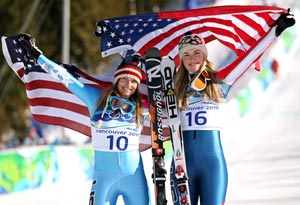
But as Torino came to a close, we got smashed in the press and we got smashed by our own “team” at home about all sorts of things that have been well publicized. But why was it worse than Salt Lake City? In SLC, 1 person earned 2 SILVER medals. In Torino, 2 athletes WON 2 GOLD medals. But Salt Lake City was viewed as a pleasant surprise and Torino was an abject failure. And now we are viewed as a rousing success. The Vancouver Olympics have made us “Best in the World” by the standard of winning medals in a 2 week period in February of
2010. I love it; I think it should be celebrated. But it should not be our measure of success or greatness. In a lot of ways it’s like having a run of luck at Black Jack at a Casino. There is some skill involved but a lot of it is actually not up to you. So finally, I have almost gotten to the point.
The American alpine athletes won a total of 8 medals at the Olympics. Norway 4, Austria 4 (0 Men’s medals), Germany 3, Switzerland 3. And what of Switzerland? Had Lara Gut not been injured, it is possible that number could have changed dramatically. Which could have changed our number too. Another example of how fragile it is to judge success by the Olympics alone. I would remind everyone that 4 athletes won 8 medals. That is also great, but take it at face value. The University or North Carolina won the NCAA Men’s Basketball Championship in 2009. They did not make the tournament this year. It is a short tournament, the Olympics are even shorter. Factor in winter weather, changing snow conditions and visibility that favor some and not others. The possibility of injury and the even more likely possibility of illness given the reality of living in a glorified dorm in the Athlete’s Village at the Olympics can put it even more in question. Add-in the luck of the draw and the Olympics just look like another race. Now I sound like Bode the Idealist of 2006.
But one last rant. Do not judge our greatness or our readiness by what just happened in Whistler. By Nations Cup standards, which is really the only way we can judge team strength (there are other ways that are more subjective), we scored our fewest Nations Cup points on the men’s side since 2001! On the women’s side, the second worst since 2004. But if we look deeper at the men’s side we see we scored 1532 points. We scored 1159 in 2001 and 1553 in 2002. Also, our second worst total since 2002 is last year, in 2009. Regardless of that disturbing trend, I want to go back to 2006; when we got thoroughly trashed by the press and USSA management for a less than stellar performance at the Olympics. We scored 3179 Nations Cup points that season which is our second highest total ever and finished 2nd in the Nations Cup Standings. We won 6 races that season, had 20 podiums and 47 top 10 finishes. And the best part of the 3179 points is that the top 2 scorers on our team only scored 57% of the points that season. The scary part of the 1532 points last year is that 76% of the points were scored by the top 2 scorers. So very few points were scored outside the top 2 (Ted and Bode).
I want to close this entry by stating that I am not ripping anyone on the team for the outcome of any of these categories. They are simple truths and I am sure they are already well aware of them and what they might mean. I am also sure they have a plan to address their weaknesses and do better at the World Cup level. It was a pretty long and round-about way to get a point across, and that is that Olympic success should not be our only measure of success or failure. There are hundreds of races that happen between Olympiads. Speed and consistency over that period of time is far more valuable.
Click here to go to
Alpine Race Consulting
Greg “Grande” Needell grew up ski racing at Stratton Mountain,
Vermont. After graduating from SMS he skied for NCAA Division 1 St.
Lawrence University in Canton, NY where he was co-captain in 1986. Greg
returned to SMS to coach there for five years serving as the Head
Women’s Coach as well as the Head J2 Men’s Coach. He then moved to
Mission Ridge in Wenatchee, Washington in 1992 to become the Program
Director and Head Coach of the Mission Ridge Ski Club. In 1997, Greg
became the Head Coach at Mammoth Mountain, California.
In 2002 Needell was asked to join the U.S. Ski Team staff as a World
Cup SL and GS coach. From 2002 to 2008 Needell helped lead the U.S. Ski
Team Men to 43 wins, 105 podiums and 264 top ten finishes. Now at the
helm of Alpine Race Consulting, Needell offers his knowledge and
experience to clubs nationwide.
Click here for “The
World Cup According to Grande” archive.
About the Author: Eric Williams

Related Post
Nothing Found



