 We are only a week out from the first slalom races of the season, far in the north of Finland. Levi is a Lapland outpost, not too far from Kittala. At almost 68 degrees latitude, it sits about 130 km north of the Arctic Circle. Levi identifies itself in their marketing program as “The North Pole.” Sleighs pulled by reindeer pull tourists around the snow-covered resort streets. Levi is big and spread-out, it reminds me of resorts in the Midwest with monstrous snow-making capacity, very cold weather and short vertical drops. Levi can barely host a FIS level GS even though it is one of the largest resorts in Finland.
I have gone through this before, but the flights to Finland from Denver are long. The USA athletes will fly from Denver to Helsinki and then a small plane up to Kittala. Finnair has provided extra flights during the Levi week to get the Circus and fans up to Levi. Usually you get in at night and then wait for race organizer arranged buses to take you an hour or so up the road to Levi and the Hullu Poro Hotel complex. The Hullu Poro is really more of an entire section of town with everything from a monstrous disco to restaurants and bars to the hotel and cabins.
Many of the central European nations are headed toward Levi to train in the darkness that you need to get used to, north of the Arctic Circle. The Scandinavians have been home since Soelden and have found training in their native lands. In the past, teams have trained in Taernaby, SWE or other Finnish resorts like Ruka in eastern Lapland on the Russian border. I am convinced that getting used to the almost constant darkness this time of year is important to get top results in Levi.
The Race-Hill:
The “Levi Black” trail is at the main ski area, which is a long ski over on a road from the Hullu Poro side of the ski area or a bus ride reserved for athletes and coaches you can pick-up right in front of the hotel. The Race Organizers also do a great job getting rides for course setters and team captains to get over to the hill in private cars on loan from Audi.
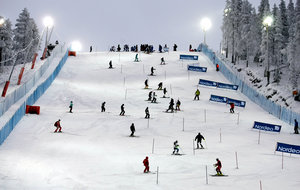 The FIS approved Levi for the snow control day last week and Hans Pieren, men’s technical race director is up there to oversee the preparations. Hans will supervise the injection process early this week and all of the side-slipping that will be necessary to make the surface smooth. The last time I was there the snow was perfect on most of the hill although, there was some water-pooling at the main break-over and at the bottom of the pitch which did catch some of the athletes by surprise.
The hill comes off of a big start ramp into a long flat for about 20 seconds. The good news is that the ramp is big enough to get some speed into the flat and it runs quite fast to the break-over into the main pitch. This is one of the two main tactical choices the athletes will have to execute on this hill. The upper flats also as a couple of man-made rollers, which keeps things interesting and helps to create some speed. The athletes are moving fast as the main pitch approaches and the break is pretty sharp into a steep pitch. The steepest section only really lasts about five turns and then it starts to flatten a bit, and rolls out very flat to the finish. But this break over can be slick and it can be a nasty. The skiers will make a choice of how much to change tempo to make the turns cleanly or they will begin to create a little more swing to their turn-shape a few turns before the break to create a better angle on the big turns on the pitch. Usually, a good rhythm is established down the pitch and as it flattens and bends to the right toward the finish. The skiers will again make a choice toward the middle of the pitch where to start risking more to carry more speed to the finish. The bottom flat is about 200 meters long and you need to establish enough momentum to get there fastest. A lot of this will depend on how demanding the course setter decides to be on the second half of the pitch. Will he keep turning the course all the way into the flat? Will he put a tough combination in transition? It will be worth watching this section to see what the athletes can pull-off.
Races in Levi tend to be very close. Last year, Maria Riesch edged Lindsey by .08 and the middle of the top 30 was stacked in very tightly. In the men’s race the first few were spaced by a couple tenths in each placing but Grange edged Hargin by .02 for the podium, and seventh place was only four tenths from the steps. And with Trevor White (CAN) slipping into 30th on the first run only 2.06 out, just a few hundredths ahead of Stefan Kogler (GER) for the last slot in the second run. To give some perspective on qualifying for second runs, the average differential is normally close to 2.5 seconds in slalom.
COURSE SETTING:
The women’s courses will be set by Stefan Buergler (AUT) and Phillippe Willman (FRA). Stefan set in Are last season which has slightly more vertical than Levi and more variety of terrain. He set 61 turns in Are on a hill that needs 59 to make minimum, so he set with plenty of room for the girls to get some arcing going. Willman set 59 last year in Levi on the second run last season which needs only 54 turns for minimum. This is a very reasonable number of turns as it is directly in the middle of the range. Buergler’s last set in Are was won by Maria Riesch and Sandrine Aubert was second. Aubert won the race. Again, Willman set the second run in Levi last season which was won by Lindsey and Maria was second. Maria won the race and Lindsey was second. I see a trend!
The Men’s sets go to Christian Hoeflehner (AUT) and Frederic Perrin (FRA). Hoefi is a good friend of mine and runs the Austria men’s slalom group. Fred is the slalom coach for France. Hoefi set the 2nd run in Levi last season and his boy Herbst won the run and the race. That’s a good feeling for the coach when that happens because it rarely does. Hoeflehner and all the Austrians have been setting very tight courses with a little less swing. A very quick tempo is their trademark because it fits their slalom athletes well. Specialists like Herbst and Pranger truly excel at that type of set. The Italian star, Manfred Moelgg is also very good on those courses. Last year in Levi, Hoefi was close to maximum turns on the Levi Black slope.
Perrin’s last set was in Adelboden last year on run one which was won by Mathias Hargin (SWE). I think the set in Adelboden will have nothing to do with what he is able to do in Levi. Adelboden is the steepest, nastiest, bumpiest slalom on the circuit and is won with a lot of tactics and solid skiing. Levi is more of an all-out race. Hargin’s style fits Levi very well and he won on a Perrin course set in Adelboden. Knowing this, he should go into Levi with a lot of confidence.
Hopefully they will fill the 23,000 beds in Levi and the crowd will be big. No matter how many people are there, the crowd will be well lubricated and boisterous. They will also cheer their Finnish boys and girls; win, lose or draw.
Click here to go to Alpine Race Consulting
Greg “Grande” Needell grew up ski racing at Stratton Mountain,
Vermont. After graduating from SMS he skied for NCAA Division 1 St.
Lawrence University in Canton, NY where he was co-captain in 1986. Greg
returned to SMS to coach there for five years serving as the Head
Women’s Coach as well as the Head J2 Men’s Coach. He then moved to
Mission Ridge in Wenatchee, Washington in 1992 to become the Program
Director and Head Coach of the Mission Ridge Ski Club. In 1997, Greg
became the Head Coach at Mammoth Mountain, California.
In 2002 Needell was asked to join the U.S. Ski Team staff as a World
Cup SL and GS coach. From 2002 to 2008 Needell helped lead the U.S. Ski
Team Men to 43 wins, 105 podiums and 264 top ten finishes. Now at the
helm of Alpine Race Consulting, Needell offers his knowledge and
experience to clubs nationwide.
About the Author: Pete Rugh