
The World Cup According to Grande: Whoo Hoo! Soelden week begins!

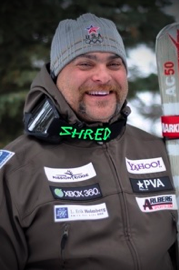 There is really nothing like the feeling in the air right now. The World Cup GS teams are bearing down on Soelden, Austria if they are not already there. They likely have been in Europe for a few weeks now. A lot of groups were in Saas Fee, Switzerland, some in Zermatt, many in Pitztal and Moelltal, Austria. Some were even in Tonale or Stelvio, Italy. Val Senales, Italy was also an option as was Soelden itself. There is also the Sutbai Glacier just off the Brennerpass just south of Innsbruck and Hinterux just up the Zillertal from Mayrhofen, Austria.
With snow-making on the race hill and the super cold icebox T-bar, there is a lot you can get done in Soelden. One thing that is nice about training there is that you can drive to the glacier base. Rather than jam into a train or tram or gondola and fight it out with hundreds of others to get on the earliest tram. Very few things can be as stressful as that early morning fight for the first option on the hill.
I first went to Soelden as a teen-aged racer in the fall of 1980 or so to visit the girls from Stratton Mountain School who were set up there for training. Our boys’ team was always setting up camp in Hintertux and we managed to find our way to Soelden once or twice, whether Fritz Vallant (Head Women’s Coach at SMS back then) knew it or not. He liked to think he knew all, but I don’t think he knew of that stealth mission. Regardless of that visit, I had not been to Soelden again until my first visit as a U.S. Ski Team World Cup Coach in the fall of 2002. We arrived in early October to do a two-week preparation camp for the World Cup at the end of the month. We were there almost three weeks by the end of it all, all packed into the Hotel Alphof at the corner of the glacier road just up the hill from the town of Soelden. As you head out of town, south I think, you hit a Y in the road and have a choice, left to the Timmelsjoch and Obergurgl or past there to Italy and the Merano area. Turn right and you head up the switchbacks to the Soelden Glaciers (Rettenbach and Tiefenbach). The Alphof is on the right, on the corner of this intersection. It’s a nice hotel with the host family Pult and all the facilities we needed. We never wanted for anything in all of the eight years I stayed there, a fantastic spot.
We organized our trip into two parts, making a four day break in Innsbruck in the middle of the camp to relax and enjoy everything that great city has to offer, along with a photo-shoot at the local VW dealership that was providing our vehicles back then. Then we returned to pare things down to the race prep part of the camp. Once we had done that, and had the group down to our eight starters, we really tried to focus on race-day. Everyone was streaming into town. We were sharing lanes with Norway and Austria on most days, sometimes other teams but mostly those two groups.
I spent about 13 hours on the hill one night in the icebox with John Ethen from the women’s team and some Austrian omen’s coach without a clue, on the end of a hose just dribbling water onto the new-fallen snow on the glacier. We were just trying to make some hard snow worth training on. We got to the hill at noon and watered it with barely a trickle coming over from the snow-making pond on the Tiefenbach side. It felt like we were trying to make hard snow by pouring jugs of water. It was painstakingly slow, and it seemed like it was idiotic. But when we got up there the next morning at 7:00 A.M., on four hours sleep, it was rock-hard and so worth it. Johnny and I were heroes, despite having to deal with our half-witted friend, and we felt very good about our effort. With about a hundred world cup men and women training on that surface, we had made it great for all. There, that night, with the lights of Soelden glistening below us, it dawned on me what this job was all about. It was about providing the best possible scenario for training for our guys, regardless of what it would take.
Back then, the bottom 1/3 of the pitch on the race-hill at Soelden had a huge cat-road across it, and it would launch guys. It is no longer there for good reason. I watched everyone train there for two weeks and could not figure out if we were fast or not. We had a good track record on the World Cup the year before but we had none at Soelden. We were starting Miller, Schlopy, Spencer, Vonn, Zamansky, Knight, Rothrock and Rahlves. We had eight guys at the start. We thought we would qualify all of our specialized GS guys, five of them. Rothrock and Knight were really slalom specialists but had skied well in timed runs on the race hill and Rotty had a Nor Am automatic spot that year. Zamansky also had a spot but this was his first shot at the World Cup and we were not sure what to expect. Anyway, we ended up with one guy in the second run. Bode had been second after run one behind Steph Eberharter and ended up fifth. It was a great start for him in his first start on Rossignol. All the marketing and Race Department people from Rossignol who were there were very happy, but we knew we had a lot of work to do to get ready for the GS in Park City.
After the race, I was sitting in the hotel getting organized for my first hard-core Euro mission. We only had a small Volkswagen cargo van, about the size of a Caravan as well as a fleet of Passats and Sharan minivans. When we looked at all the stuff we had accumulated during our three weeks, it was obvious that we would not make it to Innsbruck in one trip. So I jumped in the van, loaded full and drove to Innsbruck (just over an hour away) not counting the post-race traffic going down the Oetztal. We stuffed that van full and I drove about an hour and a half to our apartments in the Innsbruck area and, with help from our friend Johannes Erhard, unloaded everything we needed to store until December. Then I drove another hour, plus back to Soelden and re-loaded the van with our stuff destined for Munich and our homes in the USA. I laid down for an hour or two woke up at 2:00 A.M. and Phil McNichol and I hit the road. Phil was in his Passat and me in the cargo. We got to the airport a little early and met the rest of the team who slept at the Movenpick in nearby Hallbergmoos. We loaded our stuff, checked in and then I awoke in Dulles International. I ran through customs after waiting for far too long for my luggage and sprinted for my gate on the other end of the “D” terminal. My first Europe trip with the ski team and I was not going to miss my connection, no way. I made it, sweating profusely (those how know me know what I mean!) and sat in my seat. I was about to fall asleep when the flight attendant walked up and said, in a slight drawl, “Darlin’, you need a beer?” I said I did and she brought one. We started talking and I gave her a ski team pin and she asked if I might know a friend’s son who was a ski racer from Virginia. I looked at her and laughed and said I only know one, his name is Scotty Veenis. She said, “Well, well, hun, THAT IS who I am talking about, I am his next door neighbor!” She brought me a second Heineken and I fell asleep for the duration. Funny stuff and a small world.
Click here to go to Alpine Race Consulting
Greg “Grande” Needell grew up ski racing at Stratton Mountain,
Vermont. After graduating from SMS he skied for NCAA Division 1 St.
Lawrence University in Canton, NY where he was co-captain in 1986. Greg
returned to SMS to coach there for five years serving as the Head
Women’s Coach as well as the Head J2 Men’s Coach. He then moved to
Mission Ridge in Wenatchee, Washington in 1992 to become the Program
Director and Head Coach of the Mission Ridge Ski Club. In 1997, Greg
became the Head Coach at Mammoth Mountain, California.
In 2002 Needell was asked to join the U.S. Ski Team staff as a World
Cup SL and GS coach. From 2002 to 2008 Needell helped lead the U.S. Ski
Team Men to 43 wins, 105 podiums and 264 top ten finishes. Now at the
helm of Alpine Race Consulting, Needell offers his knowledge and
experience to clubs nationwide.
About the Author: Pete Rugh

Related Post
Nothing Found



