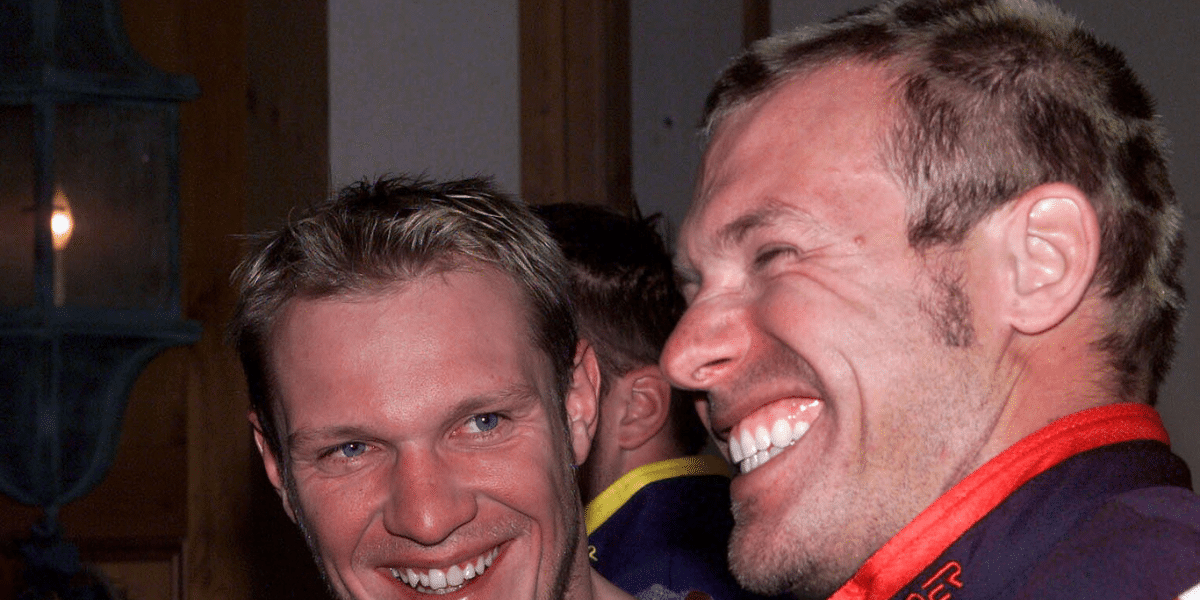
Herman Maier & Chad Fleischer: GEPA pictures
Editor’s Note
Chad Fleischer is a two-time Olympian and four-time World Championships competitor with five World Cup top-10 finishes across two disciplines. Known for his fearless style—including his unforgettable 1995 Kitzbühel crash and bow to the crowd—he now works as a coach, parent, and advocate for athlete development.
The opinions expressed below are his own, reflecting a personal call for the U.S. ski racing community to unite in rebuilding a stronger path for future American downhill and super-G athletes.
An Open Letter to the U.S. Ski & Snowboard Community
In Support of U.S. Men’s Downhill and Super-G
Pride in Our Speed Heritage
To the athletes, coaches, service technicians, supporters, fans, and leadership at U.S. Ski & Snowboard:
Before anything else, let’s recognize the extraordinary commitment of our U.S. men’s downhill and super-G athletes. Season after season, they risk everything—chasing hundredths of a second on some of the world’s most dangerous tracks. They do it with heart, integrity, and grit.
Behind every start gate stands a network of coaches, technicians, and staff who give their time and energy to help these racers perform at their best. Their work deserves not only our respect but also our deep gratitude.
I speak from experience. During my career, I represented the United States in two Olympic Games—Nagano and Kvitfjell—and four World Championships, including a sixth-place finish in the Beaver Creek super-G, my home mountain. I earned five World Cup top-10 finishes across two disciplines and spent a decade racing the world’s fastest tracks.
Perhaps my most famous moment came in Kitzbühel in 1995, when—with one split to go—I was among the fastest on the course. I misjudged the prejump on the finish jump, crashed spectacularly, and tore the plates off my skis. Then, instead of disappointment, I stood up, bowed to a roaring Kitzbühel crowd, and walked away. That moment captured what I’ve always loved about speed: courage, respect, and the powerful connection between athlete and fan.
Those experiences shaped not just my perspective as a racer, but also my commitment today—as a coach, a parent, and an advocate—to help build the strongest speed-development system in the world.
We’ve seen flashes of brilliance from U.S. athletes—World Cup podiums, Olympic medals, unforgettable runs. Yet the ultimate goal still eludes us: no American man has ever lifted the World Cup downhill globe. It’s not for lack of talent or courage. It’s about commitment, vision, and consistent support.
That’s where our greatest opportunity lies.

Challenge and Opportunity
If we want to see American athletes standing on the top step in Kitzbühel or Wengen, we must build a development model that provides them with a clear and attainable path. Olympic gold and World Cup victories are achievable—but only when we invest strategically and collectively in the next generation of speed skiers.
Private initiatives have already proven what’s possible. For instance, camps such as Marco Sullivan’s American Downhiller and the Copper Mountain speed projects run by AJ Kitt, Johno McBride, and me showed that collaboration, creativity, and passion can produce real results.
With the help of Patrick Riml and Frank Kelble, we launched an “invite-only” camp designed to prepare athletes for early NorAm downhills and super-Gs. We built the roster by calling coaches, regional directors, and former teammates—a genuine grassroots effort that worked.
Athletes like Tristan Lane, Wiley Maple, Tanner Perkins, Stef Fleckenstein, Haley Cutler, Jeremy Nolting, Allison Mollin, and Dominic Shackleton trained side by side, pushing one another to new levels. Coaches collaborated across clubs. Parents volunteered. We operated at pass-through cost, charging only for hill space. It was pure commitment and community.
However, when leadership changed, hill space was no longer secured, and the program faded. The structure wasn’t the issue—the absence of long-term institutional backing was.
Where We Stand Now
It’s time to be honest: there is no functioning men’s speed-development pipeline in the United States today.
There’s no funded development team.
No dedicated speed projects.
No consistent NorAm or Europa Cup schedule for downhill or super-G.
Even worse, U.S. athletes are sometimes denied Europa Cup starts—even when spots go unfilled. Meanwhile, hill space at Copper is often allocated to foreign teams while American programs willing to pay the same rate are turned away.
This isn’t about blame—it’s about urgency. The data is clear:
- U.S. male speed athletes are underfunded and under-supported.
- They receive fewer training and race opportunities than their European peers.
- Athletes with strong speed profiles are overlooked.
- Current policies lack transparency, consistency, and a deep understanding of speed development.
As a result, we are not at a crossroads—we are at a precipice. And the longer we wait, the more knowledge, experience, and momentum we lose.
Building the Path Forward
Fixing this doesn’t require reinventing the sport—it requires honesty, unity, and decisive action.
- Include Downhill in Junior Development Criteria.
- Make downhill part of U16 and U18 championships.
- Train and race speed earlier so athletes and coaches develop the necessary mindset and skills.
- Create Speed-Specific Criteria for National Development.
- Establish separate selections for downhill and super-G.
- Stop linking advancement solely to GS and SL points, which show no correlation to top speed results.
- Make Speed Training Year-Round.
- Racing in winter is not training—it’s testing. Real progress happens in spring, summer, and fall.
- Opportunities already exist right here at home: Mammoth Mountain in May and Copper Mountain in November are two world-class venues where consistent training can thrive.
- Promote Collaboration, Not Competition, Among Clubs and Regions.
- When I skied for Ski Club Vail, we held a five-day downhill camp over Christmas and New Year’s for athletes as young as ten. Programs like that have disappeared. They need to return.
- Club-versus-club and region-versus-region competition for access is counterproductive. Instead, we should remember that we are one nation with one goal—to create great ski racers together.
Why Speed Matters
Speed skiing is more than a discipline—it’s a mindset that defines the courage and character of alpine racing. Furthermore, it connects every generation of racers who dream of flying down the Streif (Kitzbühel) or the Lauberhorn (Wengen). Yet, when the development pipeline weakens, that dream becomes less attainable.
If we want young racers to imagine themselves competing in Kitzbühel or Wengen, they must have real opportunities to train and race speed at home. Mammoth and Copper can be the foundation for this progress, but only if we, as a community, prioritize it.
Rebalancing the System
We must listen to those who have lived this discipline—the coaches and athletes who understand the difference between technical skiing and the unique mindset required for downhill.
The path forward includes:
- Funding a dedicated men’s speed development team.
- Committing to the Europa Cup circuit full-time.
- Expanding the NorAm calendar to include consistent, quality speed tours.
- Supporting year-round projects: Mammoth in spring, South America in late summer, Copper in early winter.
- Recognizing that modern elite skiers specialize earlier, and our system must stop penalizing that.
- Valuing the downhill mentality—a mindset defined by courage, focus, and calculated risk—that cannot be measured by FIS tech points.
This mindset is rare, and it must be nurtured. Bull riders understand bulls; downhillers understand speed. It’s not arrogance—it’s identity.
A Call for Leadership and Balance
This isn’t about speed versus tech—it’s about restoring balance and fairness.
We need leadership willing to make data-driven decisions, engage experts, and allocate resources with transparency. We must rebuild pathways that serve the full spectrum of alpine racing—not just one side of it.
If that can’t happen within the system, we, the ski racing community, must build it together. Collaboration is possible—and it’s necessary. This affects all of us: men and women, speed and tech, athletes and coaches.
I can’t speak for women’s speed development, but if the same gaps exist, then the same passion for change must apply. In every camp I’ve run, men and women have trained together, pushing each other on the same course, chasing the same dream.
Belief and Action
I still believe—in the athletes, in the coaches, in the service techs, and in the heart of this sport. Yet belief alone isn’t enough anymore. It must be matched by action and shared accountability.
To my fellow teammates, coaches, and supporters: let’s demand a better system and rebuild the foundation for future stars.
Together, we can ensure that the legacy of American speed skiing doesn’t fade—it thrives again.
With respect and determination,
Chad Fleischer
Note: Review the data Fleischer provided to understand his analysis better. Click here to download his four tab spreadsheets.
About the Author: Chad Fleischer