Emma Aicher / GEPA pictures
Emma Aicher’s performances across four disciplines stand out on the World Cup circuit, and her breakthrough 2026 season put her in contention for multiple globes. What defines her success? How has her background shaped her, and what will she work on to improve next? Ski Racing Media spoke with Aicher and German women’s head coach Andreas Puelacher at the 2026 World Cup Finals.
Who is Emma Aicher?
Just a few years ago, this question seemed valid. Now, Aicher has become one of the most recognizable names on the World Cup circuit. The German national team racer has established herself among the world’s best across multiple disciplines.
Her 2026 results positioned her as a contender for the World Cup speed globes heading into the final stretch of the season. In the end, she finished second in downhill and third in super-G.
Additionally, coming into the Finals, March 21–25, Aicher still had an outside chance at the overall title, chasing Mikaela Shiffrin, the winningest alpine skier of all time.
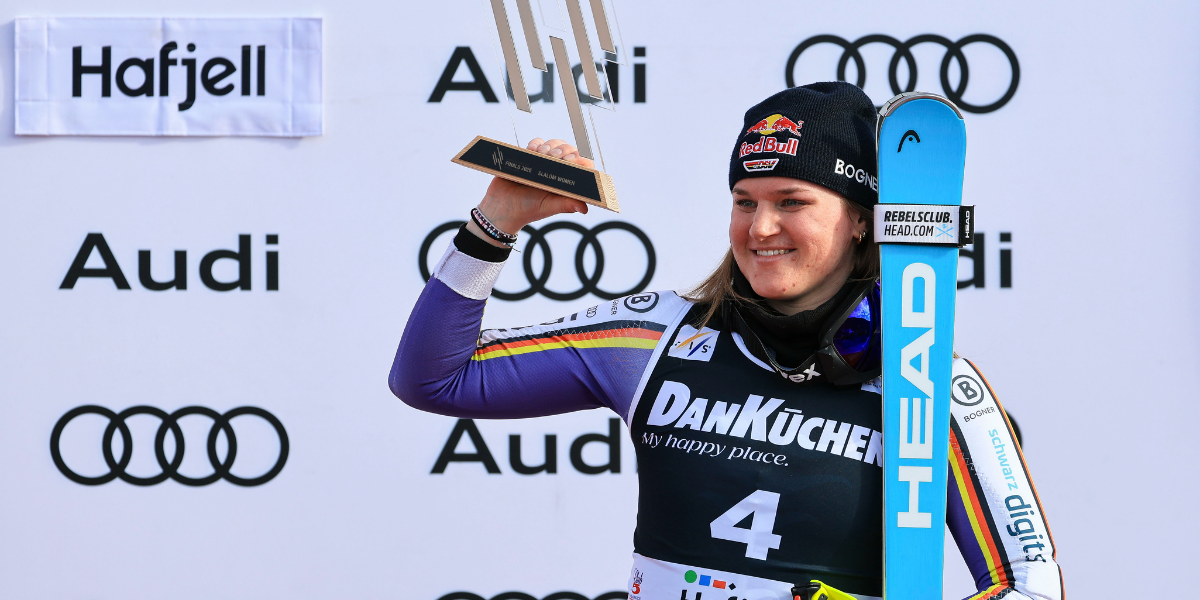
After some of the most exciting moments of the season unfolded during the final technical races in Hafjell, Norway, Shiffrin secured the overall globe just ahead of Aicher.
Add Aicher’s two Olympic silver medals from February, and her 2026 season stands out as one of the strongest across the World Cup.

What makes Aicher stand out
Aicher is one of very few athletes competing in all World Cup disciplines in recent years. She started in impressive 36 World Cup races during the 2026 season, more than any other alpine skier. Add her five Olympic starts, and her season total rises to 41.
During her five-season World Cup career, Aicher has captured 13 podiums, including five victories. Notably, her podiums are spread across three disciplines: five in slalom, four in downhill, and four in super-G. She is also closing in on a giant slalom podium, finishing fourth in Åre, Sweden, this March.
Equally important to her results are her efficient skiing style, strong balance over the ski, and ability to adapt across terrain and disciplines and her composure allows her to manage high-pressure situations during races.
What Aicher is happiest about in the 2026 season
“I’m really happy with my skiing and the consistency over the whole season—that I can show that I can be fast in three [disciplines] over the whole season, and then the fourth discipline is starting to get better. I’m really happy and proud about that,” Aicher told Ski Racing Media on March 19, before the World Cup Finals speed races began in Kvitfjell, Norway.
How does she feel about being one of the rising stars in alpine skiing—pressure or joy?
“It is joyful. My roommate [former Austrian ski racer Nella Knauss] says pressure is privilege, and it shows that I’m doing something right. If pressure is there, then people are seeing that I can be at the top, which is pretty nice, I guess.”
How Aicher felt about the battle with Shiffrin for the World Cup overall globe
The season ended with an extremely exciting World Cup Finals giant slalom race in Hafjell on March 25, determining whether Aicher would catch Shiffrin for the overall globe.
Despite the pressure over the final race days, she still seemed relaxed.
How did she approach the final race day?
“Just skiing, having fun. Before today, it was almost impossible for me to win it [the overall globe], so I could just enjoy it and focus on myself. But it’s been fun to challenge Mikaela until the very last race. It’s been a fun fight,” Aicher told Ski Racing Media after the final race.
Her response reflected her ability to stay focused on execution even with the overall title still in play.
How Shiffrin views Aicher and the future
After securing the 2026 World Cup overall globe, Shiffrin spoke with Ski Racing Media:
“My whole career, I always really put the overall globe as the big goal. But I’m coming to a point in my career where it might not happen again. This might be the last time I am in the position to fight for this globe.
“I feel like there’s a different generation of athletes who is really coming into this role. Emma is so strong. She’s strong in every discipline, she’s strong in a way that is very stable and very solid. I don’t want to make pressure for her, but I really appreciate what she’s doing and I’m very excited to see how she’s able to work with this in the future and how it looks in the coming years.
“I don’t take this for granted right now. This moment is huge in my career; it’s huge in my life. I really appreciate that,” Shiffrin said about winning her sixth overall globe in front of Aicher
Where Aicher comes from and where she learned to ski
Aicher was born on November 13, 2003, and grew up in Sundsvall, Sweden, with her Swedish mother Viktoria, German father Andreas, and younger brother Max (Maximilian). Max now competes in FIS slalom and giant slalom races for Sweden.
Emma’s father brought her to the local ski hill in Sundsvall from an early age, and both parents taught the siblings to ski.
During her childhood, the family also lived in Engelberg, Switzerland, for three years, giving young Emma experience skiing on larger mountains as a member of the Engelberg ski club.
Notably, Engelberg has produced multiple elite skiers, including Marco Odermatt, who attended the Engelberg Sports Middle School, as well as Olympic champion Michelle Gisin and her brother Marc.
Aicher shares why growing up in Sundsvall was great for skiing
Aicher did most of her childhood skiing at the small ski area at Södra Berget in Sundsvall, overlooking the town near the coast. The training hill was relatively short and not especially steep, with its base close to town.
What was it like growing up on a small ski hill?
“Sundsvall was great for growing up. We lived two minutes away from the hill, and I could just walk up myself and ski. I could also take the cross-country trails from the ski hill down to my house. So, it was great for me and my brother when we were kids.”
Ski club coach reflects: How Aicher stood out as a young skier
Daniel “Durra” Urander, one of Sundsvall’s Slalomklubb coaches, has known Aicher since she was a little girl.
In an interview on Swedish radio, Sveriges Radio P4 Västernorrland, on March 11, 2025, he described Aicher as a young skier:
“As soon as she started skiing, at the age of 3–5 years, we saw that this girl has a bit of talent. So, we started with just a few small tips, and you could see that she picked it up quickly and that this could be a bit of fun in the future.
“She had her own drive—you could tell. She started asking for more training herself. I was one of the coaches in the club, but not her group coach. I thought, ‘how cool,’ because you could tell that she wanted something more. And that’s when things start to improve, when they [athletes] have their own drive.”
How Aicher made the change from Sweden to Germany
As she grew older, Aicher attended the ski academy in Järpen, Sweden, for a year, located just 30 minutes east of Åre.
Then, in fall 2020, Aicher, who has always been a dual citizen, transferred from representing Sweden to Germany. She also moved to Germany alone at age 16.
Before deciding to transfer, Aicher and her father communicated with the German ski federation and visited to ensure she would feel comfortable with the training environment.
After her decision, Sundsvall Coach Urander made a send-off video interview with her.
He asked what she expected would increase her chances of becoming a better ski racer:
“Germany is closer to the Alps and better skiing. So, I think it will be good.”
And what would she miss the most?
“All my friends and you, Durra,” she said with a smile.
What Aicher says about the move from Sweden to Germany
Aicher moved to Berchtesgaden, Germany, and the elite sports academy CJD Christophorusschulen.
“Coming to Germany, it’s different, because of the Alps and the glaciers. It’s a completely different world,” she told Ski Racing Media.
Aicher finds it difficult to compare her two ski academy experiences.
“Both were good and I think important for my development. I was a kid when I lived at home [in Sweden], and then I was on the German team when I moved, so it’s hard to compare.
“I think Sundsvall was great to start with and build a base. And then Germany has been amazing to develop everything I learned in Sundsvall.”
How the move to Germany helped Aicher develop
“I got a lot of support from the German federation and they believe in me. They let me ski every discipline, and I think they trust me as well. It means a lot that they let me ski everything.”
Coach Puelacher responded:
“It is easy in the German team; there are spots in the races. She can learn every time she starts, and there is no pressure.”
What Germany’s national team coach sees as Aicher’s strengths
“Emma works really hard and she always wants to ski,” Puelacher said.
“Her strongest side is her mental side. The mental side is impressive. She worked step by step on her technical side as she grew up,” he continued, noting that her Swedish background has been beneficial.
Puelacher also pointed to her improvement over the past two seasons, particularly this winter.
“Now she knows how to handle the skis and what movements she has to do for good technique,” he said.
What specifically has Puelacher worked on with Aicher?
“She was a slalom skier. Sweden was slalom. I saw in her this feel for the snow and terrain, so I asked, ‘Emma, are you scared of speed?’ And she said, ‘No, I want to go there.’”
Puelacher believes expanding into speed disciplines has been key to her development.
How Puelacher sees Aicher’s development into the 2027 season
Aicher skis with a characteristic flow and composure. Puelacher wants to build on that:
“I want a little more power in her skiing. This is the next step we will handle with Emma, especially in the summer.”
What about her chances of winning the World Cup overall?
“Hopefully she stays healthy. She needs to take more steps technically and gain more experience. Then, next year, maybe it will be possible,” he said.
The following day, after the final points battle with Shiffrin, Aicher finished just 87 points short of the 2026 World Cup overall globe.

Aicher’s top results in 2026
Aicher opened the 2026 season with two World Cup speed victories and three third-place finishes in slalom before heading to the Olympics.
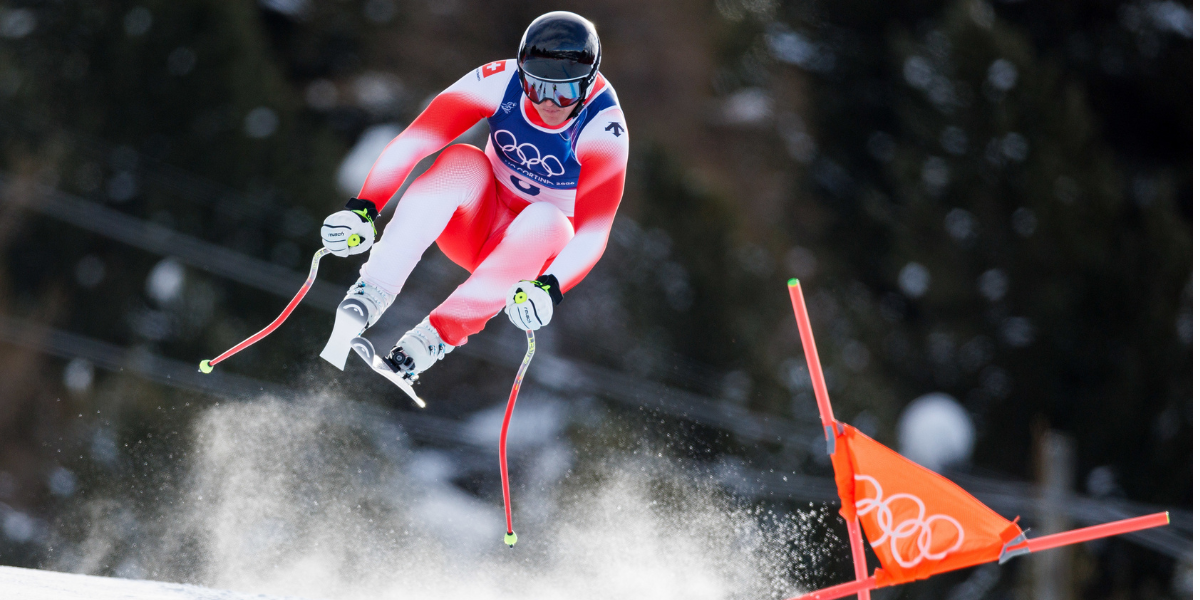
In Cortina d’Ampezzo, she captured two Olympic silver medals:
First, finishing the downhill just 0.04 seconds behind winner Breezy Johnson.
Next, Aicher and Kira Weidle-Winkelmann earned silver in the team combined event.
After the Olympics, Aicher continued racing all four disciplines in the World Cup. She added six podium finishes, including a super-G victory in Soldeu.
| Discipline | 2026 Rank | 2025 Rank |
|---|---|---|
| Overall | 2nd | 15th |
| Downhill | 2nd | 9th |
| Super-G | 3rd | 15th |
| Slalom | 6th | 17th |
| Giant Slalom | 18th | 41st |
Aicher improved her ranking in every discipline, highlighted by a jump from 15th to 2nd overall.
About the Author: Bente Bjørnsen Sherlock