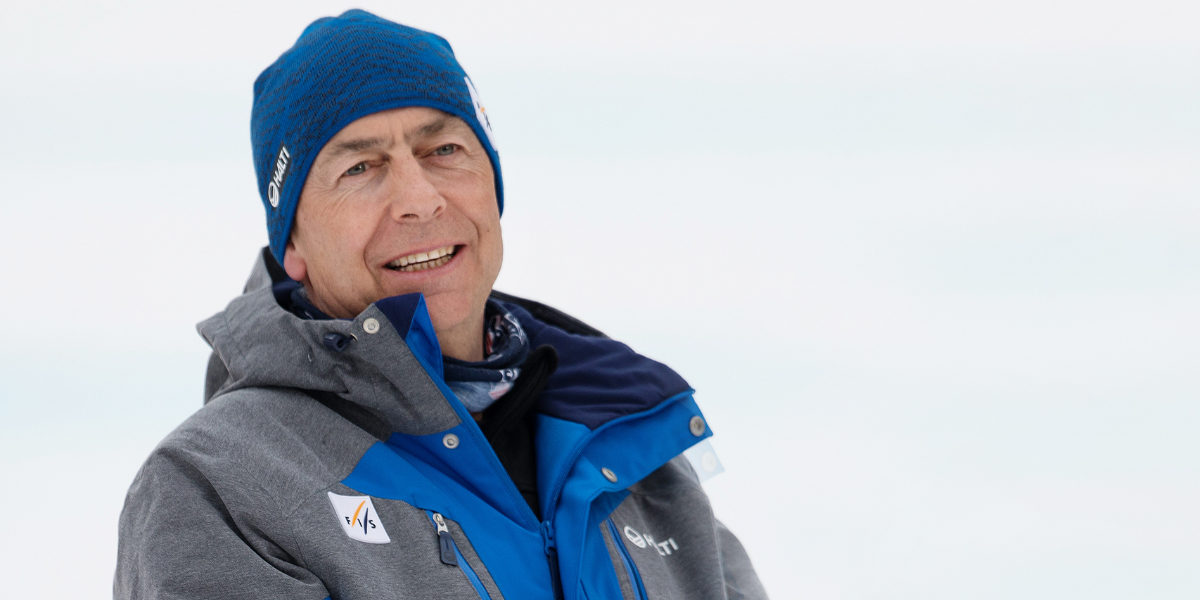
With an FIS presidential election set to shape the future of international snow sports through the French Alps 2030 Olympics, USA’s Dexter Paine is presenting a candidacy built on governance experience, financial leadership, and over two decades in the Olympic movement.
Paine has served on the FIS Council since 2014, including a term as vice president, and has also spent 13 years as chairman of U.S. Ski & Snowboard during one of the organization’s most successful periods. During his tenure, American athletes won 56 Olympic medals, while the federation expanded its commercial operations and strengthened its financial position.
A former NCAA ski racer at Williams College and graduate of Holderness School, Paine also raised a family deeply involved in ski racing, giving him experience not only from the boardroom and international federation level, but also from the perspective of a ski parent navigating the sport’s development pipeline.
He also served four years as president of the U.S. Ski & Snowboard Foundation and currently sits on the boards of the United States Olympic & Paralympic Committee, U.S. Biathlon, and the Utah 2034 Olympic and Paralympic Winter Games Organizing Committee.
“I just think it’s a unique time in the snow sports world in terms of some of the challenges we have and the need to take the sport to the next level,” Paine said.
Professionally, Paine spent decades in private equity and serves as chairman of Paine Schwartz Partners, a global investment firm focused on food and agribusiness. That business background shapes much of his view of the future of FIS and the financial pressures facing winter sports.

Governance, Transparency, and Athlete Voice
Paine repeatedly returned to governance and transparency during the conversation, often pointing to leadership structures and organizational systems he has experienced through the Olympic sport boards he has served on or chaired.
“I believe our level of governance at USSS (U.S. Ski & Snowboard) and the USOPC (United States Olympic & Paralympic Committee) is extraordinary. Our level of athlete voice and athlete representation is extraordinary at both,” he said.
He tied that experience to what he believes FIS needs moving forward, particularly when it comes to communication and trust among member federations.
“For whatever reason, trust has been lost, and we can’t be successful unless we’re all working together,” he said.
For Paine, transparency centers on clearer communication, stronger financial visibility, and more direct engagement with national federations. He repeatedly framed openness and consistency as essential to rebuilding trust across the organization.
Athletes Must Remain the Center of the Sport
Paine also emphasized that the long-term health of snow sports depends on keeping athletes at the center of decision-making.
“No one’s showing up to see administrators. They’re showing up to see the athletes,” he said.
That focus extends beyond alpine skiing. Paine repeatedly pointed to freeride, snowboard, freestyle, and Nordic disciplines as critical to the future growth of FIS, particularly in markets outside traditional alpine strongholds.
He also stressed athlete safety, athlete compensation, and creating an environment that keeps athletes in the sport longer.
“The bigger the funnel is, the better the sport is going to be 10 and 20 years from now,” he said.
Financial Sustainability and Event Pressure
Paine did not avoid the financial challenges facing the sport.
“I believe the majority of our local organizing committees lose money. That’s not a sustainable business model,” he said.
He pointed to rising operational costs, including snow-making and infrastructure requirements, while also stressing the need to continue supporting member federations and athlete development.
He also described resource-sharing among federations as essential to maintaining long-term growth and participation across the sport.
Building on Progress Already Made
While outlining areas where he believes FIS can improve, Paine also acknowledged recent progress.
He praised the federation’s efforts around digital growth and supported the move toward centralized media rights.
“I applaud the effort to centralize,” he said, while noting that the current structure has not yet fully delivered the growth many expected.
Paine also pointed to the need to convert growing digital visibility into sustainable revenue.
“Eyeballs only go so far. You’ve got to turn them into money,” he said.
Expanding Beyond Traditional Markets
Paine sees one of the sport’s largest opportunities in expanding outside traditional alpine markets.
“We have not done a great job broadening the reach of alpine ski racing,” he said.
He pointed specifically to growth opportunities in North America and Asia while emphasizing the need to engage younger audiences and better promote athletes globally.
That challenge, he said, goes beyond broadcasting and requires stronger storytelling, stronger athlete visibility, and a product capable of competing in a crowded global sports landscape.
Climate and the Future of Winter Sport
Climate change also remains central to Paine’s view of the future of snow sports.
“We need to better understand how we are successful in a world where temperatures are rising and snowpack is falling,” he said.
He described climate pressures and rising event costs as long-term realities that will continue shaping scheduling, venue planning, and the structure of winter sports in the years ahead.
A Vote That Will Shape the Next Olympic Cycle
The upcoming FIS presidential election will determine leadership through the next Olympic cycle, including the French Alps 2030 Olympics.
Paine enters the race with extensive experience across international skiing, Olympic governance, event leadership and business. His candidacy combines long-standing involvement within FIS with a governance model heavily shaped by the United States Olympic system.
His platform emphasizes transparency, athlete representation, governance, financial sustainability and stronger alignment among member federations as international snow sports enter a pivotal period.
The election will help shape how international snow sports approach governance, athlete representation, global growth and financial sustainability through the next Olympic cycle and beyond.
About the Author: Peter Lange