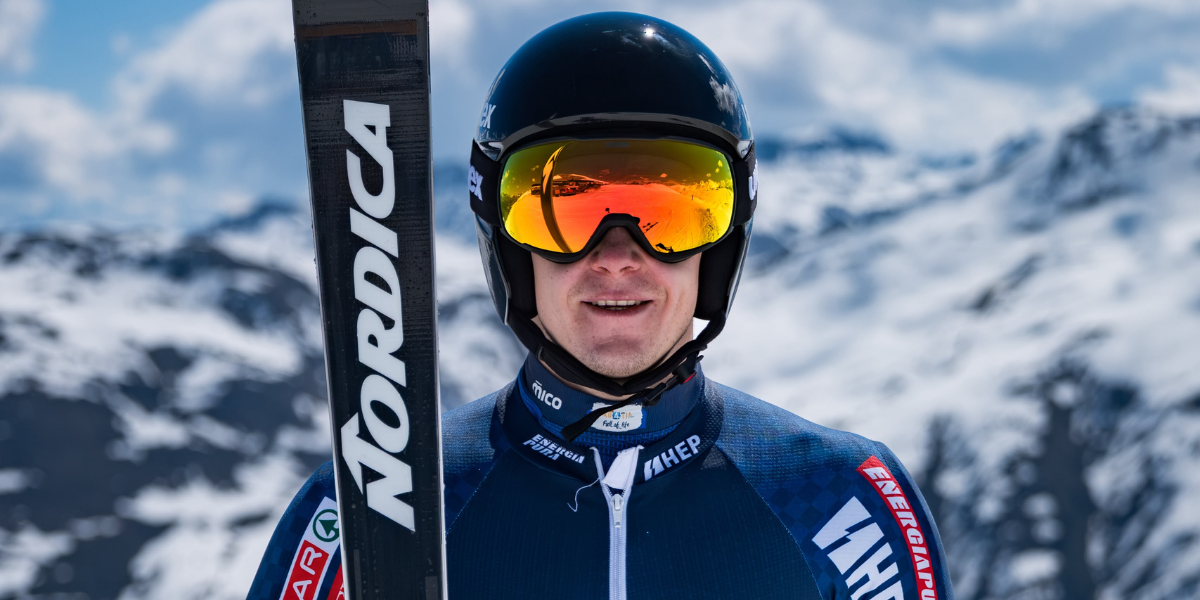
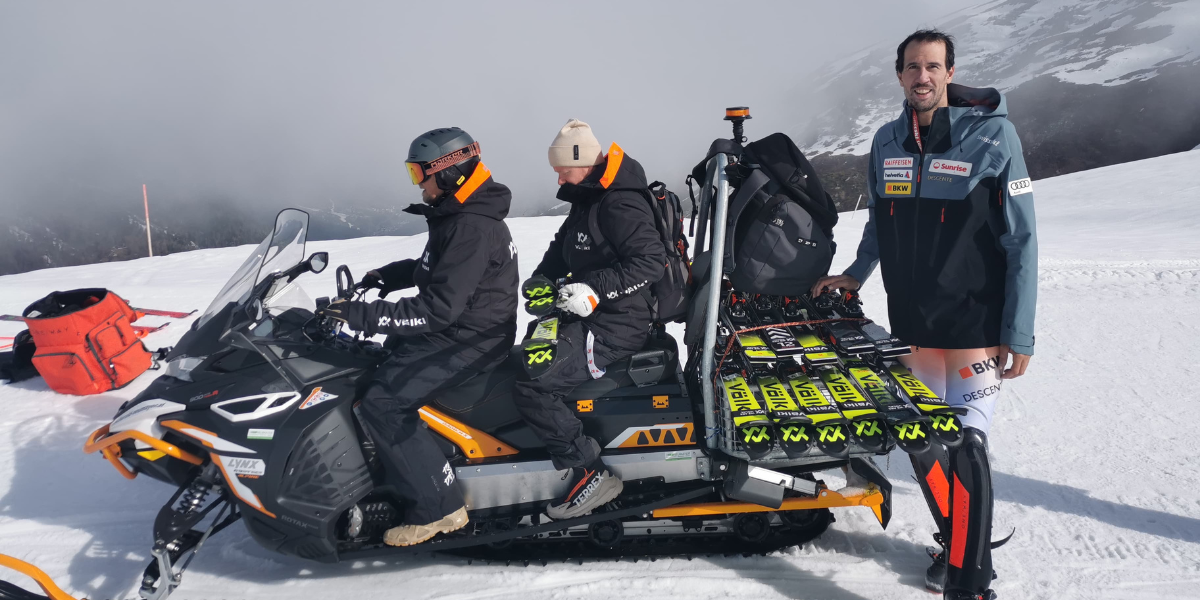
Ramon Zenhäusern / Photo: Völkl/Marker
Ramon Zenhäusern could have walked away from ski racing with nothing left to prove.
The Swiss slalom star has represented Switzerland at three Olympic Games and five World Championships. He won Olympic silver in slalom and Olympic gold in the team parallel event at the 2018 PyeongChang Games. He has stood on 14 World Cup podiums, won seven World Cup races, and scored World Cup points in 14 consecutive seasons.
For most athletes, that résumé would be enough.
For Zenhäusern, it is not.
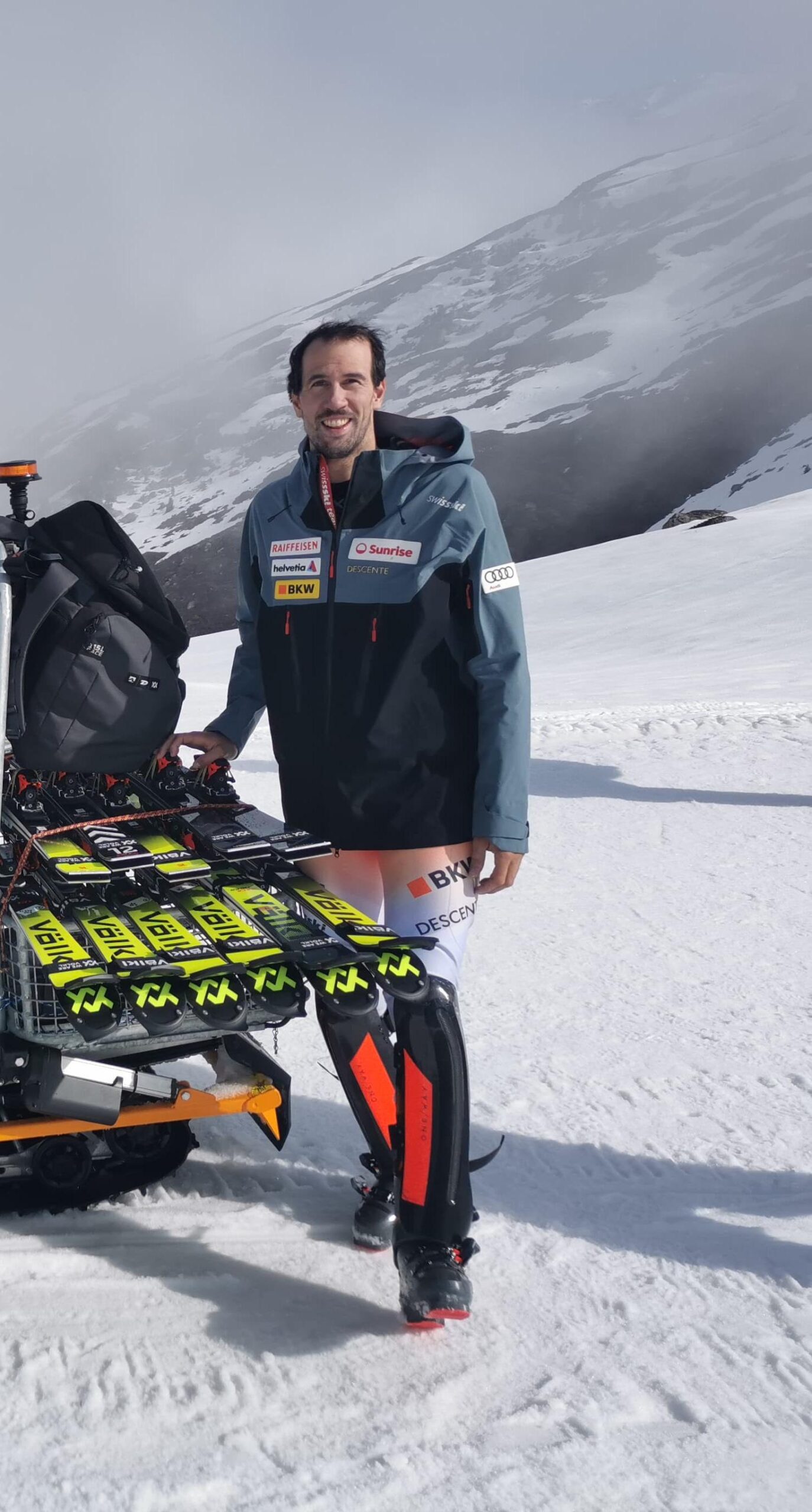
At 34, after three difficult seasons by his standards and the loss of his Swiss-Ski team status, the towering veteran slalom star is choosing a different path. He is building his own program, working closely with his father again, pursuing the dream of competing at the 2027 World Championships in Crans-Montana, and beginning a new partnership with Völkl Marker after spending his entire career on Rossignol equipment.
The decision is not driven by nostalgia.
It is driven by passion.
“My inner fire is burning too much to stop this story,” Zenhäusern told Ski Racing Media.
That simple sentence explains why one of the most accomplished Swiss slalom skiers of his generation is still chasing improvement.
More Than Medals and Victories
When asked what he is most proud of, Zenhäusern immediately pointed to his Olympic achievements.
Winning slalom silver in PyeongChang remains one of the defining moments of his career. Before that race, Switzerland had gone 34 years without an Olympic medal in men’s slalom.
What made the achievement even more remarkable was the timing.
Zenhäusern had never stood on a World Cup slalom podium before winning Olympic silver.
“I’m really proud of that achievement,” he said.
His first World Cup slalom podium would come later. So would victories. In January 2020, he produced one of the most memorable performances of his career in Kranjska Gora, winning by more than a second over Henrik Kristoffersen and Marcel Hirscher.
Yet some of the achievements he values most did not come during his most successful seasons.
They came during his most challenging ones.
What the Last Few Years Revealed
The past three winters have tested Zenhäusern in ways his Olympic years never did.
Results became harder to find. Confidence became more difficult to build. Opportunities became less certain.
Instead of stepping away, he chose to keep racing.
Last season, he even competed in both Europa Cup and NorAm events, often starting with bib numbers that offered little margin for error. At one Europa Cup race, he started with bib 46 and fought his way into contention. He also claimed a Europa Cup victory in Schladming.
For a skier with Olympic medals and World Cup victories, those results might not attract headlines.
For Zenhäusern, they carried tremendous meaning.
“They show I can still ski fast,” he said.
More importantly, they confirmed something he already suspected.
The love for the sport had not disappeared.
“It doesn’t matter if it’s World Cup or Europa Cup or NorAm,” he said. “I can ski.”
That passion remains the driving force behind everything that comes next.
An Unexpected Opportunity
Click Image to enlarge
For most of his life, Zenhäusern never imagined skiing on anything other than Rossignol.
The relationship stretched back to childhood and continued through every major achievement of his career.
“I never thought about leaving Rossignol because I was always happy,” he said. “I skied on Rossignol since I was a child.”
That is what makes his move to Völkl Marker so unusual.
For an athlete who had spent his entire career on Rossignol equipment, the decision represented one of the most significant changes of his professional life. It was not a move he anticipated making when the season ended.
The change did not begin with Zenhäusern searching for a new brand.
Initially, he was skeptical.
After all, he had never tested another ski brand in his career.
Still, he decided he had nothing to lose.
The test took place in Gurgl, Austria.
The impression was immediate.
“The skis were turning so easily from the first turn on,” Zenhäusern said. “It felt like it allowed me to make a shorter turn, a shorter radius.”
For an athlete who has spent more than a decade competing against the best slalom skiers in the world, those sensations matter.
The decision was not based solely on ski performance, however.
Zenhäusern was equally impressed by the people behind the project.
Völkl Marker paired him with veteran serviceman Marian Bires, whose experience includes years working with some of the sport’s top athletes.
Together, the package offered something he was not expecting.
A fresh source of motivation.
“For me, it’s a new motivation, something new,” he said. “It’s exciting.”
Building an Independent Program
The equipment change is only one part of a much larger transition.
Zenhäusern now finds himself responsible for many aspects of a racing program that national team athletes often take for granted.
Training camps. Logistics. Travel. Budgeting. Sponsorship.
All require additional attention.
He also faces the financial realities that come with operating more independently and taking greater ownership of his racing project.
Rather than viewing those challenges negatively, Zenhäusern sees them as part of the journey.
His father, Peter, who coached him during his formative years, will play a larger role again. Summer training will likely take place in Saas-Fee, close to home, although other options remain under consideration depending on conditions and available resources.
The path is more demanding.
It is also more personal.
“Völkl gives me a lot of confidence and possibilities to continue my dream,” Zenhäusern said.
Why Crans-Montana Matters
One goal stands above the rest.
The 2027 FIS Alpine World Ski Championships in Crans-Montana.
For any Swiss athlete, a home World Championships would be special.
For Zenhäusern, it represents both motivation and opportunity.
“That was always a big dream for me,” he said. “That’s also one of the reasons I continue my career.”
Like every athlete hoping to compete at a World Championships, Zenhäusern knows he must earn his place.
The challenge is significant.
The opportunity is real.
Despite training independently, he remains with a good start number and believes the door is still open.
“If I had to start with bib 60 or 70, maybe I would have made another decision,” he said.
Instead, he sees a possibility.
“Everything is open and everything is possible,” he said. “Nothing is impossible is my motto.”
Chasing the Perfect Run
Near the end of the conversation, Zenhäusern offered perhaps the clearest explanation for why he continues.
It had nothing to do with medals, rankings or equipment.
For him, skiing remains a fascinating combination of gravity, balance, coordination, timing and instinct.
“In ski racing, there is almost never a perfect run,” he said.
That pursuit is what keeps him coming back.
The search for a feeling that can never quite be mastered.
During his best skiing, everything feels effortless. “You reach the finish and almost can’t explain why you were fast,” Zenhäusern said. “It just happened.”
Athletes often describe that sensation as flow.
Zenhäusern knows exactly what it feels like.
“It’s this situation when you are in the flow,” he said. “I think it’s chasing this flow. That’s the best feeling.”
The medals are still there.
The victories remain part of his legacy.
Now, with Völkl Marker under his feet and a home World Championships on the horizon, Ramon Zenhäusern is writing a new chapter.
Not because he has to.
Because the fire still burns.
About the Author: Peter Lange