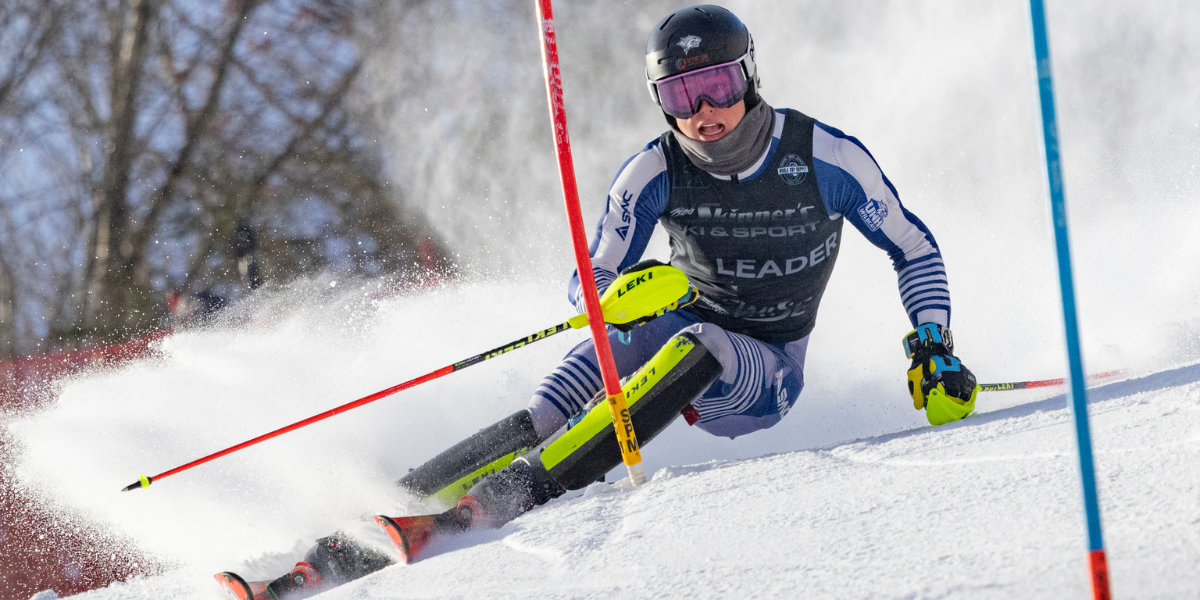
Featured Image: Canadian skier and University of New Hampshire athlete Jayden Buckrell races during an Eastern Intercollegiate Ski Association (EISA) Carnival this season. Photo: Stephen Cloutier
Editor’s note: This commentary was submitted by a member of the Canadian alpine ski racing community. Ski Racing Media agreed to withhold the author’s identity because of concerns about potential professional consequences. The opinions expressed are the author’s own.
On June 1, 2026, Alpine Canada announced the 2026-27 Canadian Alpine Ski Team nominations. It was a routine announcement — athletes, hometowns, and clubs were listed, and then Alpine Canada CEO Thérèse Brisson expressed optimism about the coming season. What wasn’t announced, and what receives little public attention, was how many of those men actually met the published nomination criteria.
Alpine Canada nominated 13 men to the team. Based on the federation’s published criteria and publicly available results, four appear to have met an objective nomination standard. The remaining nominations appear to have relied on discretionary provisions, including injury-related consideration.
The gap between what the criteria outline and what the roster reflects is not new. However, I believe it is the result of managed decline — years of choices whose consequences are now apparent at the highest level of our sport.
The Record Speaks for Itself
Alpine Canada has had many success stories in recent years, most notably Jack Crawford’s victory in the 2025 Kitzbühel downhill, with teammate Cameron Alexander joining him on the podium. Two years earlier, Laurence St-Germain and Crawford became world champions in slalom and super-G, respectively, while Alexander earned downhill bronze at the same World Championships. At the 2022 Beijing Olympics, Crawford also won bronze in the alpine combined.
There have been podiums and top-10 results throughout that period. However, the Canadian men’s championship medals have come in downhill, super-G and alpine combined.
Let’s consider what has happened to Canadian men’s technical skiing over the past five seasons.
In 2021-22, Erik Read and Trevor Philp finished 16th and 21st in the World Cup giant slalom standings, respectively. This was the last time Canada had two men in the top 25 of a World Cup technical discipline.
The following season, Read finished 21st in the giant slalom standings. Philp’s season ended early because of injury, and he retired later that year.
The 2023-24 tech team included Read, Asher Jordan, Liam Wallace and Justin Alkier. Alkier, a 2022 Middlebury College graduate, met the published criteria after a successful NorAm season racing with the Ontario Ski Team.
Alkier then received one season with the national program before he was removed from the roster. Questions remain about whether one season offered enough time and support to fairly evaluate his potential at the World Cup level.
In 2024-25, Alpine Canada eliminated its men’s World Cup technical group. Canada’s remaining World Cup technical skiers were left to pursue independent programs. Read, Simon Fournier and Declan McCormack trained with World Racing Academy that season, self-funding their World Cup and Europa Cup campaigns. Jordan and Wallace returned through injury-related discretionary consideration.
Then came 2025-26, the year of the Milano Cortina Olympic Winter Games. Both giant slalom and slalom featured the world’s best technical skiers. They also included athletes from countries with significantly smaller alpine programs than Canada.
Canada, however, did not enter a man in either technical event despite having Canadian athletes competing internationally in those disciplines during the season.
That absence should not be dismissed as a one-Olympics anomaly. In my view, it was the predictable consequence of a weakened development foundation.
Canada was allocated 13 total alpine quota positions, eight for women and five for men. Alpine Canada used all five men’s positions in the speed disciplines. That may have represented Canada’s strongest opportunity for medals. However, it also meant the country had no representative in either men’s technical race.
Brisson acknowledged the absence of Canadian men’s technical skiers during the Games. She told The Globe and Mail, “We need to rebuild our strengths in the men’s technical events. It’s a work in progress.”
It has been a work in progress for more than five years. The 2026-27 team announcement offers little public evidence that Alpine Canada has developed a coherent plan to rebuild the men’s technical team.
Brisson announced her departure from Alpine Canada following the Olympic Winter Games and became CEO of Skate Canada in July 2026. Responsibility for rebuilding the program now rests with the federation’s next leadership team, although a successor has yet to be named.
A Team Built on Discretion
The Alpine Canada 2026-27 nomination criteria establish a clear hierarchy in the nomination process: automatic nomination, current Olympic quad criteria, next Olympic quad criteria and discretionary nominations.
The objective thresholds for age-based categories are specific. They include World Cup podiums; top-15, top-20, top-25, top-45 or top-60 World Cup discipline standings, depending on age; a top-20 Europa Cup discipline standing; top-two North American status in a NorAm discipline; a NorAm overall title; and a Junior World Championships podium.
Based on the publicly available criteria and results, four of the 13 nominated men appear to have met objective standards:
- Cameron Alexander — Section 5.1, automatic nomination: 15th in the World Cup downhill standings.
- Jack Crawford — Section 5.3, current Olympic quad criteria: 22nd in the World Cup super-G standings.
- Raphaël Lessard — Section 5.4, next Olympic quad criteria: 17th in the Europa Cup super-G standings and among the top 60 in the FIS super-G world ranking.
- Jake Kertesz-Knight — Section 5.5, next Olympic quad criteria: super-G bronze at the 2026 Junior World Championships.
That makes four.
Kyle Blandford and Kyle Alexander appear to have received injury-related consideration. Based on the published criteria and available results, the remaining nominations appear to fall under Section 5.6, discretionary nominations.
Coaches’ discretion is not inherently wrong. Injury comebacks, training-group dynamics and developmental trajectory are all legitimate reasons to use it.
But when more than 50% of a roster appears to depend on internal judgment, while the public receives no explanation of how those decisions were reached, the credibility of the published criteria comes into question.
Athletes, families and clubs across the country are left without a reliable roadmap, while Alpine Canada’s men’s program operates without sufficient public accountability.
The accountability gap matters most during the prime development years, when athletes must decide whether to continue investing in the sport without knowing how or when national team support might become available.
The Pathway That Doesn’t Exist
If you were to search for the word “NCAA” in Alpine Canada’s published selection criteria, you would not find a specific NCAA qualification pathway.
The criteria include discretionary considerations such as “attitude, commitment and positive contribution.” Yet they do not directly acknowledge that many of Canada’s strongest young alpine skiers spend four important development years competing for NCAA programs.
Those athletes race in FIS-sanctioned events, improve their world rankings and compete against strong international fields. Still, they have no clearly defined NCAA route onto the Canadian national team.
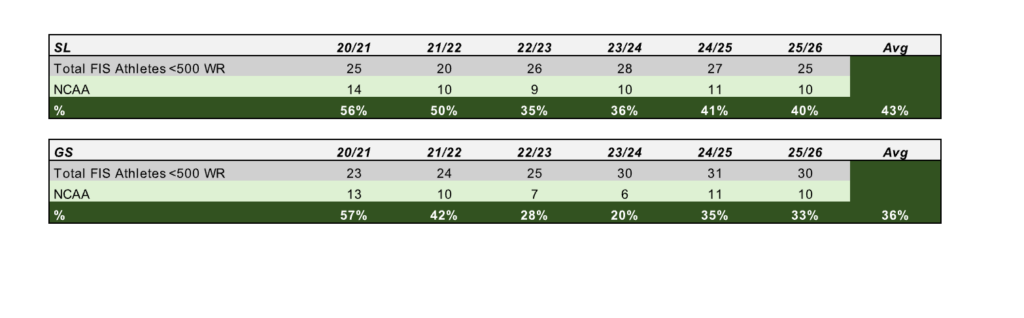
The NCAA is by no means a lesser option. Division I programs at Utah, Colorado, Denver, Vermont, New Hampshire and Dartmouth, among others, field internationally competitive rosters. The EISA and RMISA circuits produce high-level FIS races.
A significant share of Canada’s leading young slalom and giant slalom skiers compete in the NCAA. For many Canadians, a university scholarship is also one of the only financially sustainable ways to keep racing at a high level into their early 20s.
That matters in a country where even national team athletes may face substantial team fees and personal costs.
U.S. Ski & Snowboard recognized the value of collegiate racing by including an explicit NCAA route in its nomination criteria. Its pathway combines a top-three result at the NCAA Championships with two top-three NorAm finishes. The U.S. criteria also include age-based FIS world ranking standards.
The American system is not perfect, but it acknowledges that university racing can be a legitimate development environment. Alpine Canada’s criteria do not provide the same clarity.
The result? Canadian athletes can compete for NCAA titles, lower their FIS points and world rankings, represent Canada at World Cups or Junior World Championships, and graduate at ages 22 to 25 still hungry to race.
But without a reliable national program, they are left to fund independent seasons or walk away from the sport entirely.
This is not for a lack of effort. The existing criteria do not adequately account for NCAA athletes because the primary performance routes often conflict with collegiate schedules.
NorAm Cup races and NCAA race weekends routinely conflict, particularly in the Eastern circuit. Athletes who have earned the opportunity to excel both academically and athletically should not have to choose between an NCAA carnival and a NorAm Cup race without any flexibility in the selection system.
Some athletes have succeeded in both circuits. However, that requires favorable schedules, significant resources and the right support. It should not be the only way to remain visible to national team coaches.
What remains is coaching relationships.
That’s not a pathway. That’s a network.
And athletes should not have to depend on informal advocacy to receive serious national team consideration.
The Cost
The athletes have been there all along.
They develop through provincial teams or private academies, earn scholarships to NCAA programs, lower their world rankings and graduate at ages 22 to 25 with nowhere obvious to go.
Some self-fund independent seasons, hoping to earn their way onto the radar. Others leave the sport without trying because the cost and uncertainty are too great.
Declan McCormack won NorAm slalom races while competing for the University of Vermont but did not receive sustained national team support.
Justin Alkier met the published criteria, was given one season with the national program and then removed from the roster.
Simon Fournier and Étienne Mazellier built an independent program because no established national team structure was available to support their goals.
Jayden Buckrell won the 2025 NCAA slalom championship as a freshman and emerged as one of Canada’s leading young slalom skiers. He was not nominated to the 2026-27 national team.
None of those examples means an athlete was automatically entitled to a national team position. Selection should remain demanding, and one strong result should not guarantee funding or support.
Together, however, they reveal a pattern. Canada does not have a formal and transparent mechanism to consistently identify, evaluate and retain technical skiers developing through NCAA and independent programs.
What may seem like isolated cases forms a consistent pattern.
A young Canadian male skier who holds a competitive world ranking while simultaneously balancing an academic schedule is demonstrating something meaningful.
Not that he necessarily belongs on the national team immediately, but that he may only be beginning to show what he can become with greater support.
What Needs to Change
In concept, the fix is not complicated. Alpine Canada needs a broader set of criteria that recognizes the legitimate development routes available to Canadian skiers.
1. Add an explicit NCAA pathway
A top-three result at the NCAA Championships combined with a minimum FIS world ranking threshold or relevant NorAm results is a reasonable starting point. It doesn’t need to be generous. It needs to exist.
2. Add age-based world ranking objectives
Creating additional ways for younger FIS athletes to meet objective standards would provide more measurable routes toward a national team position. World rankings should not replace direct competition results. However, they can help identify athletes progressing outside the traditional national team system.
3. Create an associate team tier
An associate team could provide formal access to selected camps, coaching, testing opportunities and equipment support for athletes developing through NCAA, independent, private or provincial programs. It would allow Alpine Canada to recognize and monitor emerging athletes without committing to a fully funded national team position.
4. Publish an annual selection report
Alpine Canada should state which athletes met objective criteria, which were selected through discretion and the general rationale behind those discretionary decisions. The federation would not need to disclose private medical or personal information. It could identify broad categories such as injury protection, development potential, training-group needs or exceptional performances outside the principal criteria.
This would provide transparency and accountability for everyone. The criteria are a starting point, but not the entire answer.
The deeper issue lies in a program operating without enough coherence and transparency through the selection process. Athletes who appear to have earned similar consideration can end up on opposite sides of a roster decision without any public explanation. This method cannot build trust or the infrastructure needed to develop the next generation of athletes.
Selection decisions, development priorities and financial choices have shaped the program we now see.
Within the next five to 10 years, the leaders of Canada’s successful men’s speed program will retire from ski racing. Without a stronger technical pathway, the country could find itself facing a much broader problem in men’s alpine skiing.
It is a conversation Alpine Canada has yet to have seriously.
The athletes have been there all along. The question is whether the system is prepared to identify, support and retain them.
About the Author: Anonymous