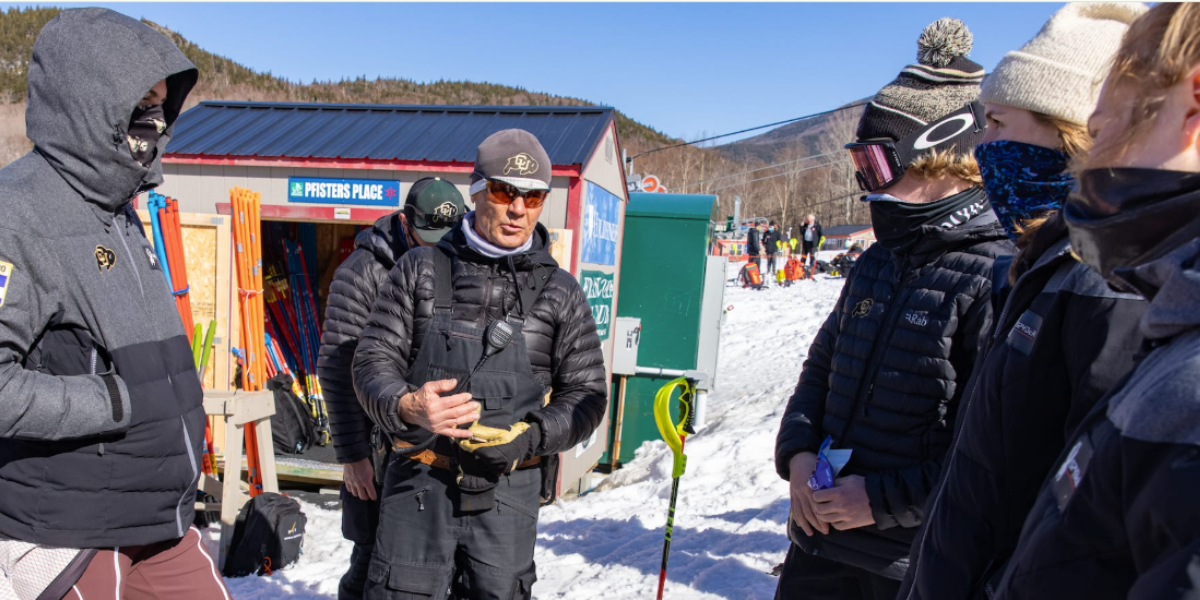
Richard Rokos / NCAA Nationals / Photo Credit Stephen Cloutier
A New Season, Familiar Concerns
Another ski season is underway, and injuries inevitably follow. If the Alpine skiing community wants to protect its athletes and sustain long-term participation, it must make real, measurable changes. Drawing on more than six decades of coaching and racing experience, these observations serve not as criticism, but as a call to action.
Presenting to the World’s Top Surgeons
In early June, I presented on Alpine skiing injuries at the Herodicus Society convention in Salzburg, Austria. Among dozens of presentations on orthopedic procedures and medical innovation, I delivered the only one focused on Alpine ski racing.
Speaking to 52 of the world’s leading orthopedic surgeons, I explained the mechanics, physics, and anatomy of a sport where injury is not hypothetical, but inevitable. After five decades of coaching and 15 years as a racer, I believed I understood this risk well—until I stood in that room and asked myself a difficult question:
Are we truly doing enough?
A Normalized Injury Culture
Knee injuries—the dominant injury in Alpine skiing—have become culturally accepted. We acknowledge them, sympathize, and move on. People now discuss ACL tears so casually that nearly everyone understands the acronym.
Scientific data places knee-injury incidence between 45% and 50%. Informal conversations with current and former racers suggest the number is far higher—closer to 70% over a full career. At what point does “risk” become resignation?

Why the knee?
It is the first vulnerable joint between the ski—our primary source of momentum—and the body. The ankle is immobilized by the boot, while the so-called “safety” binding too often fails to release when it matters most.
The Essence and Appeal of Ski Racing
Alpine skiing remains compelling because it blends gravity, speed, balance, power, timing, courage, and risk into a single movement. Few sports demand such complete integration of physical and cognitive skill.
The sport’s history reflects this complexity. In 1922, Sir Arnold Lunn introduced slalom gates and later helped FIS—founded in Cortina in 1924—codify slalom and downhill.
After 45 years coaching collegiate athletes, one conclusion is clear: Sski racing consistently attracts disciplined, resilient, high-character individuals. Their academic and athletic success mirrors the demands of the sport itself.
The Rising Burden on Athletes’ Bodies
Despite advances in equipment and safety systems, injury frequency and severity continue to rise. Emergency rooms and orthopedic clinics feel the consequences.
Recent fatal accidents have raised urgent questions about netting standards, while improved helmets and body armor have not prevented an increase in full-body trauma.
Athletes themselves have changed.
The modern racer’s physique has shifted toward greater mass and power, amplifying the forces generated by today’s skis and injected race surfaces.
Training Limits and Human Constraints
Elite training already demands 700–800 hours annually. The system cannot raise that ceiling. Adjusting content or recovery time forces trade-offs between performance, durability, and safety.
Strength training improves resilience, but reduced emphasis on agility, balance, and endurance undermines technical efficiency and increases injury risk.
The human body is approaching its upper limits, while skis, surfaces, and speeds continue to advance.
The Overlooked Role of Mental Training
Mental skills remain one of the most neglected performance factors in Alpine skiing. Visualization, focus, and decision-making are essential yet rarely trained intentionally.
Course inspection represents roughly half of the technical process in a race run, yet outside of race day it receives minimal structured attention. Training runs often become automatic repetitions rather than deliberate cognitive practice.
This gap leaves athletes underprepared for the exact decisions that determine success and safety.
Bindings: The Persistent Weak Link
Bindings remain a fundamental flaw in Alpine safety systems.
Despite cosmetic redesigns, the traditional toe-heel concept still allows release in only three directions—adequate for recreational skiing but insufficient for racing.
To prevent pre-release, racers raise DIN settings to extreme levels, but the toe piece still does not release upward—a movement directly linked to ACL injury mechanisms.
Younger athletes face additional risk when aggressive cross-blocking introduces rotational forces that the system cannot safely manage.
The Ice-Rink Surface Problem
“Ice-rink-perfect” surfaces have become the gold standard. Organizers pride themselves on uniform conditions from the first racer to the last—even when the majority of the field has never trained on surfaces this unforgiving.
With DNF rates approaching 60%, the question becomes unavoidable: Are we prioritizing fairness—or survival?
A Sport Outrunning Its Human Limits
The human body has changed little while the environment around it has changed dramatically.
Equipment, surfaces, speed, and expectations have surged ahead—creating a growing mismatch between what the sport demands and what the body can tolerate.
Lessons Other Sports Have Already Learned
Other high-risk sports have acted in response to similar crises. Formula 1 introduced sweeping safety and technical reforms in 2014. MotoGP expanded runoff zones and enforces in-race penalties. Even basketball has modernized protocols to reduce non-contact injuries.
Alpine skiing must now ask the same hard question: Where—and how—can the system evolve to protect its athletes without losing its soul?
Part two examines where those changes can begin.
About the Author: Richard Rokos