In ski racing, success is often measured by podiums, rankings, and FIS points.
Those metrics matter. They open doors, create opportunities, and help athletes take the next step in their careers. But within the most successful development programs, growth is measured by much more than results alone.
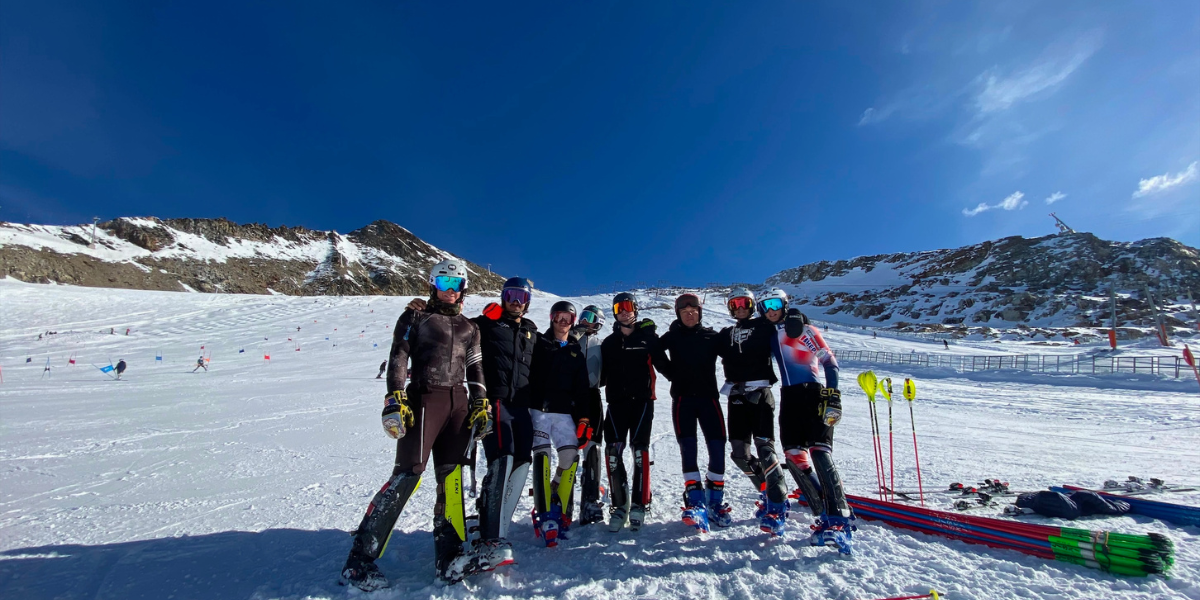
At Waterville Valley Academy, the 2025–26 FIS men’s season was a powerful example of what happens when athletes commit to the daily process of improvement. The results were impressive, but the story behind them is even more meaningful.
Across the roster, athletes significantly lowered FIS points in technical and speed disciplines, earned NCAA opportunities, competed internationally, and continued progressing along the collegiate pathway. Behind every point drop were early mornings, difficult training blocks, setbacks, breakthroughs, and teammates pushing one another to improve.
The NCAA Pipeline Continues
One of the strongest indicators of a successful development program is its ability to prepare athletes for collegiate racing.
This season, four members of the WVA FIS men’s team committed to NCAA programs:
- Gunnar Guilbert — Colby College
- Christian McCourtie — Plymouth State University
- Albie Preisler — Saint Michael’s College
- Tucker Thayer — Saint Michael’s College
The pipeline remains strong beyond this year’s commitments.
Matteo Padoan, who will spend a postgraduate year racing and training in Italy, is exploring opportunities with programs including Harvard and Williams. Mason Cunio has generated interest from Saint Lawrence University, Saint Michael’s, Colby, UNH, and Williams, while Jake Wagner continues discussions with programs including the University of Nevada, Reno and Colby.
For athletes pursuing collegiate ski racing, development is built through years of consistent training, racing experience, and the ability to perform under increasing levels of competition.
International Experience on the World Stage
The season also featured international representation.
Albie Preisler competed for Denmark at the FIS Junior World Ski Championships, racing against some of the world’s top junior athletes. Experiences like Junior Worlds provide valuable exposure to elite competition while raising the standard for what is possible within a development program.
For younger athletes in the program, seeing a teammate compete on the international stage reinforces the opportunities that can come through dedication and long-term commitment to the sport.
Technical Events: Significant Gains in GS and SL
Several athletes made substantial progress in giant slalom and slalom throughout the season:
- Gunnar Guilbert
- GS: 46 → 30 (16-point drop)
- Jake Wagner
- GS: 62 → 46 (16-point drop)
- SL: 80 → 54 (26-point drop)
- Matteo Padoan
- GS: 61 → 48 (13-point drop)
- SL: 83 → 62 (21-point drop)
- Mason Cunio
- GS: 60 → 42 (18-point drop)
- SL: 59 → 53 (6-point drop)
- Tucker Thayer
- GS: 67 → 48 (19-point drop)
- SL: 47 → 40 (7-point drop)
- Albie Preisler
- GS: 71 → 54 (17-point drop)
- SL: 58 → 46 (12-point drop)
- Jake Leonard
- GS: 999 → 109
- SL: 999 → 80
- Will Bradica
- GS: 999 → 116
- SL: 999 → 150
- Evan Cavallero
- GS: 127 → 98 (29-point drop)
For newer athletes like Jake Leonard and Will Bradica, the season represented more than a reduction in points. Moving from no established FIS ranking to competitive profiles reflects significant growth, confidence, and valuable racing experience gained throughout the winter.
Speed Development Continues
The team’s progress extended well beyond the technical disciplines.
- Matteo Padoan
- SG: 106 → 68 (38-point drop)
- DH: 131 → 83 (48-point drop)
- Gunnar Guilbert
- SG: 159 → 103 (56-point drop)
- Tucker Thayer
- SG: 119 → 98 (21-point drop)
- Jake Wagner
- SG: 139 → 96 (43-point drop)
- Jake Leonard
- SG: 999 → 174
- Will Bradica
- SG: 999 → 244
Success in speed events often reflects more than technical ability. It requires confidence, trust, and the willingness to commit fully when terrain, conditions, and speed demand it. The gains made across the roster demonstrate growing maturity and comfort in disciplines that challenge athletes both physically and mentally.
What Does Growth Actually Look Like?
The statistics tell only part of the story.
Growth does not happen in isolation. It happens when athletes challenge one another daily, whether on snow, in the gym, during recovery sessions, or through the countless small moments that often go unnoticed.
Throughout the season, the WVA FIS men’s team built an environment where effort mattered. Athletes held one another accountable, celebrated successes, learned from setbacks, and consistently pushed the standard higher.
There were breakthrough performances and frustrating weekends. Athletes learned when to attack and when to stay patient. They learned how to manage nerves, trust their training, and compete with greater consistency.
Perhaps most importantly, they learned that progress is rarely linear.
For some athletes, growth looked like dramatic point reductions. For others, it meant gaining confidence in competition, adapting to stronger fields, or stepping into leadership roles within the team. Sometimes growth looks like a personal-best result. Other times, it looks like showing up and doing the work when progress feels slow.
Building the Future
Under the leadership of Head Coach Jason Guilbert, the momentum within the Waterville Valley Academy FIS men’s program continues to build.
The NCAA commitments, international experience, and measurable performance gains all point toward a healthy and thriving development pathway. Yet perhaps the most important accomplishment of the season was the culture the athletes built together.
A culture centered on accountability. A culture built on work ethic. A culture where teammates push one another to improve and celebrate each other’s success.
In a sport where results often dominate the conversation, the 2025–26 season serves as a reminder that the strongest programs are built on something deeper.
At Waterville Valley Academy, success is never just about where athletes finish.
It’s about who they become in the process.
About the Author: SR Staff Report