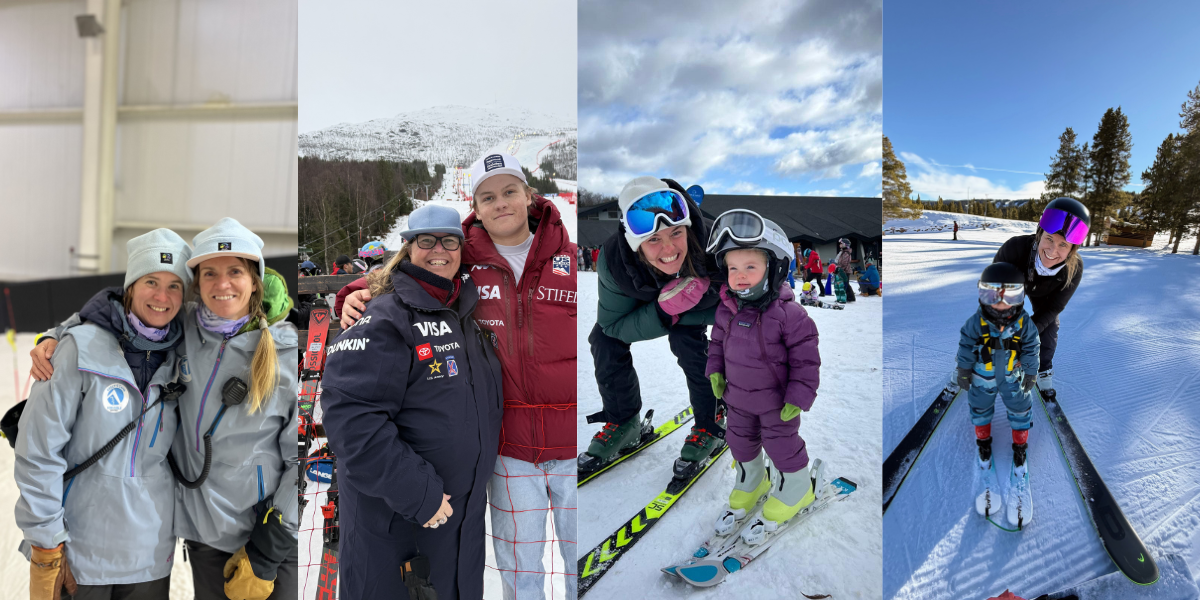
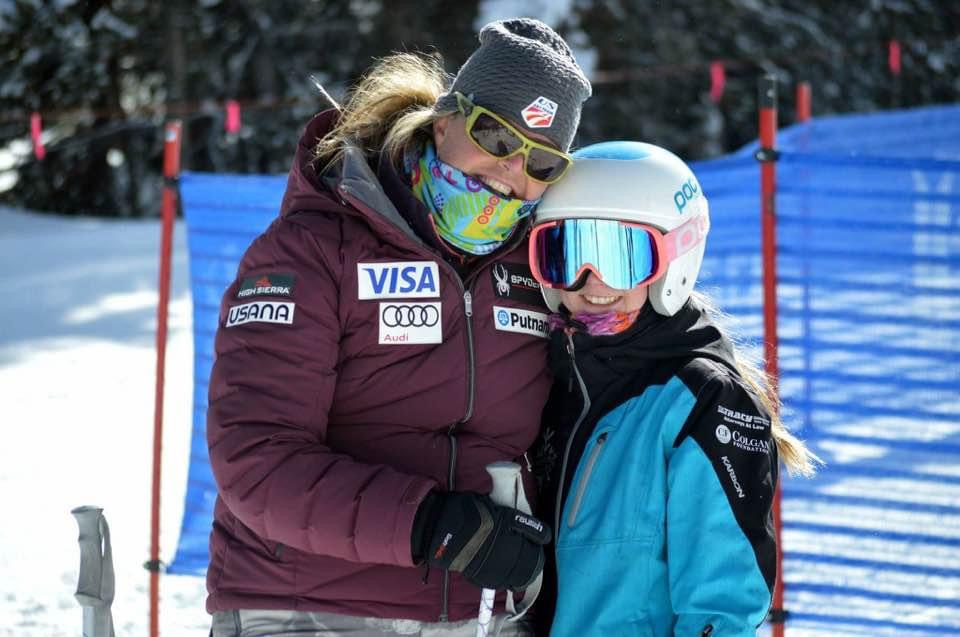
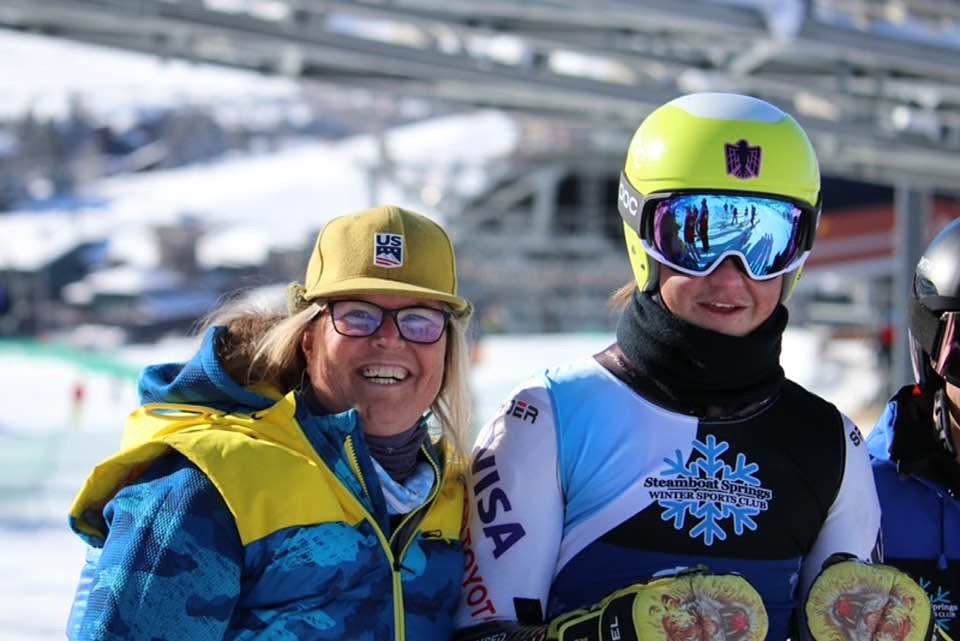
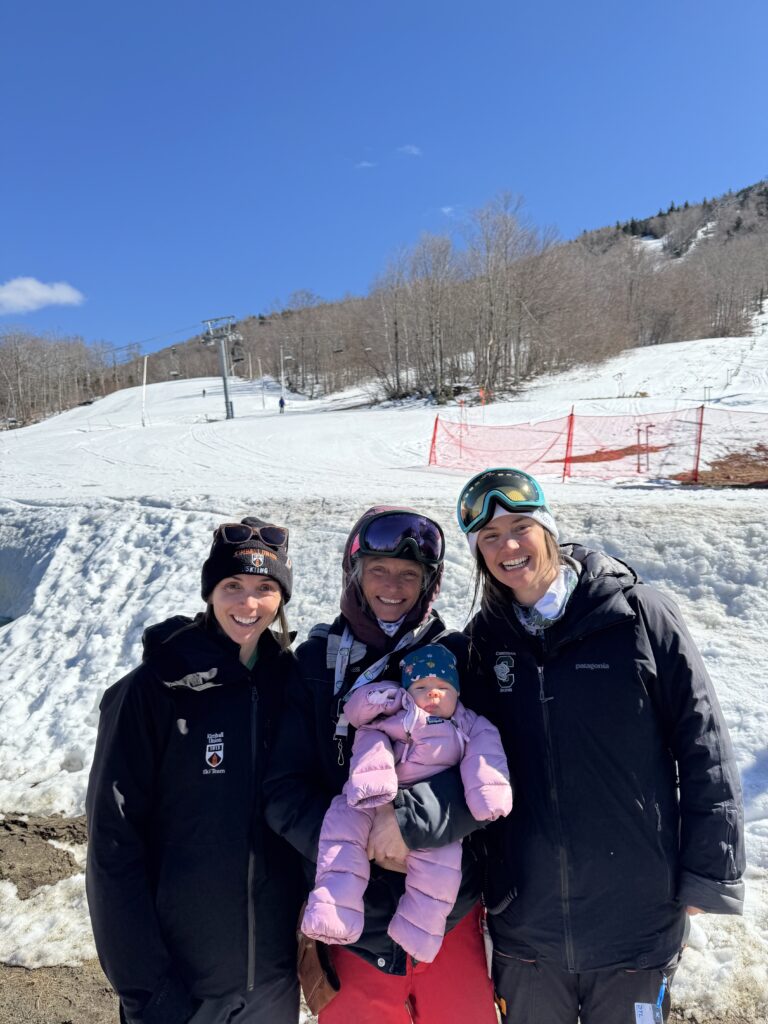
Featured Image: Chelsea Marshall, Keely Kelleher, Darlene Nolting and Julia Ford.
Ski racing has never been an easy sport. It demands time, travel, physical sacrifice, emotional resilience, and an almost stubborn level of commitment. For decades, athletes and coaches alike have accepted that reality as part of the deal.
For women who transition from elite racing into coaching and leadership, the equation often changes the moment motherhood enters the picture.
The shift is subtle, but it is real. Suddenly, the same qualities that made them exceptional are quietly questioned. Availability comes under scrutiny. Commitment is often assumed to be compromised.
Too often, women are left navigating a system that was never designed with families in mind.
A Generation That Refuses to Leave
Across generations, women in ski racing have been finding ways to stay.
Pioneers like Darlene Nolting were doing it long before there were real pathways. She raised children while holding leadership roles in high-performance environments that rarely included women at all.
Today, that evolution continues. Former World Cup athletes and high-level coaches like Alice McKennis Duran, Keely Kelleher, Julia Ford, and Chelsea Marshall are pushing back on outdated assumptions. At the same time, they are actively reshaping what coaching can look like.
They are not alone.
Across the sport, women are still coaching, leading programs, running camps, mentoring athletes, and shaping culture while raising families. Many are making it work quietly. Some adjust roles. Others scale travel or share responsibilities. Some step into more flexible positions to stay connected to the sport they love.
The question ski racing must confront is not whether women can balance coaching and motherhood. They already are.
The real question is whether the sport is doing enough to support them, both creatively and intentionally.
The False Choice Between Coaching and Family
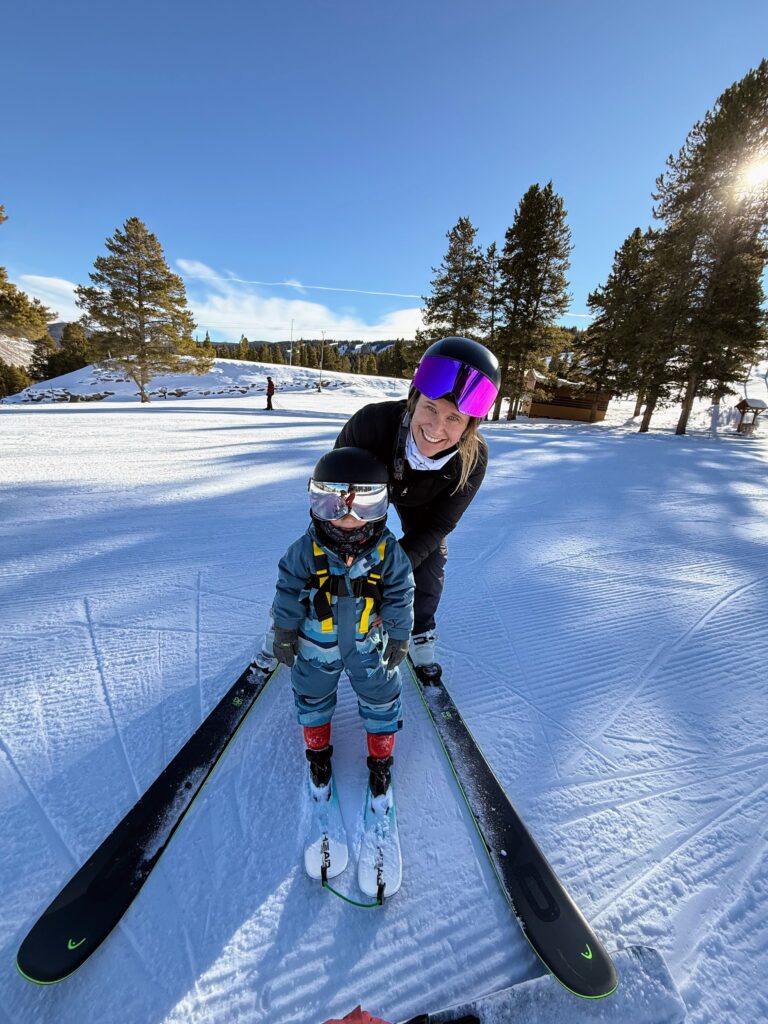
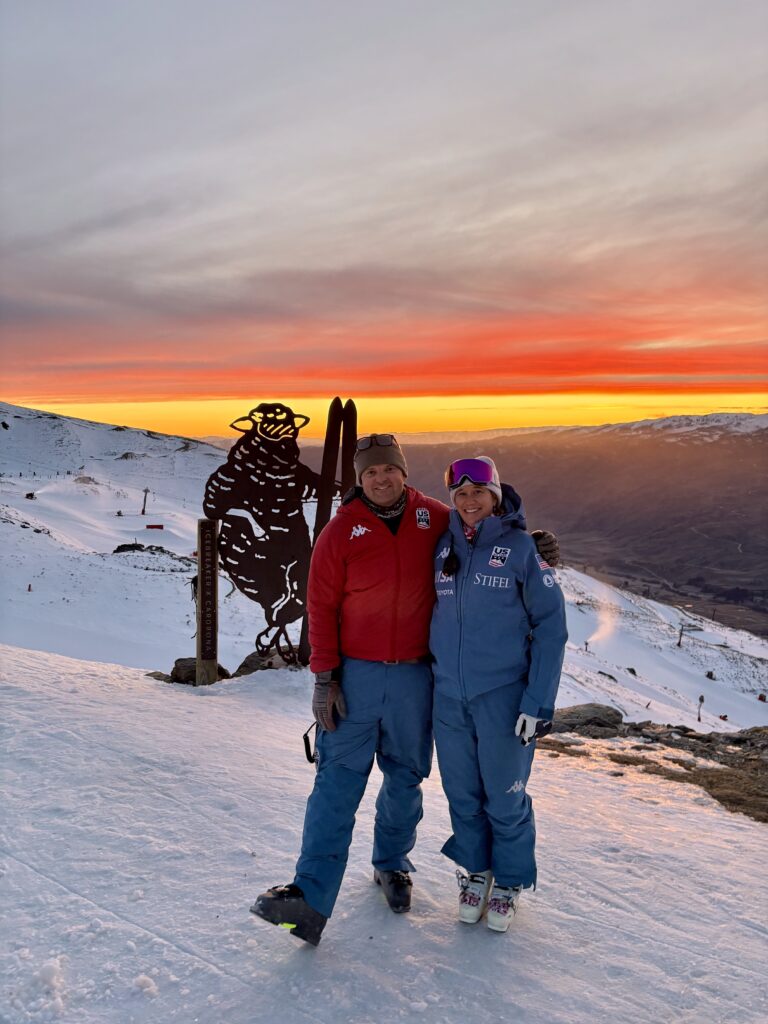
Alice McKennis Duran never believed becoming a mother meant stepping away from high performance coaching.
A former World Cup racer, she now works within the U.S. Ski Team women’s regional programming alongside her husband, Pat Duran, while raising their young son.
“It’s really just about balance and planning and timing and preparation,” McKennis Duran says. “Much like when I was an athlete, it’s making sure I have everything organized.”
That level of preparation goes far beyond what most people see. Childcare must be arranged months in advance. Babysitters are found in Mammoth, in New Zealand, and everywhere in between. Days are scheduled down to the hour so that when she is on the hill, she can give athletes her full attention.
“Once I know he’s taken care of, then I have the freedom and confidence to focus on the athletes,” she says.
Being a parent, she explains, is always the first priority. Coaching comes second, but that does not mean compromise. It means structure and intention, leaning on the same habits that once defined her as an athlete.
“It’s leaning on what I used to do as an athlete. Being organized, being prepared, having a plan.”
Even in a situation where both parents are coaching, the margin for error is small.
“If the babysitter doesn’t show up, then you can’t be on the hill,” she says.
Her experience highlights a deeper imbalance in the sport. Many male coaches never have to consider these logistics. Their careers often continue uninterrupted, supported by partners who absorb the majority of childcare responsibilities. For women, those invisible systems are rarely assumed, and when they are missing, women are the ones who step away.
What makes McKennis Duran’s situation different is not that it is easier. It is that it has been made possible. The structure around her role allows space for both coaching and family, something that remains rare across the sport.
“This was our chance to do something together,” she says.
That opportunity came from an unexpected place. While many club programs struggled to adapt, the national team found a way.
“The U.S. Ski Team was willing to figure it out,” she says. “And that was surprising.”
Her perspective leads to a question the sport can no longer ignore.
“How are we not trying to figure this out better?” she asks. “We’re losing coaches every day.”
Before There Was a Model
Long before flexibility, shared roles, or childcare conversations entered the coaching landscape, Darlene Nolting was figuring it out in real time.
A longtime leader in the Rocky Mountain Division, Nolting built her career in an era when female coaches were rare. Structural support for mothers in coaching was virtually nonexistent.
When she became a mother, continuing in high-performance coaching required a fundamental shift.
“I had to go from coaching high-level athletes to a youth coordinator role,” she says. “It became more administrative, more local. Less travel.”
That transition was not about a lack of ambition. It was about sustainability.
She made it work through a strong support system.
“You have to have a partner willing to make it work,” she says. “They have to make sacrifices too.”
Even with that support, the realities were demanding. She brought her infant daughter to races. She hiked the hill with her in a carrier. She found ways to stay present in the sport however she could.
What proved more difficult was not the logistics—it was perception.
“The hardest part was losing a bit of credibility,” Nolting says. “I wasn’t on the hill every day anymore.”
That shift in visibility changed how others viewed her experience, even though her knowledge had not changed.
Still, she stayed.
“It was important for me to stay relevant,” she says.
Looking back, she sees progress—but also a familiar pattern. More women are visible in coaching today, but the responsibility to make it work still often falls on the individual.
“If we want to keep women in the sport, we have to be creative,” she says. “Clubs have to be willing to adapt.”
Losing Coaches at the Moment They Matter Most
Ski racing frequently talks about a coaching shortage. What it discusses far less is who is leaving—and why.
Women often exit high-level coaching not because they lack expertise or ambition. They leave because the structure of the job becomes incompatible with family life.
The challenges are consistent. Long travel blocks. Inconsistent pay. Unclear maternity leave policies. A lack of re-entry pathways.
Individually, each barrier is manageable. Together, they become unsustainable.
This loss is not theoretical.
It shows up every season when programs struggle to retain experienced staff. It shows up when female coaches move to lower levels or leave the sport entirely. It shows up in leadership rooms where women remain underrepresented.
Ironically, motherhood often makes coaches better.
What Motherhood Adds to Coaching
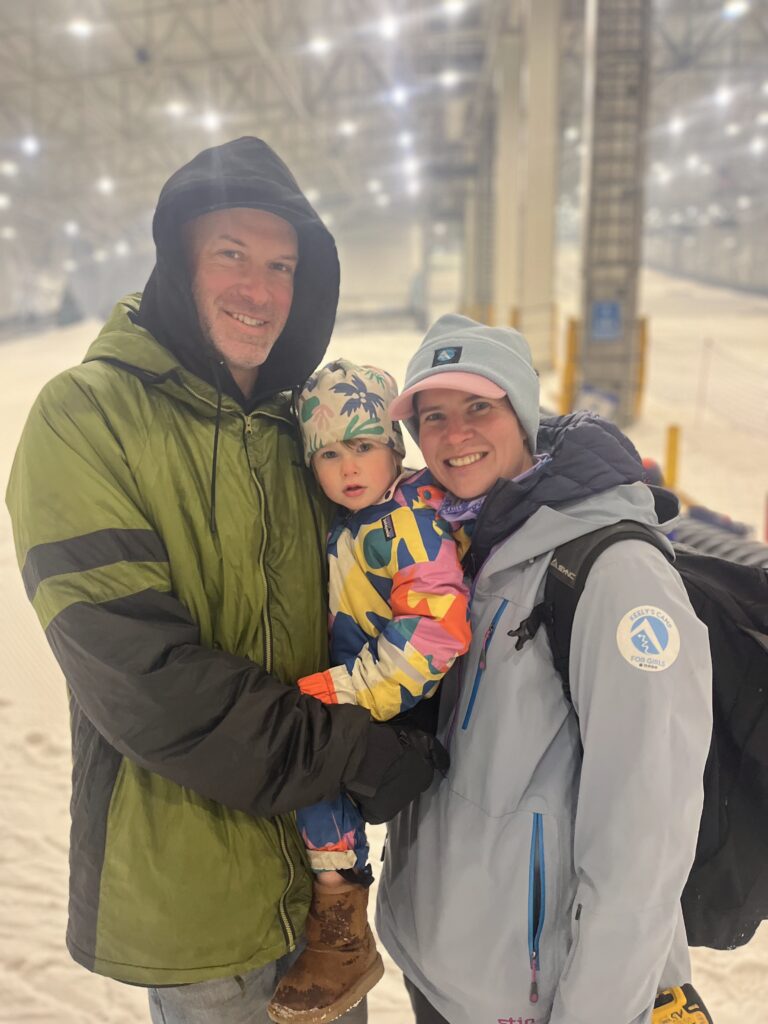
Keely Kelleher has seen that transformation firsthand. As the founder of Keely’s Camp for Girls, she built a women-led program that operates differently—by design.
“I validate parents more now,” Kelleher says. “Before, I might have thought they’ll be fine. Now I understand where that anxiety comes from.”
That shift in perspective has changed how she leads. At her camps, childcare is built into the structure. Coaches rotate days. Babies are present. Schedules adjust around family needs.
Motherhood is not treated as a disruption. It is expected. “There are a lot of things I’m way better at now than I was before being a mom,” she says. “I’ve never felt so dialed.”
That clarity comes with a more complicated reality. “There are moments where you just think, can I do this? Is this even possible?”
Even so, stepping away was never part of the equation. “I always knew I wasn’t going to stop working,” she says. “I love being part of this community.”
Her approach reflects a simple shift. Instead of asking women to adapt to the structure, she adapts the structure to them.
“I don’t care how much it costs. I want them there,” she says. “I don’t want to lose a Chelsea Marshall in coaching because we couldn’t make it work.”
When Support Is Structural, Women Stay
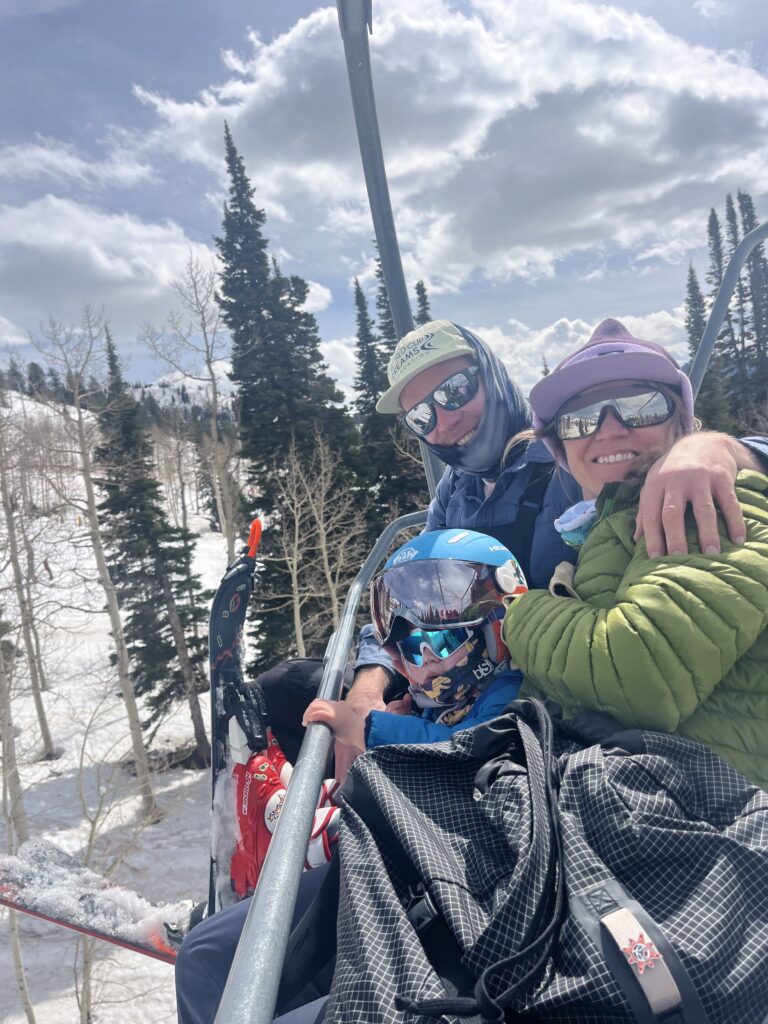
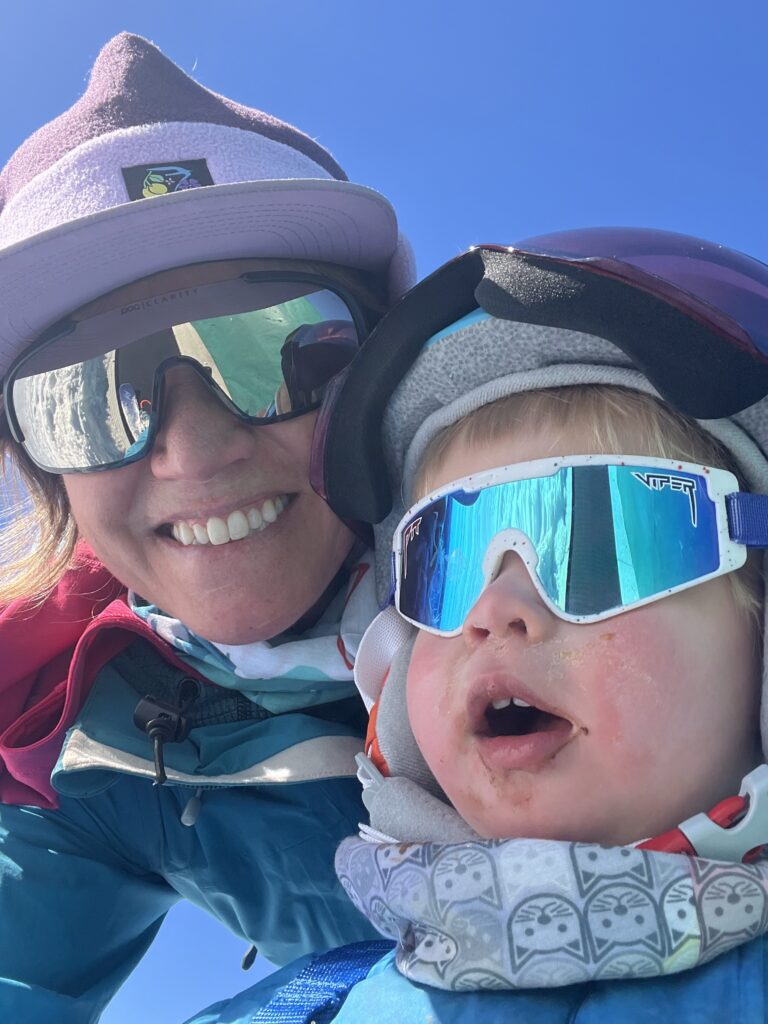
Chelsea Marshall’s experience at Keely’s Camp for Girls shows what happens when support is built into the system.
As a lead coach and a mother, she is able to show up fully. Her role was designed with flexibility and respect. Childcare is part of the conversation. Scheduling reflects real life. Her value is assumed, not questioned.
The result is continuity. It is leadership. It is mentorship that would otherwise be lost.
Women are not leaving because they care less. They are leaving because the cost of staying becomes too high.
When programs adapt, women stay.

Leadership, Visibility, and Cultural Change
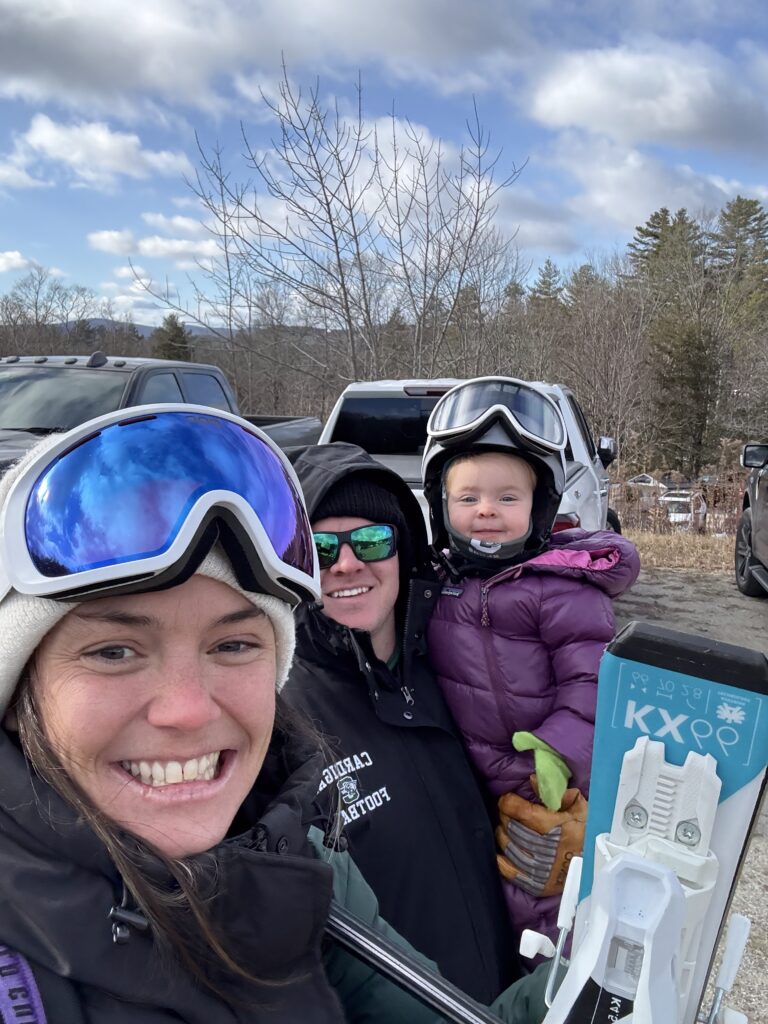
Julia Ford brings another perspective. A former World Cup athlete, she now leads the alpine program at Cardigan Mountain School while raising her daughter.
“When I got pregnant, what I was most nervous about was how families would view my ability to do my job,” she says.
Instead, she found support. “I think my biggest surprise was how excited people were for me.”
That support made it possible to continue. “You’re adding a whole other layer to everything you’re already doing,” she says. “And it takes a lot of support around you.”
She also recognizes that her experience is not universal. “I feel like I might be in a bit of an unfair position,” she says. “I don’t know if that’s the case for everyone.”
Part of that confidence was shaped long before her own career. Growing up, she was surrounded by strong female role models who balanced leadership in ski racing with raising families. Her mother coached her and her three siblings, making ski racing a central part of their lives. Her aunt Wendy Neal served as head of school at Okemo Mountain School, and her aunt Julie Woodworth has long been president of the Vermont Alpine Racing Association.
“They were doing these roles while raising families—and really before a lot of women were,” Ford says. “That laid a fundamental belief in me that moms belong in the sport and we can do both. They fit together.”
Her presence now extends beyond results. In an all-boys environment, representation shapes perception. “If I can show them what a strong woman looks like in this role, hopefully that carries forward.”
At its core, her belief is simple.
“I don’t think women want to choose between being a mom and being in ski racing. We believe we can do both.”
A Question the Sport Must Answer
Across the sport, women are making it work in different ways. Some reduce travel. Others shift roles. Some step into leadership or administration. Others build entirely new models.
Their careers may look different, but they have not left ski racing. What remains consistent is this: the burden of adaptation still falls on them.
Ski racing prides itself on innovation. Equipment evolves. Training evolves. Athlete development continues to push forward. Coaching structures, however, have not kept pace.
These women are not asking for less. They are asking for recognition. Motherhood does not diminish commitment—it reshapes it.
If ski racing wants to retain women in coaching and leadership, creativity cannot be optional. Shared roles, flexible schedules, childcare support, and clear re-entry pathways are not luxuries. They are necessary investments in the long-term health of the sport.
The women are already proving it can work.
The question now is whether ski racing is willing to meet them there.
About the Author: Katie Twible