Featured Image: Sam Maes. Credit: GEPA
The Far West Development Initiative (FWDI), with support from Melissa and Martin Huml, created The Young Skier’s Guide: Fundamentals of Ski Racing to develop U14 racers, though its lessons benefit all ages. Ron LeMaster’s stunning photos and videos lead the instruction, with Ron Kipp’s text providing valuable support. Ski Racing Media proudly publishes nine articles highlighting the book’s key concepts, and this article covers “Balance Against the Outside Ski,” the ninth concept in the series.
The Role of Photos and Photomontages
Ron LeMaster’s remarkable photos immerse athletes in images of ski racers, helping them internalize technique through their neuromuscular systems. Athletes then replicate the technique coaches teach, aligning with these concepts.
Notably, a new edition of the book is currently being published, and we will soon provide a link for purchase at a very low cost.
The Nine Essential Concepts
- Upper Body Facing Downhill
- Equal Ankle Flexion
- Turn Connection/Transition
- Inclination
- Angulation
- Long Leg/Short Leg
- Pressure in the Fall-Line
- Edge Angle
- Balance Against the Outside Ski
Click images to enlarge.

Explanation:
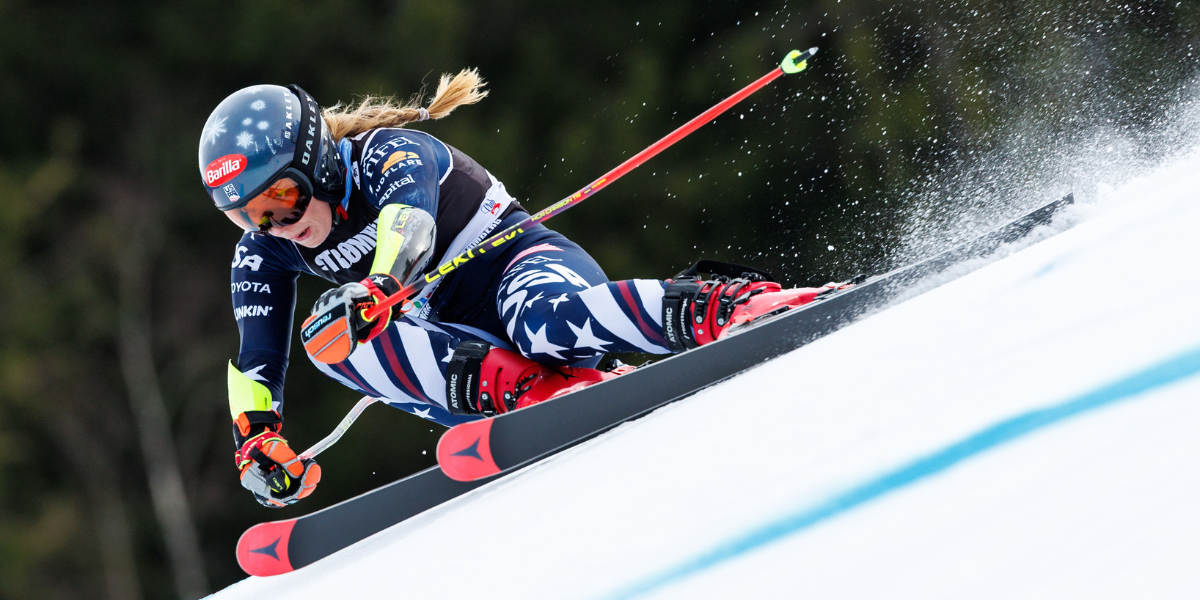
Both skis can be used. However, the young skier must master balancing against the outside ski. This is the strongest posture for the ski racer.
Classically when?
Any time the ski is being used to turn.

Especially when?
When the apex of the turn coincides with the impulse of pressure.
Which ski is the outside ski?
The outside ski is the ski that is on the outer side of the turn’s arc.
What is balance?
Balance is when the skier’s Center-of-Mass (CoM) is in line with their base of support. The skier must continuously adjust their CoM throughout the turn to maintain balance.



What is balancing?
A balanced skier has two forces that cancel each other out; they are in equilibrium. Equi, Latin for equal, and libra, Latin for balance, define equilibrium—two equal actions acting in opposite directions. For example, skis sliding forward are counteracted by an opposite force, so the skier does not move aftward. Moving the CoM inward during a turn counters the skis moving laterally. Skis rotating or turning clockwise are countered by the upper body rotating counterclockwise.
One balance, three directions:
Balance is broken down into the three cardinal planes. A ski racer in the backseat is out of balance in the fore/aft sagittal plane. The ski racer that leans or banks is out of balance laterally in the frontal plane. The ski racer with excess rotation either starts or finishes the turn out of balance in the horizontal plane.
Another way to say it:
The old-school definition is to “stand on the downhill ski.” However, this definition misses the point of where pressure is and what is happening to the ski.
Better ways to say it:
“Stand” against the outside ski is good, but “balance” against the outside ski may be more informative. At the elite levels, the “command” of the outside ski may give the skier more choice to react. There are many World Cup turns where the outside ski doesn’t efficiently engage with the snow. These fast, bumpy, and challenging courses make balance on the outside ski difficult. In these cases, just having “command” of the outside ski may be a worthwhile objective.
Exceptions:
Some turn entries have a later weight transfer to delay pressure and impulse when the ski loses purchase due to the snow and/or sidehill challenge.
What to look for:
Watch for the line-of-action from the center-of-mass to the inside edge of the outside ski.


Why?
To be strong and have an athletic anticipatory attitude.
What happens if not:
The skier ends up in the backseat. They skid sideways or bank in with their upper body. The upper body rotates in the same direction as the turn.
Drills:
Stork turns, Traverse on downhill ski, Javelin turns, 1000 steps, Step turns, Hands on knees.
Talking points or cues:
“Stand between the bindings,” “Utilize the whole ski,” and “Feel the tip, middle, and tail.”

About the Author: Ron Kipp