Marco Schwarz, Gürgl Slalom: GEPA pictures
The Far West Development Initiative (FWDI), supported by Melissa and Martin Huml, created The Young Skier’s Guide: Fundamentals of Ski Racing to support the development of U14 racers, but it benefits all ages. Ron LeMaster’s stunning photos and videos lead the teaching, with Ron Kipp’s text offering valuable support. Ski Racing Media is pleased to publish nine articles highlighting the book’s key concepts. The concept covered in this, the second in the series, is equal ankle flexion.
The Role of Photomontages
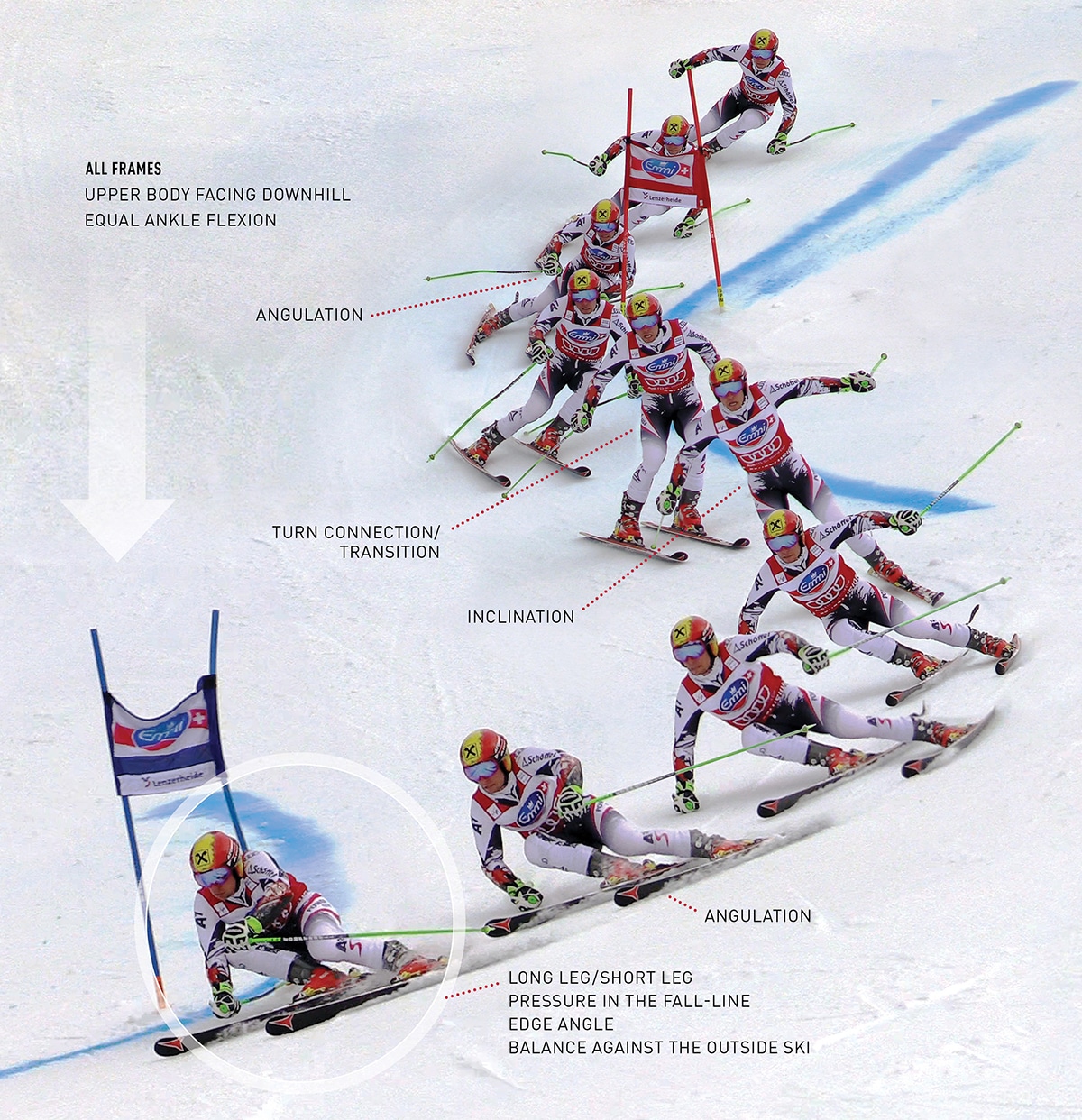
The amazing Ron LeMaster photomontages aim to immerse athletes in the images of ski racers, helping them internalize the technique through their neuromuscular system. Athletes then replicate the “technique” their coaches teach, aligned with these concepts.
Equal Ankle Flexion
Maintaining equal ankle flexion in skiing is critical to achieving a biomechanically aligned stance, which helps the upper body face downhill.
Understanding the Ski Turn
During a ski turn, one ski is always higher on the slope while the other is lower. As the skier moves through the turn, the separation between the skis changes continuously. Keeping equal angles in both ankles throughout the turn ensures that the higher ski remains ahead of the lower ski. This positioning allows the pelvis to align efficiently, supporting proper flexion and angulation from the pelvis to the shoulders.
The Nine Essential Concepts
- Upper Body Facing Downhill
- Equal Ankle Flexion
- Turn Connection/Transition
- Inclination
- Angulation
- Long Leg/Short Leg
- Pressure in the Fall-Line
- Edge Angle
- Balance Against the Outside Ski

Click on the image to enlarge
Is Flexion the Main Focus?
Although we often talk about flexion, what truly matters is the tension created in both ankles. Since tension is invisible, we observe ankle flexion as a visible indicator.
When we talk about flexion in skiing, we’re actually focusing on muscle tension. Tension is the amount of electrical activity in the muscles. Studies using electromyography (EMG) show that what sets the best ski racers apart is the level of tension in their inside ski. When the tibialis anterior muscle dorsiflexes the ankle, it keeps the ankle of the inside ski flexed and in a strong, biomechanically aligned position. This tension is critical to maintaining that alignment.
Click on the image to enlarge

When Should This Happen?
Equal ankle flexion is crucial throughout the entire turn and when linking turns.
Exceptions to the Rule
In cases of extreme edge angles (like dragging knuckles), the inside ankle might open up or become more obtuse. This occurs because the skier’s pelvis anatomy allows for more significant hip joint flexion in the fore/aft plane than in the lateral direction.
What to Look For
Watch for equal flexion in both ankles during all turn phases, especially at the end or during turns extending far beyond the fall line. Pay close attention if the athlete applies late pressure.
Click on the image to enlarge

Why Is This Important?
Unequal ankle flexion puts the ski racer in a biomechanically inefficient position, reducing strength and performance.
What Happens if Flexion Is Unequal?
If the inside ankle lacks flexion and tension, it can cause the inside ski to lead excessively. This can result in the inside foot advancing unnecessarily during the search for extreme edge angles. The challenge then becomes restoring equal ankle angles to initiate the next turn. Simply pulling the foot back is a temporary fix. It’s better to create the necessary flexion and tension in the inside ankle beforehand to prevent it from moving too far forward
Common Issues
- Stove piping
- Backseat positioning
- Dropping the hip
Drills to Correct the Issue
- Push me, pull me
- Shuffle turns
- Telemark imitation
Additional Tips
- Watch videos, especially at the end of the turn, after passing the gate, and be aware of these potential problems.
- Use cues like “Bend your boot at the instep,” “Make your toe piece heavy,” and “Feel like you’re holding a soccer ball.”
About the Author: Ron Kipp