
Neurological Inhibition and Force Expression in Alpine Skiing
Alpine skiing places extraordinary demands on the human neuromuscular system. Few sports require an athlete to repeatedly absorb and redirect high levels of force while managing rapid changes in speed, joint position, muscular contraction, balance and direction.
With every turn, the skier must control large eccentric forces, stabilize the body and transition between muscular contractions. At the same time, the athlete must regulate the interaction among the body, skis and snow.
Meeting these demands requires more than muscular strength. The nervous system must continually determine how much force to produce, when to produce it and which muscles to activate. It must also coordinate that force as the mechanical environment changes.
An athlete may possess the physical capacity to produce a movement without being able to consistently access or express that capacity under the demands of skiing. This creates an important distinction between physical capacity and usable performance.
The objective of training is not simply to build more strength. It is to progressively develop an athlete’s ability to access, regulate, coordinate and express that strength as force, speed and environmental uncertainty increase.
For alpine skiing, that means progressing from capacity to access, coordination and expression. The athlete must first build the physical reserve to tolerate the sport. Then, the athlete must learn to access and control that capacity before expressing it through the skis under extreme conditions.
How the Nervous System Regulates Force
Neural output is not fixed. The nervous system continually integrates sensory information, mechanical demands, previous experience, task requirements and perceived risk. It uses that information to organize movement.
As a result, the amount of force an athlete can produce in a controlled gym environment does not necessarily equal the force that athlete can use on snow. The nervous system may change motor-unit recruitment, firing rate, reflex activity, muscle activation and coordination when a task becomes unfamiliar or extreme.
Inhibition is part of that regulation. It should not automatically be viewed as a failure or a protective switch that simply turns muscles off. Instead, inhibitory processes help regulate motor output as the body responds to changing demands.
Disinhibition is equally nuanced. It does not simply turn muscles on. Rather, it describes a reduction in inhibitory influence that may allow greater motor output. Research has shown that eccentric strength training can reduce corticospinal inhibition, although applying that finding directly to alpine skiing requires caution.
What the Research Can Tell Us
Neuromuscular research becomes particularly relevant when mechanical demands increase. Studies of landing and drop-jump tasks show that people adjust muscle activation, joint position and coordination as landing height, load or uncertainty changes.
One study of single-leg landings found that greater mechanical demands changed muscle activation and reorganized movement patterns. Research on drop jumps has also shown that knowing or not knowing the drop height influences muscle activity, leg stiffness and joint movement.
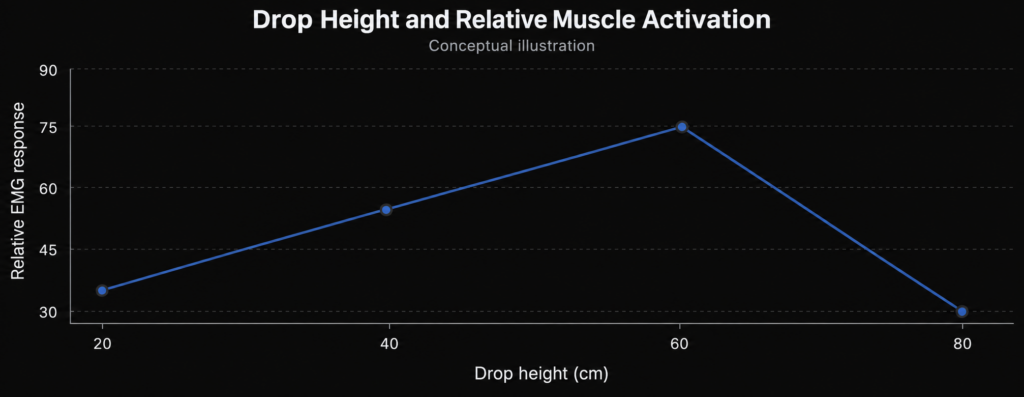
These findings reinforce an important point: Increasing mechanical demand does not necessarily produce a proportional increase in neural output. The nervous system may instead organize a different movement strategy.
However, reduced electromyographic activity, or EMG, does not by itself prove neurological inhibition. It may reflect changes in motor-unit recruitment, firing rate, timing, reflex modulation, preactivation or coordination. It can also reflect the mechanical conditions of the task.
The research does not perfectly recreate a World Cup turn. Still, it helps explain why an athlete with considerable strength may struggle to access or coordinate that capacity at speed, on hard snow or in an unpredictable environment.
Building a Larger Physical Reserve
Taking the relationship among sensory input, neural regulation and motor output seriously changes how we think about training. The goal is not simply to make the athlete stronger. It is to increase the athlete’s ability to access, regulate and express force as skiing’s demands increase.
Physical capacity remains the foundation. Athletes need muscle mass, maximal and eccentric strength, power, rate of force development, tissue tolerance and muscular endurance. They also need enough reserve that skiing does not continually push them to their physical limit.
Consider a skiing task that requires an athlete to use 80% of their available capacity. That leaves little margin for changes in terrain, snow, speed or balance. If training increases the athlete’s capacity, the same task represents a smaller percentage of the athlete’s potential. The demand may then become easier to control and express.
Greater strength does not guarantee better skiing. However, a larger physical reserve can create more room for the athlete to regulate movement under pressure.
Progressing Eccentric and Reactive Training
Eccentric training is particularly important within this model because skiing repeatedly requires force acceptance and redirection. The athlete must absorb large forces, stabilize the body and redirect those forces into the next turn.
Training can progress from controlled eccentric strength to heavier eccentric loading. Eventually, it can include higher-speed actions such as landing, braking, plyometric and reactive tasks.
The objective is not simply to tolerate more force. It is to teach the sensory-motor system to organize and control force in progressively shorter periods. As movement speed increases, the athlete has less time to consciously solve the task. The athlete increasingly relies on the nervous system to regulate the response.
That is why plyometric and reactive training should not become a competition to see how high an athlete can jump or drop. The goal is to find the highest useful stimulus while preserving the desired response.
If greater mechanical demand produces a less effective movement strategy, more is not necessarily better. Training should challenge the system without overwhelming it to the point that movement becomes excessively stiff, chaotic or dominated by protective cocontraction.
Transferring Capacity to the Snow
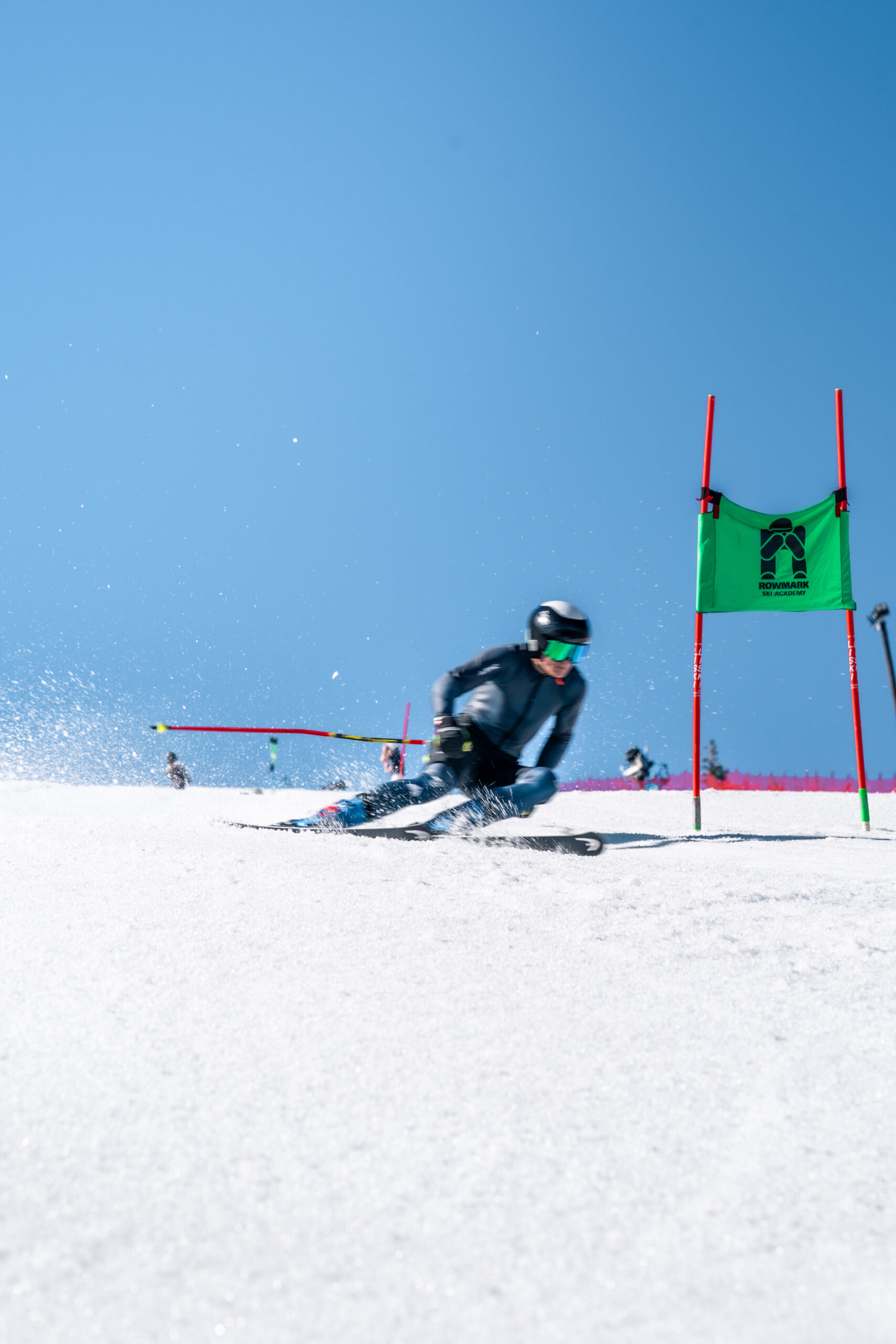
Eventually, this progression must move onto snow. An athlete can advance from controlled free skiing to greater speed, steeper terrain, harder snow and higher edge angles. Course setting, fatigue and the uncertainty of racing add further demands.
Each step increases mechanical stress, sensory information or perceptual demand. The objective is not merely to tolerate more. The athlete must maintain movement quality, timing, pressure control, edge control and posture as the environment becomes more difficult.
In this context, technical skiing is more than executing a prescribed movement. It requires the athlete to maintain an effective movement pattern while regulating increasing mechanical and perceptual demands.
This creates a continuum between physical preparation and skiing. Strength develops force capacity. Reactive training develops rapid force regulation. Perturbation and movement training challenge neuromuscular control. Skiing provides the environment in which those qualities must be integrated.
The athlete moves from force capacity to force regulation, coordinated expression and performance under uncertainty. The goal is not to remove the nervous system’s regulatory mechanisms. It is to expand the conditions under which the athlete can remain coordinated and express their physical potential.
Four Components of Force in Skiing
This framework helps distinguish four connected components of performance:
- Force capacity describes what the athlete is physically capable of producing.
- Force expression describes what the athlete produces in a given situation.
- Force utilization describes how effectively the athlete transfers that force through the body and into the skis and snow.
- Force timing describes when the athlete produces that force.
In alpine skiing, these qualities cannot be completely separated. An athlete may possess enormous force capacity but express too little of it. The athlete may also produce force at the wrong time or fail to transfer it effectively through the skis.
Absolute force matters, but the ability to coordinate and time that force may be equally important. This helps explain why athletes with similar physical testing results can perform very differently on snow.
The limitation may be physical. The athlete may lack the strength, power, mobility or tissue capacity the task requires. It may be neurological: The athlete possesses the capacity but cannot consistently access or coordinate it under the demands of skiing.
The limitation may also be technical. The athlete can produce force but cannot organize it effectively through the ski-snow interaction. Finally, it may be perceptual or protective. As speed, terrain, snow conditions or consequences increase, the nervous system may adopt a more conservative movement strategy.
These distinctions lead to different training solutions. A physical limitation requires greater capacity. A neurological limitation may require opportunities to access and coordinate that capacity under progressively demanding conditions. A technical limitation requires better transfer of force into the skis and snow.
If the limitation is perceptual or protective, adding strength alone may accomplish little. The athlete may need progressive exposure to the speed, force, terrain and uncertainty that trigger the more conservative response.
Building Access to Capacity
Ultimately, the training question is more interesting than simply asking whether an athlete is stronger. Can the athlete remain strong when the environment becomes difficult? Can the athlete access and regulate force at speed, under pressure and in uncertain conditions?
We are not simply building capacity. We are building access to capacity.
As athletes develop a greater physical reserve, they must also experience progressively demanding movement and environmental conditions. That process gives the nervous system opportunities to adapt while the athlete maintains the desired movement pattern.
Elite skiing is not simply about producing force. It is about continuously regulating force, constraining it when necessary and releasing it when appropriate. It also requires the athlete to transfer force through the body and skis at the right moment.
The best athletes are not necessarily those who can produce the greatest force in isolation. They are the athletes who can access, coordinate, time and use the appropriate force while the environment continually changes.
That may be the defining characteristic of high-level performance: not simply possessing more capacity, but having more of that capacity available when it matters.
Final Thoughts
Rowmark Ski Academy is committed to advancing knowledge within the U.S. ski community. Through future Science Corner articles in Ski Racing Media, the academy aims to share insights that support athlete development across clubs and regions.
Explore more research and athlete-development insights in the Rowmark Science Corner series.
Research Referenced
- Franchi, M.V., et al. (2019). Maximal Eccentric Hamstrings Strength in Competitive Alpine Skiers: Cross-Sectional Observations From Youth to Elite Level.
- Helm, M., et al. (2019). The Relationship Between Leg Stiffness, Forces and Neural Control of the Leg Musculature During the Stretch-Shortening Cycle Is Dependent on the Anticipation of Drop Height.
- Kidgell, D.J., et al. (2015). Increased Cross-Education of Muscle Strength and Reduced Corticospinal Inhibition Following Eccentric Strength Training.
- Nordin, A.D., and Dufek, J.S. (2016). Neuromechanical Synergies in Single-Leg Landing Reveal Changes in Movement Control.
- Verkhoshansky, Y. V. (2007) The Training System, Journal of Sport Strength Training Methodology
About the Author: Per Lundstam