Beatrice May, Photo @Stephen R Cloutier
Beatrice May did not expect racing downhill to change the direction of her career.
The Dartmouth freshman entered the season focused on college racing, technical events and Junior Worlds. By March, the Burke Mountain Academy graduate had met the criteria for the 2026-27 Stifel U.S. Ski Team through a consistent downhill season in the NorAm Cup.
But she didn’t fully realize it was happening.
“I didn’t really, to be honest, at all until I did,” May said, when she realized the criteria was within reach. “I hadn’t really looked at the criteria because I thought it didn’t apply to me.”
May finished third in the NorAm downhill standings after recording five top-10 finishes, including a victory in the final downhill of the season and a podium finish at Whiteface Mountain in February. She missed a NorAm World Cup start position by only 30 points.
For a skier who arrived at Dartmouth this season expecting technical events and NCAA racing to define her winter, the breakthrough came from an entirely different direction.

From Easy Street to ski racing
May’s skiing story started the way many New England ski stories do: family weekends, small mountains and long days outside.
She first clicked into skis at age two and grew up skiing at Cranmore Mountain in New Hampshire before her family eventually settled in East Burke, Vermont.
Her earliest memories are not about training sessions or race results.
“I feel like my earliest memories were just laughing with my family, mostly my older brother and my dad,” May said. “My favorite trail is called Easy Street, and we would just ski it all day on the weekends.”
She sometimes skied carrying a stuffed animal.
“It was a lot of fun,” she said.
May joined Cranmore’s U10 race program at age eight, but skiing still felt playful more than structured. By U12, that changed.
“I realized that I really wanted to keep doing it and it became something that was super important to me,” she said.
Her older brother helped shape the path ahead. He raced before her, attended Burke Mountain Academy and introduced May to the world she eventually hoped to join herself.
How Burke Mountain Academy shaped her development
For ambitious ski racers in the East, Burke Mountain Academy has long represented one of the sport’s most respected development programs. For May, the connection formed naturally.
She trained with Burke coaches during camps at Mount Hood and Loveland while still skiing in New Hampshire. The impact was immediate.
“They were just so great to me, and I felt like I learned so much and improved so quickly,” May said.
Ashley Davenport became one of the most influential coaches in May’s development. Before her family fully relocated to Vermont, May even stayed with her family during part of middle school while continuing to train with Burke.
“She supported me through all that,” May said.
Eventually, the entire family moved to East Burke, where May spent her academy years as a day student living just down the road from campus.
Looking back, she believes Burke shaped far more than her skiing.
“The community is so strong and the coaches and all the staff care so much about you,” May said. “It just really forces you to figure out what you want and how you can find success and what habits work for you.”
Those lessons stayed with her.
Dartmouth introduced a different kind of pressure
May arrived at Dartmouth with high expectations for herself. The transition proved more difficult than she anticipated.
Individually, she already knew many of the hills and competitors from years of racing in the East. Mentally, though, NCAA skiing felt completely different.
“It’s like turning ski racing into a team sport,” May said.
Suddenly, every run carried weight beyond her own result.
“If you DNF, it’s kind of also on everyone,” she said.
The team environment brought energy and purpose but also added pressure that took time to understand.
May admitted her freshman season did not produce the results she hoped for, but the experience accelerated her growth.
“I certainly learned a lot,” she said. “I feel like I’m excited, hopefully to have more seasons, and I can adjust.”
The opportunity itself still meant everything to her.
While competing at NorAm races in Panorama, British Columbia, May opened the Dartmouth acceptance communication.
“It was such a great feeling,” she said.
Junior Worlds in Narvik became a career highlight
Above the Arctic Circle, surrounded by Norwegian fjords and Northern Lights, May experienced her first FIS Junior World Ski Championships this winter in Narvik, Norway.
Qualifying for the team had been one of her biggest motivations since the start of the season.
“That was my biggest goal for this season,” she said. “It was something that I’ve wanted to do for many years.”
Representing the United States on that stage was enormously meaningful, especially because she competed in every event that was contested: Team Combined, Super-G, Giant Slalom and Slalom. The downhill was canceled due to weather conditions.
“I’ve never really been able to represent the U.S. on that scale,” May said. “So to be able to do it also in all events — it was just a super cool experience all around.”
Narvik itself left a lasting impression.
May had never traveled that far north before. During the trip she saw the Northern Lights for the first time while training above the Arctic Circle before the championships began.
“It was so pretty,” she said. “That was bucket list.”
The downhill breakthrough that changed everything
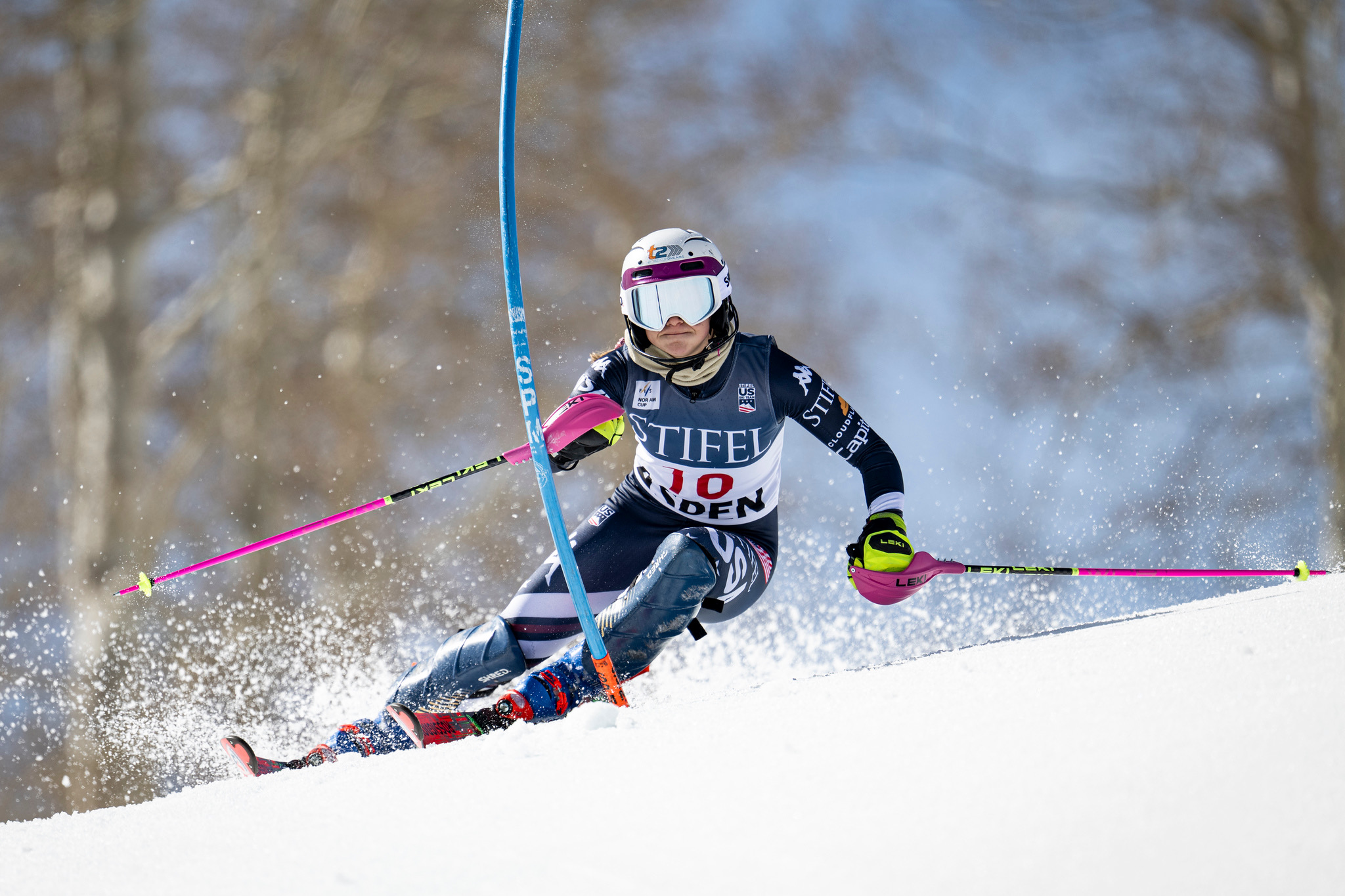
Despite her background in technical skiing, downhill became the discipline that changed May’s trajectory.
The consistency stood out immediately.
Other than one DNF on Copper Mountain, May finished in the top 15 in every NorAm downhill she completed. Five of those finishes landed her inside the top 10.
The results came despite almost no formal speed preparation before the season.
“It had been almost like 10 months since I last skied speed,” she said.
Many of the technical changes she focused on in giant slalom unexpectedly translated into downhill skiing.
“I think the things I was working on were patience and gradual rolling onto the new ski,” May said. “I think that very directly translates into speed.”
May also credited coaches from the regional development system, including former World Cup winner Alice McKennis Duran, for helping her continue progressing in speed events during the winter.
More than anything, though, she discovered how naturally the discipline fit her mindset.
“I enjoy it so much and I love going fast,” she said.
Can she balance Dartmouth and the Stifel U.S. Ski Team?
May now enters a completely different phase of her career.
After one season of NCAA racing, she already has Junior World Championship experience and Stifel U.S. Ski Team criteria secured.
Exactly how she balances Dartmouth and the opportunities now opening through the national team system remains undecided.
“I’m going to try to do both to some degree,” May said. “But I’m not sure.”
What is now certain is where she belongs.
One unexpected downhill season changed that conversation completely.
About the Author: Peter Lange