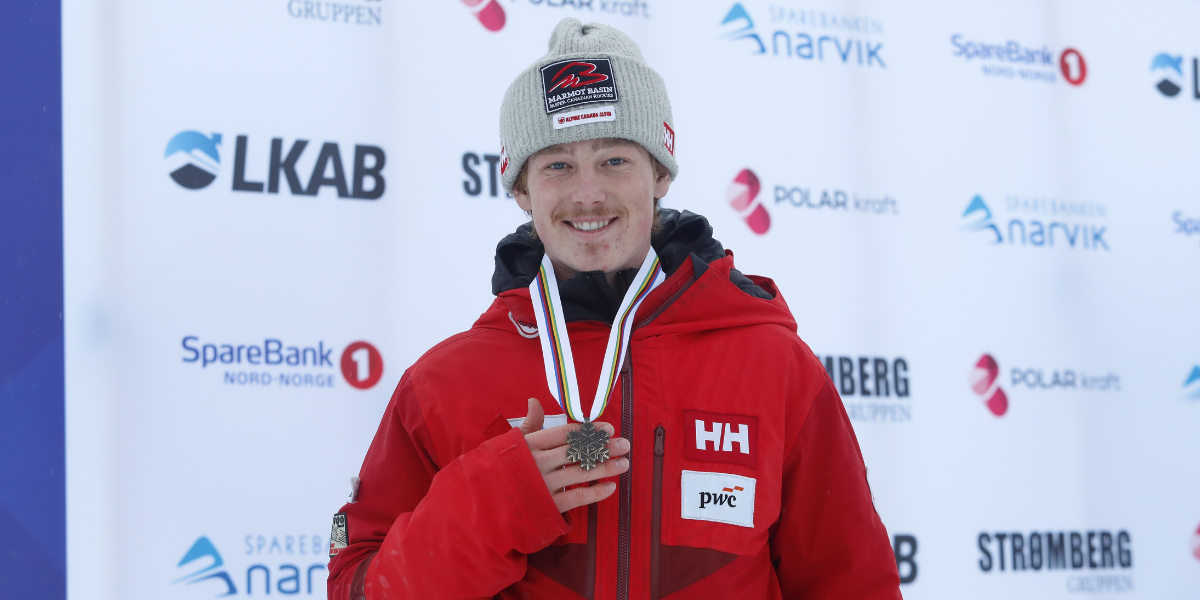
Featured Image: Jake Kertesz-Knight celebrates his bronze medal in the men’s super-G at the 2026 FIS Alpine Junior World Championships in Narvik, Norway. Photo: Kjetil Janson
Canada sent one male athlete to the 2026 FIS Alpine Junior World Championships.
At the most recent Winter Olympic Games, Canada did not start a male skier in slalom or giant slalom.
Either moment alone could reflect the circumstances of a single season. Together, they raise a broader question about the depth of Canada’s men’s alpine skiing pipeline.
Jake Kertesz-Knight, Canada’s lone male athlete at Junior Worlds in Narvik, seized his opportunity and won bronze in the men’s super-G. His result confirmed that Canadian athletes can still compete with the world’s top junior racers.
But the number itself was striking
A country with one of alpine skiing’s strongest traditions sent only a single male athlete to the sport’s premier junior competition.
A Key Development Opportunity
The FIS Alpine Junior World Championships are one of the most important events in alpine skiing’s development pathway.
For many athletes, the championships provide their first opportunity to compete against the world’s strongest junior racers. Athletes and coaches often structure entire seasons around preparing for the event.
Most Junior Worlds medalists reach the podium in their final year of eligibility after gaining experience through multiple appearances at the championships.
In alpine skiing, development takes years. Events such as the Junior World Championships play a critical role by exposing young athletes to international competition.
Alpine Canada lists a clear objective for the Junior Worlds program: provide international experience and visibility for athletes identified within the high-performance development pipeline.
In 2026, Canada sent only one male skier to the championships. For a development competition designed to expose athletes to international racing, that limited representation raises questions about the depth of Canada’s current pipeline.
Selection Criteria and a Changing Landscape
Selection for Junior Worlds begins with basic eligibility standards set by the International Ski Federation (FIS). National federations then apply additional performance criteria when selecting their teams.
For 2026, Alpine Canada evaluated athletes using factors such as world ranking, world ranking by age, and performance on the NorAm circuit.
NorAm rankings quickly became the central benchmark.
However, the competitive landscape on the NorAm circuit has changed.
Upcoming adjustments to the FIS points system place greater value on results achieved in Continental Cup competitions such as NorAm and Europa Cup. As a result, more European athletes traveled to North America this winter to compete in NorAm races, alongside a growing number of foreign NCAA athletes racing on the circuit.
The standings reflected that shift. In both slalom and giant slalom, non-North American athletes occupied many positions inside the Top 30 NorAm rankings.
When qualification standards remain unchanged while competition intensifies, fewer domestic athletes reach those benchmarks.
Several Canadian racers approached the criteria but ultimately missed the threshold, leaving Canada with a single male athlete at the championships.
That limited representation also carries competitive consequences. With only one male skier at the event, Canada cannot enter the men’s team combined or the mixed team parallel, eliminating additional medal opportunities and preventing Canadian women from competing in the mixed event.
Olympic Representation
The limited presence at Junior Worlds followed another unusual moment earlier in the season.
At the Winter Olympic Games, Canada did not start a male athlete in slalom or giant slalom.
Canada’s speed team continues to compete strongly on the international stage, but the absence of a technical skier stood out.
Olympic races follow a different structure than the World Cup circuit. World Cup events feature large start lists, while Olympic fields remain smaller because national quotas limit each country to four athletes per event.
Those smaller fields can create opportunities for athletes who regularly finish just outside the top thirty on the World Cup circuit.
Leading into the Games, Canadian skier Erik Read delivered several performances that placed him near the World Cup second-run threshold in technical events. In multiple races he missed qualification by only a few hundredths of a second. Earlier in the season he finished 20th in giant slalom in Schladming, showing his ability to convert opportunities when they appear.
Several smaller alpine nations entered athletes in Olympic technical events.
Canada did not.
For a country with Canada’s alpine skiing history, both moments stand out.
Representation at major events matters beyond results. When athletes see their country competing across disciplines and levels, they recognize a pathway forward. That visibility builds momentum within the system and strengthens the culture that encourages young racers to keep pushing toward international competition.
A Question of Depth
Strong alpine skiing programs rarely depend on one or two standout athletes.
They depend on depth.
Depth comes from groups of racers who push each other forward as they move through the development system.
Across many regions in Canada, fewer male athletes continue racing through their late teenage years. Participation remains strong at younger levels, but numbers often decline during the U16 and U18 stages.
Canada previously produced generations of racers who progressed together from NorAm racing to the World Cup, strengthening each other through strong domestic competition.
When fewer athletes move through the system, the impact appears years later at the highest levels of international racing.
Structural Pressures
Several factors shape the size of Canada’s alpine pipeline.
Cost presents one of the largest barriers. At the FIS level, travel, coaching support, equipment, and race schedules often push annual expenses into the tens of thousands of dollars.
The NCAA system has therefore become an important pathway for Canadian athletes. University programs allow racers to pursue both high-level competition and education, often supported by scholarships.
Many European nations also operate centralized ski academies, where athletes combine education, training, and daily life within a single high-performance structure.
Canada operates fewer centralized environments, forcing many athletes and families to manage training and logistics independently.
Another issue often discussed within the Canadian ski community involves the absence of a dedicated national men’s technical team.
The national development structure has also changed in recent years. Canada spent several seasons without a dedicated men’s development team, shifting greater responsibility to Provincial and Territorial Sport Organizations (PTSOs).
Without a national development structure, expectations within the system shifted. Provincial programs carried the responsibility to produce international results while preparing athletes for progression to the national team.
Athletes and families responded by exploring alternative pathways, including independent programs and NCAA opportunities. As those alternatives expanded, the pathway toward the national team became less clearly defined.
Canada has now re-established a national development team, but important questions remain. How will the broader system adapt to this new reality? How should provincial programs measure success for athletes progressing through their ranks? Has leadership provided a clear vision for the new stepping stone along the pathway?
Where Change Could Come From
No single organization controls the depth of Canada’s alpine skiing pipeline.
The system includes clubs, provincial programs, national leadership, university teams, and private training environments.
In most national sport systems, leadership at the top defines the direction of the development pathway.
At the national level, Alpine Canada’s leadership shapes priorities that influence selection frameworks, development strategies, and the integration of pathways such as NCAA racing into the national team system.
Clear alignment between national leadership, provincial programs, clubs, and athlete pathways allows successful ski nations to maintain depth over time.
Looking Forward
Canada’s alpine skiing history proves that the country can produce world-class racers. Jake Kertesz-Knight’s podium at the 2026 Junior World Championships shows that the talent still exists.
The larger challenge involves keeping enough athletes in the system long enough for that talent to emerge.
Canada may need to expand development opportunities, adjust how it interprets selection criteria as competitive landscapes evolve, integrate alternative pathways such as NCAA racing more effectively, and strengthen training environments that support athletes through the transition to international competition.
Leadership across the system must also define what success looks like at each stage of the pathway. Diverse training environments can strengthen the pipeline, but the system must ensure that athletes remain visible, supported, and motivated to represent Canada internationally.
Successful alpine programs do not wait for exceptional athletes to appear.
They build environments where large groups of racers push each other forward, raising the overall level of performance.
Because in alpine skiing, success rarely begins with a single athlete.
It begins with the strength and depth of the pipeline behind them.
About the Author: Katie Twible