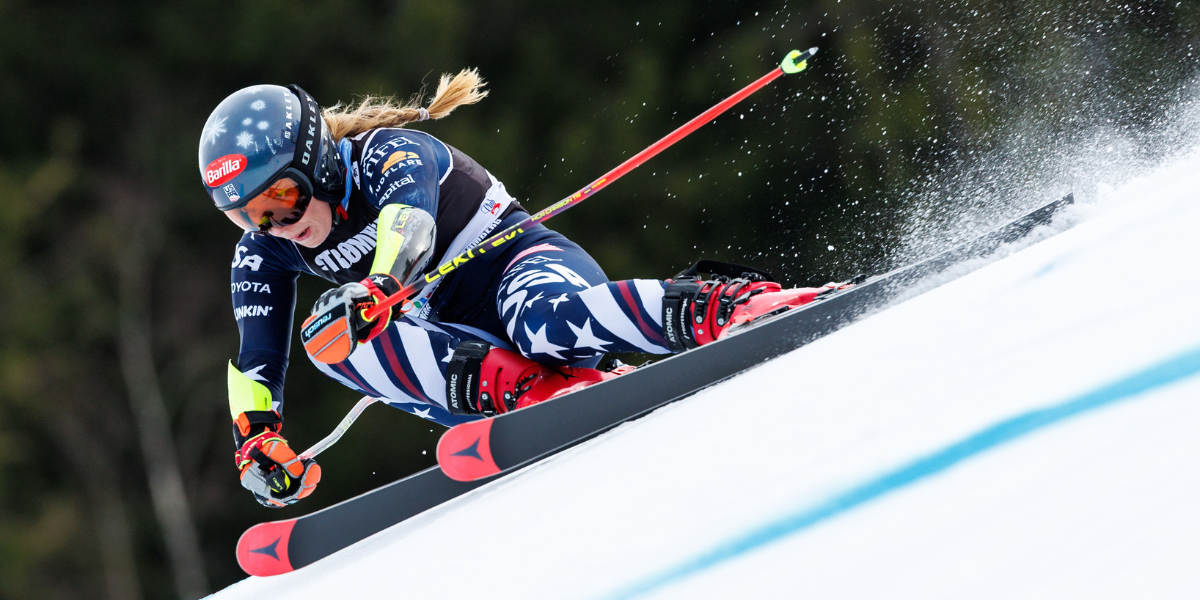
Marco Odermatt Photo: GEPA pictures
The Far West Development Initiative (FWDI), supported by Melissa and Martin Huml, created The Young Skier’s Guide: Fundamentals of Ski Racing to support the development of U14 racers. Fortunately, it benefits all ages. Ron LeMaster’s stunning photos and videos lead the teaching. Additionally, Ron Kipp’s text offers valuable support. Ski Racing Media is pleased to publish nine articles highlighting the book’s key concepts. The concept covered in this article is “Edge Angle,” the eighth in the series.
The Role of Photos and Photomontages
The amazing Ron LeMaster photos aim to immerse athletes in the images of ski racers, helping them internalize the technique through their neuromuscular system. Athletes then replicate the “technique” their coaches teach, aligned with these concepts.
The Nine Essential Concepts
- Upper Body Facing Downhill
- Equal Ankle Flexion
- Turn Connection/Transition
- Inclination
- Angulation
- Long Leg/Short Leg
- Pressure in the Fall-Line
- Edge Angle
- Balance Against the Outside Ski
Click on images to enlarge.


Edge Angle
Explanation:
The angle between the ski base and the snow surface. It ranges from a flat ski with zero edge angle to a more significant edge angle as the ski tips up.
When does edge angle occur?
The edge angle constantly increases or decreases every moment of the turn cycle.

Why is an edge angle important??
The edge angle creates a skidded or carved turn. Increasing the edge angle decreases the turn radius.
What is the turn radius?
The turn radius is the product of the edge angle and the skis’ radius. Put simply, it is the cosine of the edge angle multiplied by the sidecut. For example, a 45-degree edge angle with a 15-meter ski has a turn radius of about 10.6 meters (cos of 45° = .707) * 15 = 10.6.
Can there be too much edge angle?
The platform angle is the line of force from the skier’s center-of-mass (CoM) to the ski base. If the platform angle is 90 degrees or less, the ski holds. If the skier banks and the platform angle exceeds 90 degrees, the ski will skid sideways. While the edge angle deals with the ski and the snow, we need to look at the skier’s CoM in relation to the edge angle.


Example of Exceptions:
A long-gliding section during downhill.
What to look for:
A carved turn where the ski tail follows the tip’s path. During most turns, the edge angle should be maximal at the gate passage (fall line).


Remember:
It is not just the extreme edge angle but also how it was tipped up and the pressure applied.
What it looks like if not executed properly:
A skier without angulation: backseat or any non-athletic balanced postures.
What happens if not executed properly?
The skier skids.
Drills:
Sideslip with edge sets, One-legged sideslip with edge sets, Hockey stops, Garlands, Outrigger pole drag, Schlopy drill, Carry the torch, Outrigger pole drag, Outside pole drag, 2-0-2.
Talking points or cues:
“Touch your left knee to right boot cuff,” “Release or start your turn with your ankles,” and “Stand on the side of your boot.”

About the Author: Ron Kipp