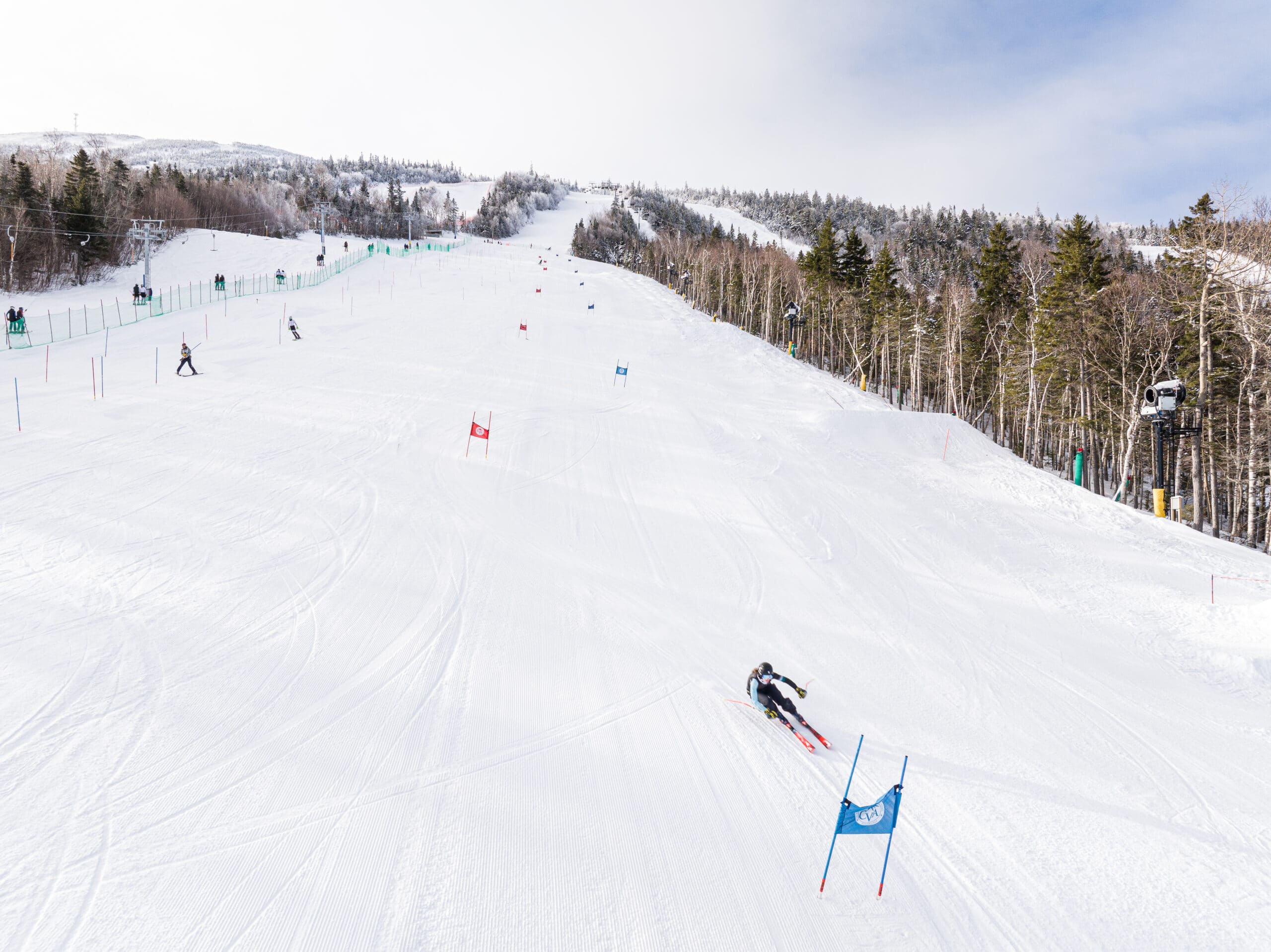
Featured Image: The Podium Project expanded training venue at Sugarloaf Ski Resort. Image provided by Carrabassett Valley Academy
Carrabassett Valley Academy (CVA) is committed to giving all their athletes the opportunity to reach their full potential, with the intent to ski more with higher quality; the expanded race venue created through The Podium Project has leveraged that goal at CVA.
In 2021, Kirk Dwyer, the Alpine Program Director at CVA, collaborated with others to orchestrate The Podium Project at the Sugarloaf Ski Resort in Maine, striving to achieve their strategic vision.
Within its first two years of fully being open, the training venue has already assisted tremendously in achieving the vision, which included the goals of:
- Increase training days
- Focus on repetition and volume
- Positively influence team camaraderie
- Fulfill different training strategies
- Provide the ability to train on a variety of course lengths
- Reduce lift lines at Sugarloaf Ski Resort
- And more…
You Don’t Know What the Podium Project is? Let’s Summarize it!
The Podium Project is the result of a partnership between CVA, Sugarloaf, the Sugarloaf Ski Club, Colby, and the University of Maine at Farmington. The project took two excellent training hills, Narrow Gauge and Competition Hill, to the next level by installing state-of-the-art snowmaking, expanding hill space, and installing a high-speed surface lift.
The CVA/Colby T-bar opened in December of 2022. The venue is now named the Beth Kubik Training Venue.
To make this project a reality, over $1,600,000 was raised through organizations and companies for the venue and the venue name.
In the process of figuring out what was needed for the new venue, Kirk Dwyer explained, “We had to look at our strengths and weaknesses, as well as the larger issues of the sport.”
Dwyer hinted at the importance of forward-thinking when considering the various obstacles that alpine ski racing will encounter in the future while venue planning.
He discussed the increased expenses of alpine ski racing, the impact of climate change, the need for developing athletes to practice on diverse terrain, the optimal training duration for athletes, and the importance of providing freeskiing space.

Optimal Training Accelerated with the New T-bar
“On the existing expanded venue, the hill space can now fit up to four GS courses and seven slaloms. Additionally, with the T-bar, you can access two to three more GS courses on the adjacent Narrow Gauge, so it just leveraged what we had for existing venues,” Dwyer explained.
Dwyer further discussed how, during the first two seasons of utilizing the expanded venue, including the T-bar, he has seen a variety of positive impacts for the athletes and coaches at CVA.
Repetition and Volume
Volume and repetition for the CVA program were desired aspects gained from the T-bar installation. The existing Narrow Gauge racing venue offered stellar full-length courses, but Dwyer elaborated on the need for quick turnaround time on runs and more capability to train in varying weather conditions.
Dwyer stated, “Our athletes needed the ability to get more repetition, and on weekends when it’s crowded, the weekend program kids are able to get many more runs in.” With a lift ride time of 2-minute and 15-seconds, athletes can get more laps and never have to leave the venue.
He continued in regards to operating in inclement weather, “As for the weather, chair lifts can close because of wind, but the T-bar has largely run regardless of the weather.”
Mentorship
Daniel Coyle, who wrote The Talent Code, presented the terminology called the ‘hotbed,’ which Dwyer used to explain the dynamic of the venue and close relationships between the CVA athletes and Colby College high-level racers.
He stated, “Training shorter-length courses encourages skiing at higher tempos (time per gate) than an athlete’s norm. This fosters a “hotbed” environment where individuals remain in close proximity to their peers and, alongside stronger and faster skiers, is conducive to higher levels of pace. We enjoy a great benefit from frequent training adjacent to Colby College and the ability for our strongest skiers to train with Colby.”
He also mentioned that the venue allows for the CVA students to work closely with the University of Maine in Farmington, which is one of the top USCSA schools.
“The combination of the Weekend Program kids, college skiers, and academy skiers all training together is really cool,” Dwyer stated.

Camaraderie, Enthusiasm, and Motivation
In the past year, CVA has noticed an increase in the team’s camaraderie, enthusiasm, and motivation due to the venue expansion.
Dwyer stated, “On the T-bar ride, everyone is in close proximity watching one another, which makes it really fun, and they tend to feed off one another.”
By adding a high-repetition environment, the athletes are getting 20+ laps during a session, which can sound daunting. However, within the CVA program, they have noticed that the students are having fun while working hard and are highly motivated while lapping runs.
“Skiing is hard work. To take 20 runs, you have to be very motivated, but the kids in that environment are having fun, too. And you have to have fun to take 20 runs,” he continued. “Also, the efficiency of training makes resetting courses normal rather than an exception, providing athletes motivation to train more runs, while increasing stimulus for improvement.”
Increased Coach Interaction
Over the past year in the CVA program, the coaches have adjusted to the variety of short and long runs. They are figuring out how to regularly change up course sets, especially in the condensed T-bar section, so that it remains interesting for the athletes.
CVA’s program and coaches strongly believe that the appropriate mix of short and full-length courses is a key element of quality training, so they are all joining forces to ensure that they optimize that.
Furthermore, with the T-bar, coach-athlete interactions are more frequent, which builds on the basis of respect, trust, and support.
“There is a lot of mentoring and interaction between coaches and athletes, which you just don’t get when you’re training on a chair,” Dwyer stated.
The Overall Impact and Future Goals for the Podium Project
Dwyer was very confident in his response after being asked if the venue upgrades had a positive impact on CVA’s athletic performances.
“Yeah, definitely, but it takes time. Over my experience, it takes maybe five years [for changes to see big impacts], and rather than doing a lot of recruiting from outside of Sugarloaf, we’re primarily trying to develop from within.”
He continued to give praise to several of the athletic achievements performed last season.
Also, the program understands that the core of their athletes comes from their junior program, which they have been working on building up, positively influencing retention rates. They have seen a spike in their retention of junior athletes heading into their alpine program.
Dwyer stated, “Look at our alpine numbers; last year we had 52 alpine athletes at CVA, and this year we will have 70.”
CVA’s main objective this year, working together with Sugarloaf, is to kick off T-bar training by November 15th to 18th, marking the earliest start to the program’s training. They also hope to promote and provide training for other eastern programs throughout the season.
The foundation that owns Ski Racing Media and SYNC Performance, was delighted to contribute a financial donation to the Podium Project.

About the Author: Ellie Hartman