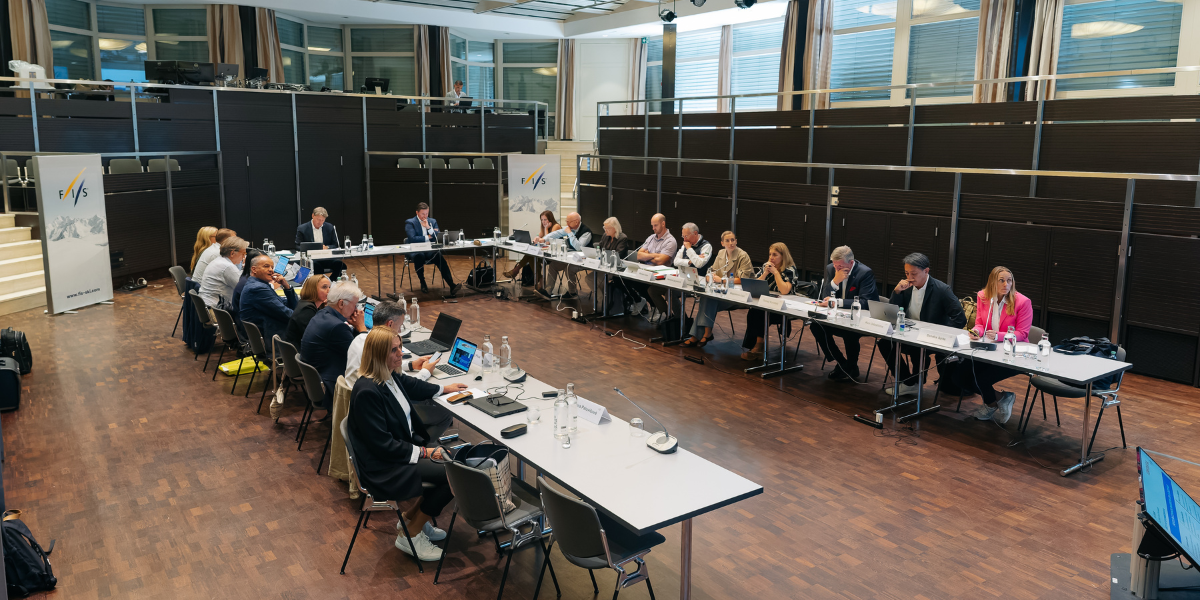
Featured Image: FIS Council meets in Thun, Switzerland/FIS
The FIS Council has advanced plans that could significantly change the structure of international ski racing, including more frequent World Championships, a long-term World Cup calendar and standardized wild-card rules. It also approved a pathway for eligible Russian and Belarusian athletes to compete as neutrals during the 2026–27 season.
The International Ski and Snowboard Federation is considering a series of major structural changes that could reshape the future of alpine ski racing.
During a two-day meeting in Thun, Switzerland, the FIS Council addressed the frequency of World Championships, the construction of World Cup calendars, wild-card regulations and the return of eligible Russian and Belarusian athletes under neutral status.
The decisions are significant. However, several remain at the concept or development stage, with many of the details still to be determined.
FIS explores holding World Championships more frequently
The FIS Council agreed with the concept of increasing the frequency of World Championships beginning in 2032.
Under the proposal, World Championships would continue to be held in odd-numbered years but could also take place during even-numbered, non-Olympic years.
FIS is also open to exploring whether an additional edition could be held as early as 2028.
Currently, the Alpine World Ski Championships take place every two years in odd-numbered years. Adding championships in non-Olympic even years could create a major international title event during nearly every season.
The proposal followed a preliminary feasibility study examining sporting value, calendar considerations and commercial and media-rights potential. A more detailed assessment will be required before the change moves forward.
For alpine racing, the impact could be substantial.
Additional World Championships would create more medal opportunities for athletes and more high-value inventory for broadcasters, sponsors and commercial partners. They could also increase the number of cities and resorts able to host a major FIS championship.
At the same time, another championship would add pressure to an already demanding calendar. National teams would need to manage travel, athlete preparation and budgets around more frequent title events. Organizers would also be competing for space within a season that already includes the World Cup, Olympic Games and domestic championships.
The proposal raises another important question: Would more World Championships increase the sport’s visibility, or reduce the significance of an event that has traditionally been held every other year?
FIS has not yet provided a proposed format, host-selection process or detailed timeline beyond the possibility of beginning in 2032—or potentially 2028.

A long-term World Cup calendar moves forward
The Council approved the core principles of a long-term FIS World Cup calendar across all disciplines.
The proposed approach would consider regional calendar clusters, the development of emerging markets while protecting established markets, and a new “Calendar Impact Score” for each event.
Regional clusters could allow the World Cup to schedule events geographically, potentially reducing repeated travel between continents and distant regions.
For alpine teams, that could help limit costs and logistical strain. It could also reduce the physical demands placed on athletes and staff during a season that regularly involves extensive travel across Europe and North America.
However, the effect will depend entirely on how the calendar is built.
A focus on emerging markets may create new commercial opportunities for the sport, but it could also affect traditional venues that have been part of the World Cup circuit for decades. FIS has not yet explained how the Calendar Impact Score will be calculated or how heavily it will influence which organizers receive World Cup races.
Potential factors could include financial strength, audience reach, sustainability, broadcast value, snow reliability and the quality of the competition venue. FIS has not confirmed the criteria.
The proposal will now return to FIS management and eventually move to the Media Rights Executive Board. A draft long-term calendar is expected to be submitted to the Council for approval following the Autumn Meetings.
Until that draft is presented, no specific alpine venues or races have been added, removed or repositioned.
Standardized wild-card rules are under development
FIS also approved the principle of creating a common wild-card framework across its disciplines.
The framework is expected to address objective achievement criteria, a fixed number of starts, a defined eligibility period, anti-doping compliance and safety controls.
Each discipline would then establish its own requirements, including performance thresholds and the effect wild-card entries could have on seeding and national quotas.
Wild cards have become an increasingly important subject in alpine racing. They can bring high-profile athletes into World Cup fields and generate valuable attention for events, but they also raise questions about competitive access, qualification standards and fairness.
A standardized framework could provide greater clarity for athletes, teams and organizers. The most consequential details, however, have not yet been written.
FIS plans to develop the regulations over the coming months, with a final version targeted for approval by the Technical Committees and the Council in spring 2027.
Neutral pathway approved for Russian and Belarusian athletes
The Council also approved the conditions under which athletes and support personnel of Russian and Belarusian sporting nationality may be granted access to FIS competitions during the 2026–27 season.
Approved athletes would compete only in individual events and would not be permitted to use national flags, anthems or uniforms. They must sign a declaration of neutrality, meet all applicable anti-doping requirements and remain subject to continued compliance monitoring.
FIS stated that sanctions could be imposed if an athlete or support person breaches the neutrality requirements.
The decision does not mean every Russian or Belarusian athlete is automatically eligible to compete. Individuals must apply for and receive neutral status under the FIS conditions.
FIS has not yet announced which athletes or support personnel will be approved or when they could begin appearing in competitions.
The decision follows recent actions by the International Olympic Committee regarding the participation of individual neutral athletes.
What happens next?
The FIS announcement signals the direction the federation wants to explore, but it does not finalize many of the changes.
The long-term calendar still requires further development and Council approval. The detailed wild-card regulations are not expected to be finalized until spring 2027. The possibility of additional World Championships requires further assessment, and individual decisions regarding neutral athletes have not been announced.
Still, the Sept. 3 meeting could mark the beginning of a significant shift in how international alpine racing is organized and commercialized.
More World Championships could create new opportunities for athletes, hosts, media companies and sponsors. A regionally clustered calendar could reduce travel demands, while a venue scoring system could change how races are awarded and retained. Standardized wild cards could clarify athlete access, and the neutral-athlete policy will likely generate significant discussion throughout the ski racing community.
The next rounds of meetings—and the details that emerge from them—will determine whether these concepts become meaningful reforms or remain proposals.
About the Author: SR Staff Report