Franjo von Allmen / GEPA pictures
Swiss alpine skiing has a new global star—and his influence is no longer confined to the racecourse. Franjo von Allmen, fresh off a historic performance at the 2026 Winter Olympics, has been nominated for the prestigious Forbes 30 Under 30 Europe list, placing him among the continent’s most impactful young figures across sport, business, and culture.
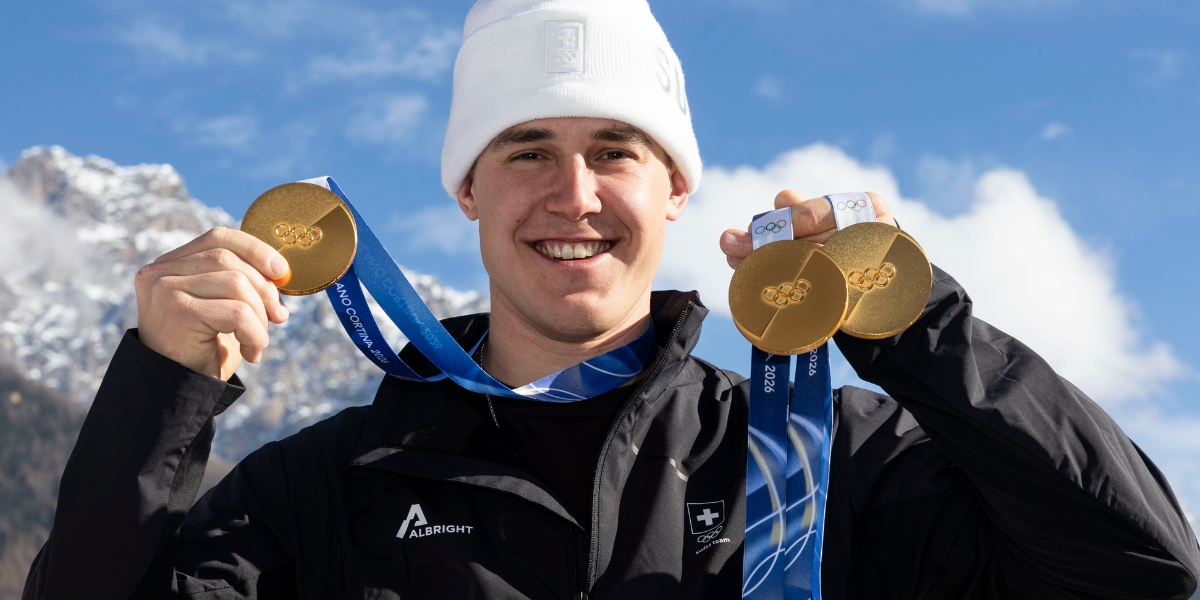
At just 23, von Allmen delivered one of the most dominant Olympic campaigns the sport has ever seen. Competing in his first Games, he captured three gold medals—downhill, super-G, and the team combined alongside Tanguy Nef—establishing himself as the most successful male alpine skier of Milano-Cortina 2026.
The Swiss star’s triple-gold performance places him among the most accomplished Olympic alpine skiers in history.

What Made This Olympic Run Historic?
Greatness in alpine skiing is often measured over seasons. Von Allmen compressed it into a single Olympic fortnight.
Only two men before him—Austria’s Toni Sailer in 1956 and France’s Jean-Claude Killy in 1968—had ever won three gold medals in a single Olympics, sweeping the downhill, giant slalom, and slalom.
Von Allmen joins that company—but his path was different.
Sailer and Killy achieved their three gold medals across individual events. Von Allmen’s third came in the team combined, making the comparison historic, but not identical. His accomplishment still places him in rare company, while reflecting the evolution of the sport.
The way he did it matters just as much as the result.
Downhill demands courage at the limit. Super-G requires the same level of commitment—but with more turns and far less familiarity. There are no training runs; only a single course inspection, forcing athletes to process terrain, line, and speed in a single look and then execute at full intensity.
Across downhill and super-G, von Allmen proved his ability to push the limit in two of the sport’s most demanding speed disciplines. In the team combined, it was the same downhill challenge—but with a different weight. The team dynamic brings a unique kind of pressure, knowing every move directly impacts a teammate and the final result.
In Cortina, von Allmen delivered the downhill leg at full speed, setting the tone for Switzerland. His partner, Tanguy Nef—a former All-American at Dartmouth College—was well accustomed to that shared responsibility from his days racing in the NCAA. He answered with the fastest slalom run in the field, sealing the gold.
From Olympic Champion to Forbes Nominee
Recognition from Forbes represents a different kind of milestone.
Each year, the publication evaluates thousands of candidates across Europe to assemble its 30 Under 30 list—300 individuals under the age of 30 who are driving innovation, impact, and influence. The process draws from more than 20,000 public nominations and incorporates insight from thousands of alumni and industry experts, including investors and global leaders.
Candidates are assessed on scale, innovation, measurable success, and long-term potential. The emphasis extends beyond achievement alone—focusing on those shaping industries and influencing what comes next.
Von Allmen’s Olympic success fits that profile. His performances in Milano-Cortina captured global attention, elevated the visibility of alpine skiing, and reinforced Switzerland’s position as a powerhouse in the sport. At the same time, his growing international recognition signals expanding influence beyond competition.
Why Athletes Like von Allmen Are Changing the Conversation
The Forbes 30 Under 30 list has traditionally highlighted entrepreneurs, creators, and business leaders. Increasingly, elite athletes are entering that space—not just for results, but for their broader impact.
Performance at the highest level now intersects with media visibility, commercial appeal, and cultural relevance. Athletes who succeed on the biggest stages shape narratives, attract global audiences, and influence industries connected to sport.
Von Allmen represents that shift.
His breakthrough season created more than victories. It built momentum. His presence now extends beyond start lists and finish times into a wider conversation about influence, opportunity, and the future of sport.
What Comes Next?
The final Forbes 30 Under 30 Europe list will be decided after multiple rounds of evaluation and judging.
Whether von Allmen secures a place among the 300 remains to be seen.
What is already clear is this: his Olympic breakthrough carried him far beyond the finish line. It placed him in rare historical company—even if not a perfect apples-to-apples comparison—and into a broader arena where the impact of elite performance extends well beyond the mountain.
Information source fis-ski.com
About the Author: SR Staff Report