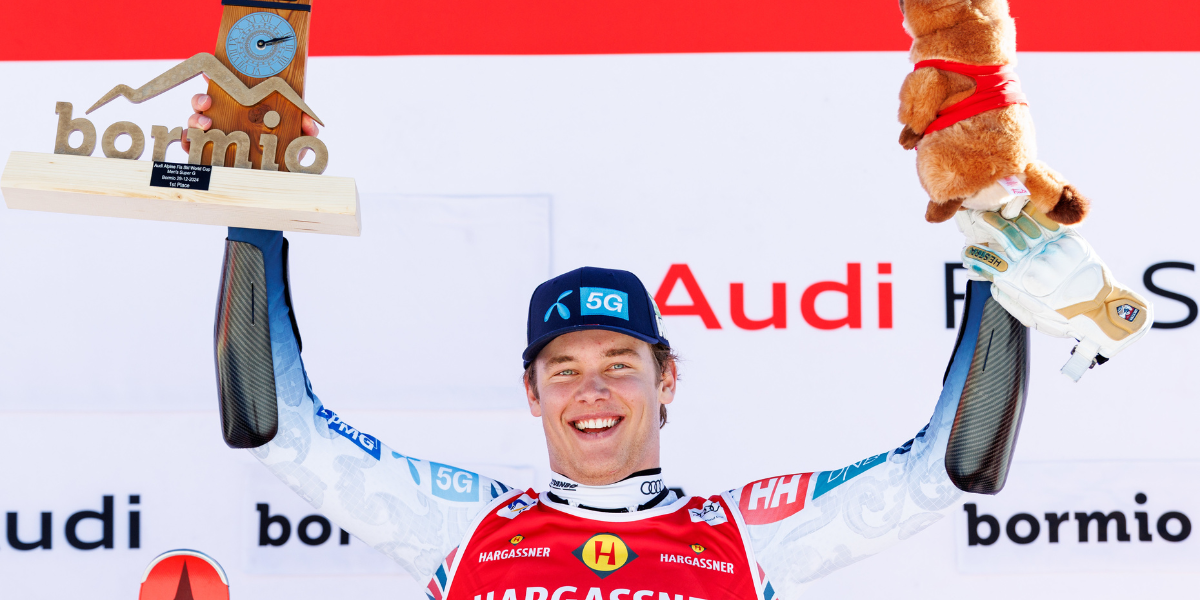
Fredrik Møller Bormio Podium: GEPA pictures
After his astonishing victory in Bormio during his second World Cup season, Fredrik Møller trails leader Marco Odermatt by only five points in the super-G World Cup standings. In an exclusive interview with Ski Racing Media, Møller talks about his progress to the top of the World Cup.
The Stelvio Victory
Only days before the Jan. 17-19 men’s World Cup race weekend on the famed Lauberhorn course in Wengen, Switzerland, Møller found time to talk with Ski Racing Media. The first topic was his impressive super-G victory two weeks earlier on the rough and icy Stelvio course in Bormio, Italy.
“That was a lot of fun,” the Norwegian says excitedly about his win while maintaining his usual calm.
“I didn’t believe before the season that I would win a World Cup race this season. That’s for sure!” he adds, chuckling.
To put the feat in perspective, remember that the Stelvio race hill is one of the most demanding on the men’s World Cup tour. Competitors usually require years of race experience on this hill to fight for a top result.
The race slope is shaded in late December when the Bormio World Cup speed races traditionally occur. The dim light makes it difficult to see the constantly uneven and bumpy surface while skiing at speeds higher than most highways allow. The Stelvio is mostly covered in solid ice, and the snow conditions tend to change as the racers approach the end of the course at a lower altitude.
Møller not only won the Bormio super-G race; he did so in his first-ever attempt.
Mental Strength
“It shows an enormous mental strength when you manage to win Bormio in your debut super-G there,” Alpine Director Claus Ryste of the Norwegian Alpine Team tells Ski Racing Media.
Ryste also points out the challenging setting during the super-G on Dec. 29, 2024. There had been several serious injuries on the Stelvio in connection with the downhill training and then the race days before the super-G, including Cyprien Sarrazin’s head injury. Then, the first competitor in the super-G race, Gino Caviezel of Switzerland, fell before the San Pietro jump, sustaining a complex knee injury and a dislocated shoulder. Caviezel had to be airlifted out of the course by helicopter. Soon after the course hold ended, Møller started with bib No. 4.
“That Møller still managed to stay calm and focus on what he was supposed to do adds to his achievement,” Ryste says.
Click on images to enlarge
Confidence on the Ice
What enabled Møller to ski faster than his competitors and secure his first World Cup victory that day?
“I had skis and boots that worked well, and my confidence was good after skiing well in the two previous races,” he explains, referring to his fourth-place finishes in the World Cup super-G competitions in Beaver Creek, Colo., and Val Gardena, Italy, earlier that month.
“But I was fairly skeptical. I hadn’t been to Bormio before and I hadn’t heard a lot of positives about [the Stelvio race course],” the sympathetic 24-year-old says.
However, the challenging downhill in previous days provided confidence.
“During the downhill training and downhill race, I could tell I had a good grip on the ice when the conditions were very difficult. So, it was just a matter of trying to give it full throttle and to be smart where you had to be smart,” Møller tells Ski Racing Media.
Why This Progress?
Last season, Møller (spelled Moeller in the international FIS system) told Ski Racing Media that he primarily focused on giant slalom training, with little time for training the speed disciplines. His packed schedule included both European Cup and World Cup racing.
Despite limited speed training, Møller impressed in his first World Cup season by finishing in the top 30 across all three disciplines: 24th in giant slalom at Val d’Isère and Adelboden, 21st in super-G at Val Gardena/Gröden, and 30th in downhill at Kvitfjell.
“I will come back stronger,” he confidently stated in an interview nearly a year ago at the Kvitfjell finish area, following a 34th-place result in the super-G there.
What changed between then and now, enabling Møller to suddenly compete among the world’s best in super-G?
“I train a lot more speed now, which shows in my giant slalom skiing—it was slightly better last year. And I’ve trained with the World Cup team this season,” Møller explains.
While currently holding C-status on the Norwegian Alpine Team—a ranking based on last season’s results, starting list position, and Ironman physical test scores—Møller has benefited from training alongside elite Norwegian teammates Adrian Smiseth Sejersted and Rasmus Windingstad. His coaches bring extensive experience from working with world-class athletes like Aleksander Aamodt Kilde, Aksel Lund Svindal and Kjetil Jansrud.
Positive with the U.S. Team
Møller described his preseason preparations as “a step up” from past years. “We’ve had a lot of good training, and we’ve been lucky with the weather and conditions,” he said, noting they lost just one training day due to heavy snowfall in Copper Mountain, Colorado.
He also highlighted the strong on-hill cooperation between the Norwegian and U.S. speed teams. The groups trained together in Chile during the preseason and later shared sessions in Copper Mountain.
How was it to work with the U.S. team?
“It’s been a lot of fun. They’re an enjoyable group to travel with, and it worked incredibly well. The level of that group is quite high, too, so if you ski well in training with them, you’re definitely near the top. It’s cool,” Møller says.
Møller’s Strengths
What makes him such a good super-G racer?
After thinking about this for a few seconds, Møller pinpoints his tactical skills and explains: “That’s an advantage in super-G when you aren’t allowed to train in the [race] course first. So, I’ll say that’s one of my greatest strengths and one of the reasons I succeed in super-G.”
He also enjoys the course sections where you transition directly from turn to turn and thinks these are parts where he has an advantage.
What does Møller consider his greatest strength?
“Oh, good question…” Once again, he thinks briefly before responding: “To put it simply, my skiing skills are my strength.”
When explaining the youngster’s super-G success this season, Ryste also highlights Møller’s extraordinary skiing abilities and strong technical base.
Long-term Focus
Møller is an athlete “here to stay,” Ryste says about the skier from the Norwegian town Oppdal and its renowned ski program. “[In Oppdal] they are very focused on ski technique, and you can see that; he has a very solid technique.” Add his mental strength, and more results will come, Ryste predicts. However, the Norwegian alpine team boss emphasizes giving Møller time to build himself up as a speed racer.
“Thinking long-term is important for all of us. And he [Møller] does that. He is very sensible and balanced,” Ryste says.
Ryste and Møller both mention that the downhill discipline typically requires more experience on challenging World Cup race venues—knowledge that can primarily be gained from annual training and race runs at each location.
Staying Calm
Møller is a generally calm person, which also characterizes his ski racing style, including in the Bormio super-G. Does Møller see himself as a calm person, and did he maintain this calmness on the Stelvio?
“Yes, I agree that I am calm. But it didn’t feel very smooth in any way down the course. It might have looked smoother than it was. But, yes, that is me—calm.”
Now, Møller and the men’s World Cup tour are heading into subsequent speed weekends on two of the greatest classics: the Lauberhorn race in Wengen, Switzerland, and the Hahnenkamm race on the Streif in Kitzbühel, Austria.
Does he feel more pressure to perform after his World Cup victory?
“I don’t really notice if there’s pressure from other people. It’s more that you wish to continue with the same good energy that you already have,” Møller says, pointing out past experiences and the importance of always sticking to the same process.
“I have won some European Cup races and so forth and remember that if I kind of thought, ‘Yes, I can handle this,’ and thought I could take on the job a little lightly in the following races, the results were usually not as good.”
Three-discipline Allrounder
A three-discipline World Cup racer’s tight schedule and total workload are heavy, especially for athletes who participate in downhill racing and its added days of official training. On top of that comes the demanding focus required when racing at extremely high speeds.
During the preseason and early race season, Møller was away from home for two months straight. Other racers from various continents go through the same. While Møller has no problem being away from home for long periods due to ski racing, he says it is always good to come home. “There’s something about living out of a bag for two months.”
The tight race schedule allows fewer training days, which is reflected in Møller’s results. Last season, he had little time for speed training. This season, there is little time for giant slalom training, which has resulted in him being outside the top 30 and earning no giant slalom World Cup points so far.
Still, he wants to stick with three disciplines and give giant slalom “a proper attempt.” In the recent Adelboden giant slalom, he started with bib 49, which makes achieving a good result more challenging. However, with more giant slalom training, he sees improvement as possible. He also hopes to score 500+ World Cup points (currently at 211), allowing him to start right after the top 30.
The Ski Racing Family
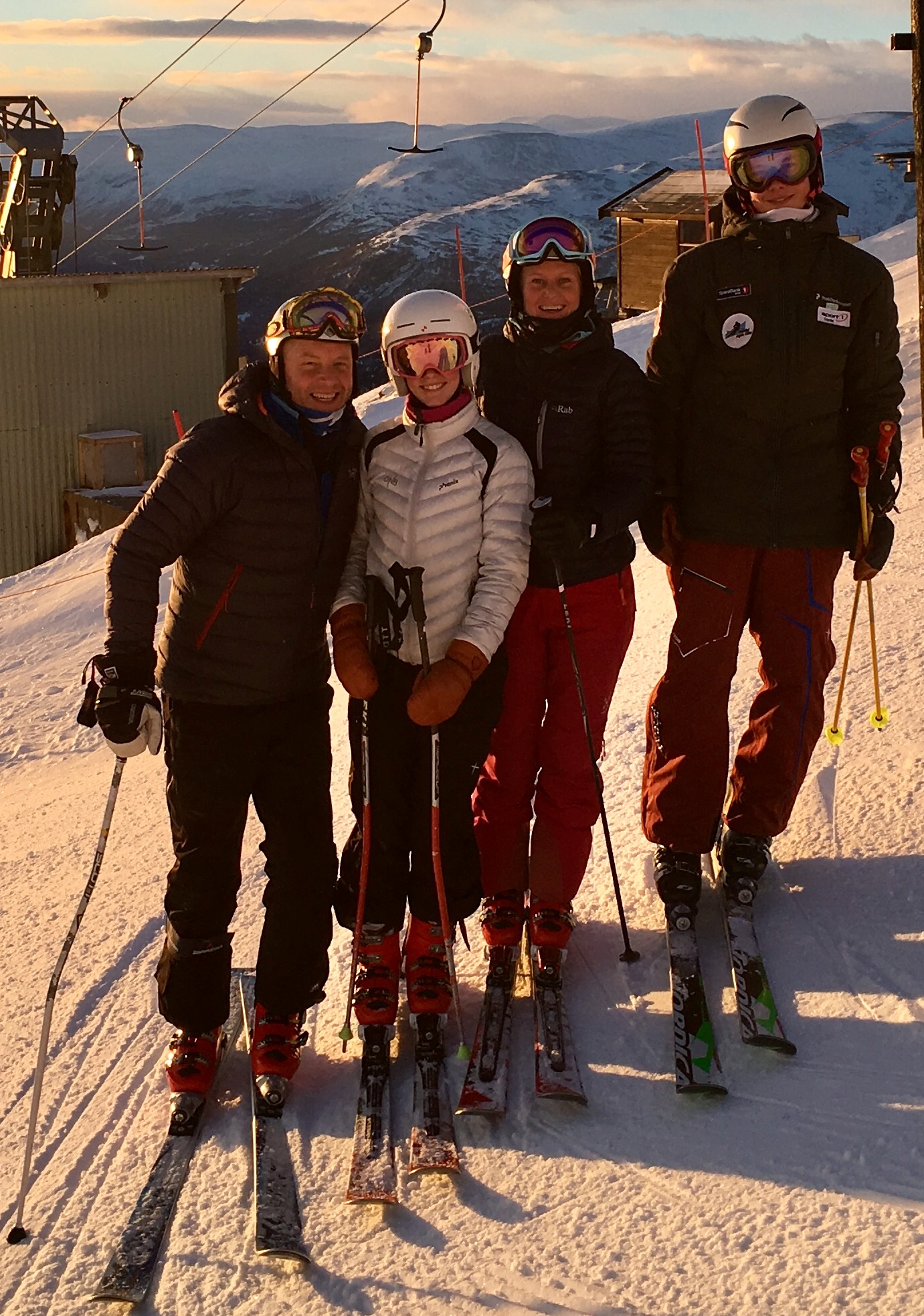
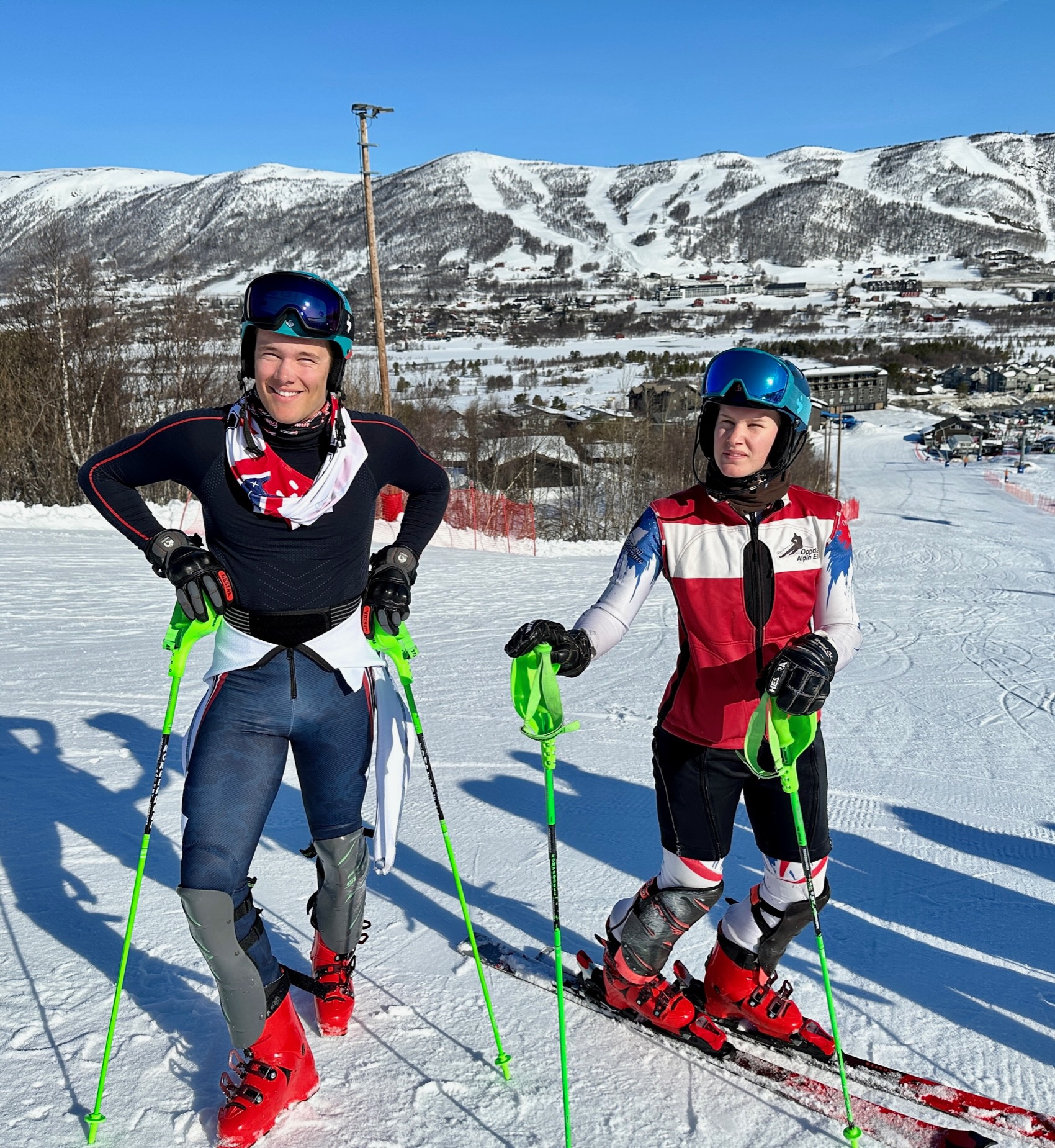
Møller laid the groundwork for his excellent skiing skills and solid technique on the ski area hills around the small, rural town of Oppdal. His parents moved the family there when he was 10 years old, from Bærum, right outside Norway’s capital, Oslo. The move ensured the sports-enthusiastic family had year-round easy access to exciting opportunities for skiing and other outdoor adventures.
All four members of the Møller family have an impressive ski racing track record:
- Hege (mom): Alpine skiing – downhill medal from the Norwegian Junior National Championships. Telemark skiing – won the World Cup overall. Ski cross – victories in the Norwegian Cup.
- Morten (dad): Alpine skiing – downhill bronze medal from the Norwegian Junior National Championships. Telemark skiing – 17 World Championship medals, including four consecutive overall victories, a World Cup overall title, and other top results. Ski cross – bronze medal in the Norwegian Senior National Championships.
- Pia (sister): Alpine skiing – bronze medal from the FIS World Junior Championships in the team parallel event; bronze medal in alpine combined from the Norwegian Senior National Championships; and FIS race victories and podiums.
Pia, two-and-a-half years younger than Fredrik, stopped ski racing after the 2023 season and is now pursuing a career in the Norwegian military. Hege coaches the successful Norwegian Para Elite Alpine Team.
Growing Up on Skis
Møller says his family’s involvement in sports and skiing has meant everything in his development. “I might not have ski raced if they hadn’t been so eager and supportive. This sport requires the parents to be involved when you go to training camps and so on at a younger age. And it is not free to participate in this sport, so without them, it would’ve been difficult.”
Møller’s father has also helped provide continuity in training through the years.
“My dad has been quite involved in my skiing career, with the ski technique. We have had many different coaches through the years, especially when we were younger. The coaches want the best for you, but you don’t always use the same lingo, so you might not always understand exactly what they mean. So, to have a dad who can tell you a bit about what you should do, especially when you struggle, has helped a lot,” Møller says about his youth.
Gradual Improvements
People in the Norwegian ski racing community describe Møller as a hard worker.
Møller says his development has been gradual, and the results have been proven in recent years, after his first years of FIS racing. “I wasn’t all that good during U14-U16 and when I started skiing FIS,” he says, and continues:
“I remember when Lucas [Pinheiro Braathen] and Atle [Lie McGrath] started having their breakthroughs while I was pretty far back in regular FIS races. And I thought it was impossible to be as good as they were.
“But then you always take some steps forward and don’t give up; do what you can to improve. And in the end, you are where you are, seeing that it isn’t so far up [to the top] as you would think. So, it’s just that I haven’t given up through the years, which is the most important. Always try your best.”
Playing in the Snow
Living in Oppdal, the Møller family spent many days a week at the ski area. What does Møller think about growing up there?
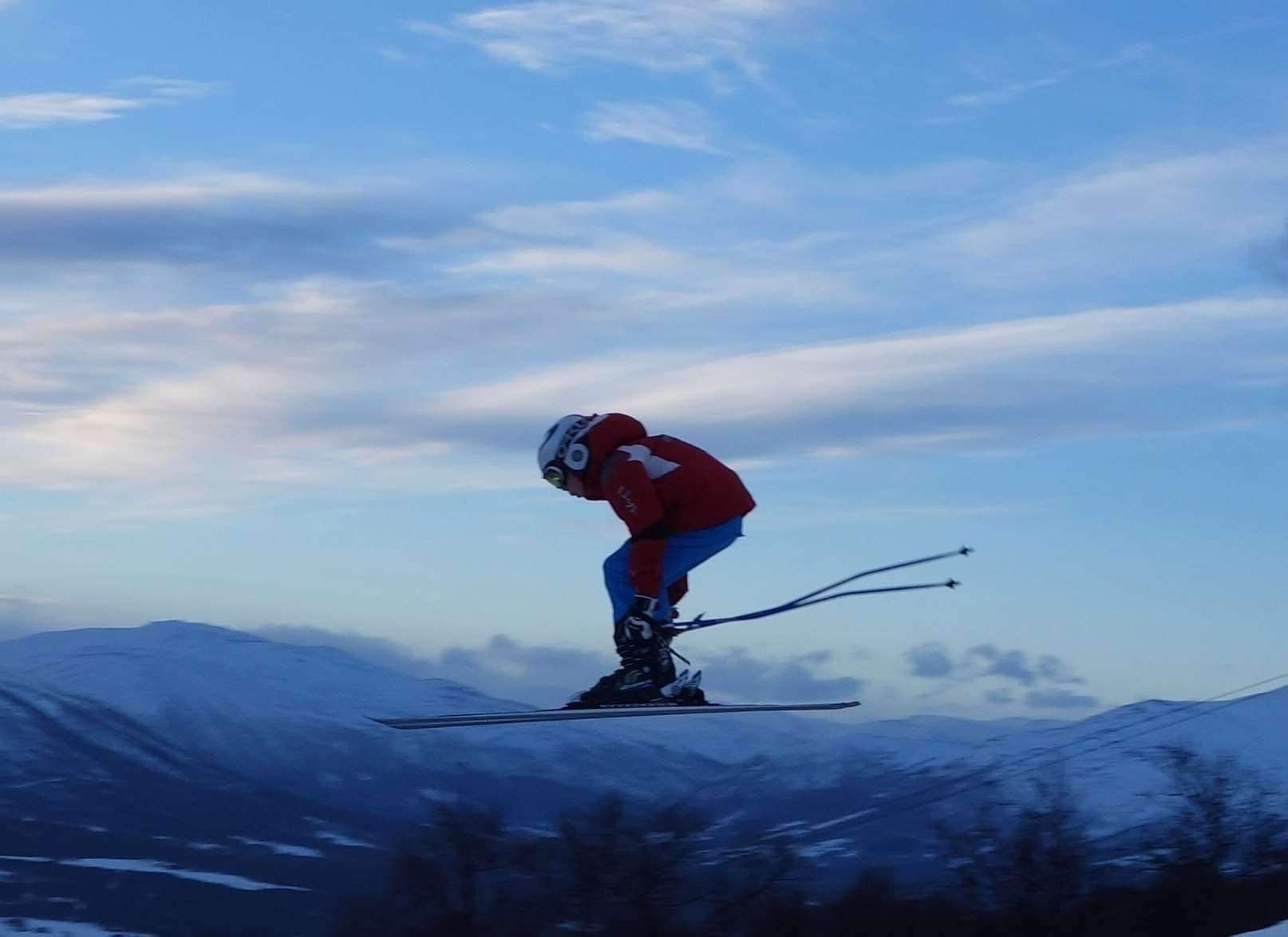
“It has been excellent. I think part of why I wasn’t that good [as a ski racer] while I was younger was because I skied a lot in the park and the forest. I skied a lot, but not so much in the gates, which might not have paid off until now. It’s a bit of a bummer, then and there, not to be good at the turns [in a course]. But, in the long run, I think this is what’s good,” Møller says about his playful approach to skiing during his younger years.
“What has meant the most is that I have skied a lot. I also have a mom and dad who always drove me to the ski area so I could stay there from ten to four and hang out with people from school. It has been a lot of fun, a cool childhood.”
Professional Ski Academy Years
As he got older, Møller attended the Oppdal upper secondary school, a public school that works closely with the successful Oppdal Alpin Elite ski program. Ski fans will recognize current World Cup racer names among the alums: Timon Haugan, Alexander Steen Olsen, Thea Louise Stjernesund, Madeleine Sylvester-Davik, and Finnish National Team tech racer Eduard Hallberg. Former World Cup stars among the Oppdal alums include Aksel Lund Svindal and Ragnhild Mowinckel.
Møller describes the program as professional with coaches who constantly give their all to help the athletes succeed: “Coaches who are up on the hill and prepare the course, water, and do all that it takes. Coaches who wake up daily with a genuine desire to help us become better [skiers].
“What I remember the best is how much fun we had. Those were incredibly great years, driving around the country and getting to ski race with the people you think are the coolest, to hang with them. It was both fun but quite serious,” Møller concludes regarding his upper secondary school years.
Then, during the 2019/20 and 2020/21 seasons, Møller trained with the university team Trønder Alpin, where coach Tomas Karlsson had positive impact on Møller’s development.
Return to Wengen
Møller still gets to hang out with a pretty cool crowd—and they with him—traveling on several continents with the World Cup tour.
Next up is the Wengen three-day race weekend, where Møller will race Friday’s super-G and Saturday’s downhill. Last year, he competed in the shortened downhill and the super-G, placing 52nd and 36th, respectively. He skied the full-length downhill there only once during last year’s official training run.
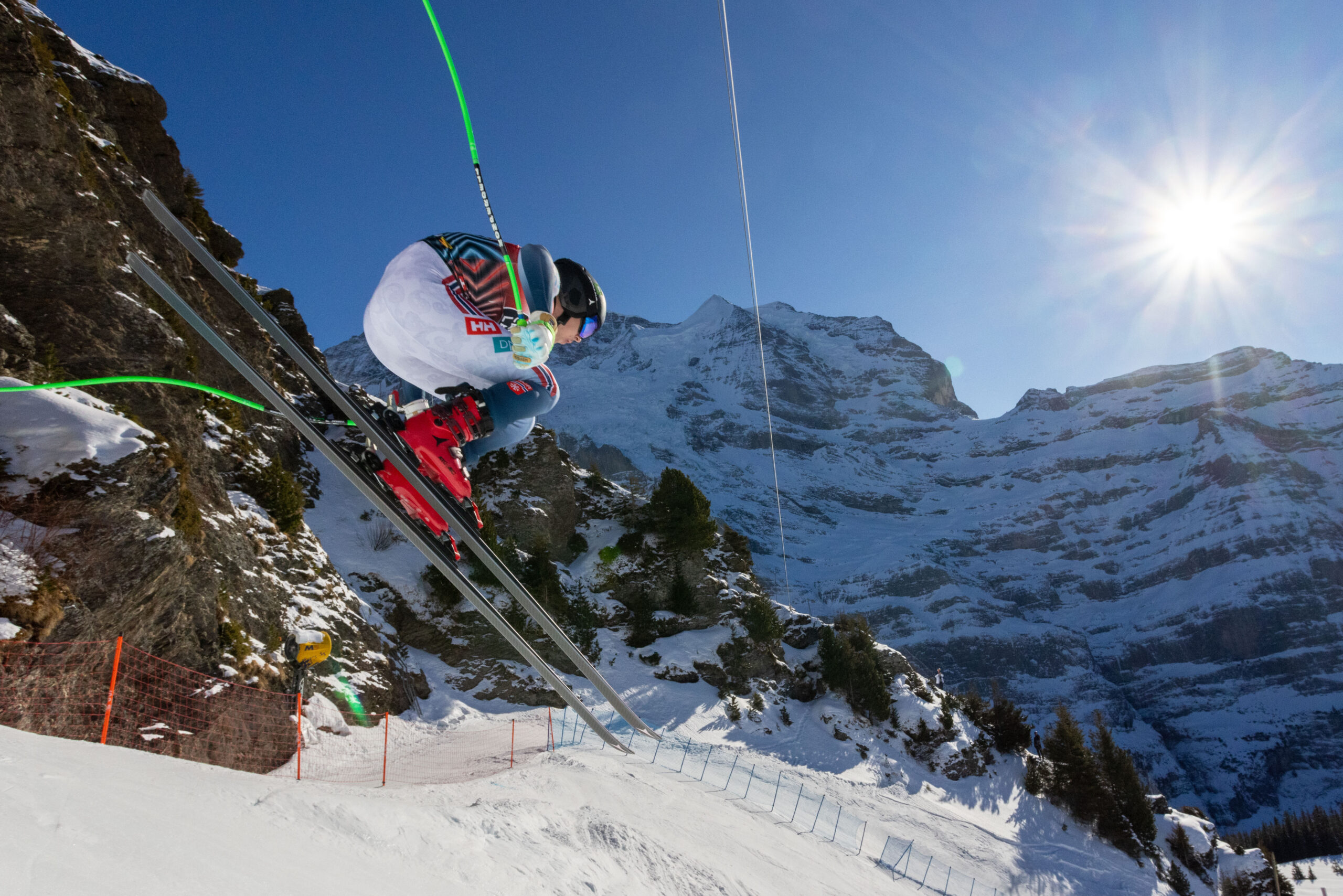
Before this year’s Lauberhorn races, he says, “It will be very exciting, at least for the super-G, now that I have done well in earlier races and maybe have a bit higher hopes.” He also hopes to achieve better downhill skiing in the following races. He continuously works with the team to improve his boot and ski setup for the downhill discipline.
Following Wengen is the famed Hahnenkamm race in Kitzbühel. Møller says:
“I will take things a bit as they come, but it will be exciting. It will be exciting to see everything around [the Kitzbühel races] also; I have heard that there are many people and a great show.”
He has never skied in Saalbach, Austria, where the World Championships will take place in early February. But that’s far off in the distance for an athlete who will have to tackle the world’s most demanding racecourses within the next few weeks.
“I will focus on Wengen first,” Møller says calmly.
About the Author: Bente Bjørnsen Sherlock