The Norwegian racer helped design Oakley’s most state-of-the-art brain bucket

Although it’s accrued decades of fame and respect for its goggle and eyewear innovations, Oakley is quickly etching a pivotal mark in the world of helmets.
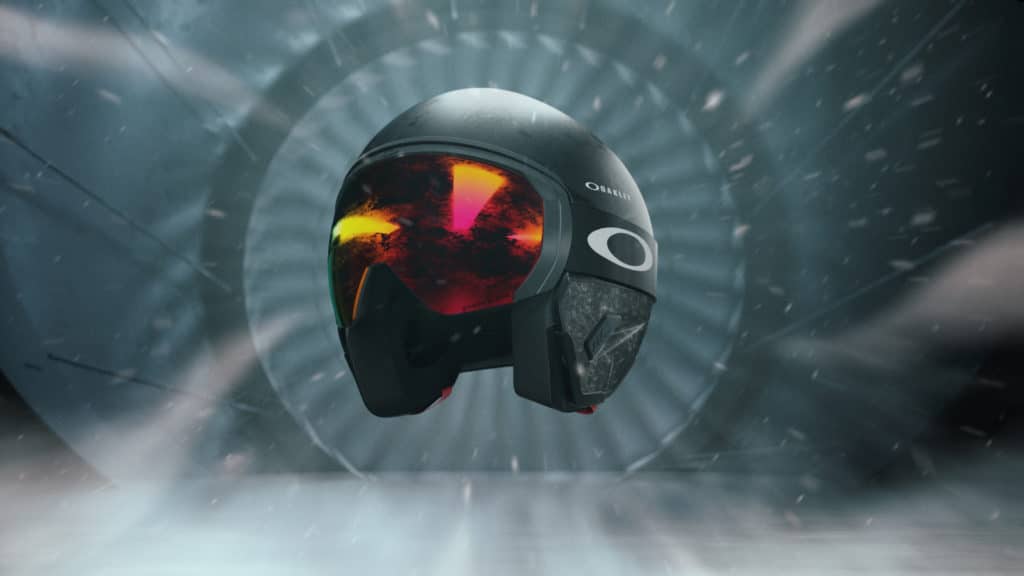
The 47-year-old company delved into the helmet business in 2016, but the latest, greatest and unmatched in technological advancements is the ARC5 Pro.
Every step of the newly released ARC5 Pro helmet came with the help and meticulous scrutiny of one of the world’s fastest skiers. That’s right. None other than Norway’s Aleksander Aamodt Kilde oversaw and informed each detail of the ARC5’s development.
“Alpine skiing is a sport with tiny margins. With a lot of risk of getting injured. Your head is probably the most important thing you have, so you want a strong and safe helmet,” Kilde said in a video filmed during the development of the ARC5 Pro, during which he spent several days at Oakley’s Foothills Ranch, Calif.
While visiting this facility that Oakley insiders refer to as the company’s “interplanetary headquarters,” the Norwegian met with Oakley’s Advanced Product Development team. They got to work evaluating and measuring his head and body positions, using 3D photogrammetry to study how the helmet shifted and adjusted in race simulations as he tucked, turned and practiced the gamut of movements that come into play when navigating a racecourse at high speeds.
Does a helmet shift while racing?
“The head and body scans gave us great information on how the helmet was behaving as he entered and exited these different positions,” says Oakley’s Mike Turner. “For example, when he enters his deep tuck, the muscles on his back and neck become stressed and would apply upward pressure to the back of his helmet, which would drive the front of the helmet into his goggle, pushing them down on his face and obstructing his vision. When he exited the tuck, the goggle would stay out of position – low on his face – but the helmet would rock back, creating a gap between goggle and helmet, which isn’t good for his aerodynamics and safety.”
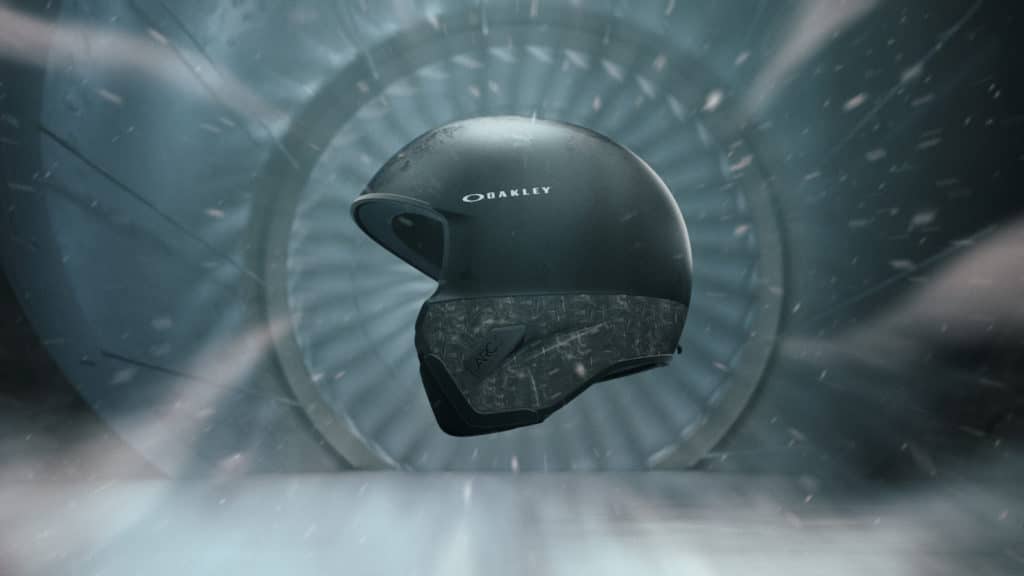
Thus, Oakley essentially designed the ARC5 Pro – and in conjunction, its Flight Path goggles (seen on the head of nearly every skier and snowboarder on Olympic podiums in Beijing) – to eliminate such problems with specific profile considerations, cut lines and internal materials that are now taking the entire world of helmet protection technology by storm.
Raising the bar in protection technology
“The ARC5 Pro is the first helmet to bring M-Forge® technology to snow sports and was a result of us really trying to push the boundary in terms of balancing performance, weight and safety,” Turner says.
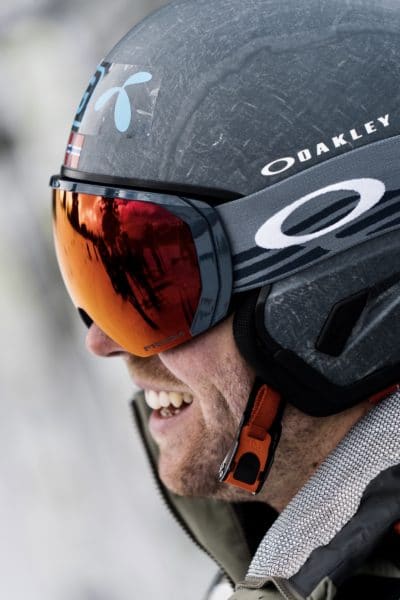
A material technology comprised of polymer and fiber shells, M-Forge® is surprisingly lightweight, eco-friendly (recyclable and made from Volatile Organic Compound) and resilient even after multiple impacts.
“The Pro has a rich aesthetic with that sleek, carbon look. But it’s not carbon fiber, it’s glass polymer,” Turner says. “It has all the good qualities of carbon, but also plastic, so it’s super durable. The problem with carbon is when it breaks, it shatters. This shell has the technology that when it hits once and hits again and again, it protects with repeated impact.”
But the protective elements don’t stop at the shell. Thanks to Kilde’s feedback, the interior construction of the ARC5 raises the bar for helmet protection of every ilk, even beyond snow sports. “After feedback from Aleksander that we needed to minimize the amount of stuff inside the helmet, MIPS Integra was developed,” Turner says.
MIPS, a world leader in helmet safety, fused Integra into its own protective technology as its “lightest and slimmest systems,” used by all leading helmet brands across numerous sports.
The fine balance of featherweight durability
While foam material has been used inside helmets for decades to protect one’s brain in the event of a crash, the Integra, while lighter and less dense, is equally as protective, especially if a crash results in the “ragdoll effect,” as it often does in ski racing, the helmet taking not just one blow, but several.
“Weight and protection are diametrically opposed, so to keep things light and protective in a helmet is difficult,” Turner says, adding that Kilde’s attention to detail and openness to returning to the drawing board is what finally resulted in the masterpiece that is the ARC5 Pro.
“He hammered us,” Turner says. “Every iteration was, ‘it’s too heavy, this is too light. It’s scary, I’m not going to wear it.’ Weight was one he wanted us to get right, the other was the fit.”
In addition to protecting that all-important object inside the helmet, Kilde insisted that Oakley’s new helmet be fast. Without a jetpack, is speed even possible for a helmet? It turns out that it is.
“Because a helmet is the front of your figure when skiing, you want it to be as fast as possible,” Kilde says in the ARC5 video.
How the right helmet makes you faster
So, will donning this helmet magically make you as fast as Kilde? Maybe not. Still, you’ll be in good company.
“Now we’re looking at a product that is 100 percent ready to go,” Kilde says. “It’s fast, it’s safe and it looks awesome.”
Also, the Norwegian champion’s input helped tremendously.
“Aside from the elevated materials, race-tailored feature set and Oakley aesthetic, what makes ARC5 PRO special is its journey to existence,” Turner says. “Collaborating with one of the world’s best, representing the whole racing community to develop a product that gives racers the confidence to find that little extra edge all while respecting the dangers of the sport and not compromising an inch of safety.”
When races are often won or lost by a mere hundredth of a second, a lightweight, well-fitted helmet can absolutely make a difference.
“Every second, every tenth of a second counts,” Turner says. “A big insight working with Kilde was that there’s a sense of security when that thing is locked onto his head. That is a confidence booster. When we feel protected, we push ourselves. We get better. We get faster.”
About the Author: Shauna Farnell