
What makes the dominant Swiss men’s speed team so successful? Speed Team Head Coach Reto Nydegger talks about his coaching style, the Swiss team, and what he learned from the Norwegian Attacking Vikings in an exclusive interview with Ski Racing Media. Swiss stars Marco Odermatt, Franjo von Allmen, Stefan Rogentin, and Norwegian legends Aksel Lund Svindal and Kjetil Jansrud share their insights.
Tremendous Success
The Swiss men’s speed team earned titles, medals, victories, and podiums more than any other nation during the 2025 World Cup and World Championship season. The team embraced a strong team spirit, and young athletes stepped up and challenged their seasoned teammates for the top spots.
The team’s 2025 downhill and super-G statistics are noteworthy:
- Three World Championship gold medals, one silver and two bronze medals
- Downhill and super-G World Cup globes and five out of six possible speed discipline World Cup podium spots
- 27 World Cup race podiums, including 10 victories and two podium sweeps
Odermatt, von Allmen, Rogentin, Alexis Monney, and Justin Murisier recorded these results. The Swiss men also delivered impressive performances in giant slalom and slalom, not included above.
Resemblance to Norway’s Team Culture
In addition to their performances, many admire the Swiss men’s current camaraderie and strong team spirit.
Seeing Swiss athletes embrace each other through success and hardship reflects the Norwegian team culture. The Attacking Vikings build their success on close bonds, teammates helping each other, and hard quality work.
Nydegger has also served as both nations’ men’s head speed coach.
Therefore, Ski Racing Media sought to determine what makes the Swiss team so successful this season and what Nydegger might have learned in Norway and brought with him to Switzerland.
Athletes Are the Key
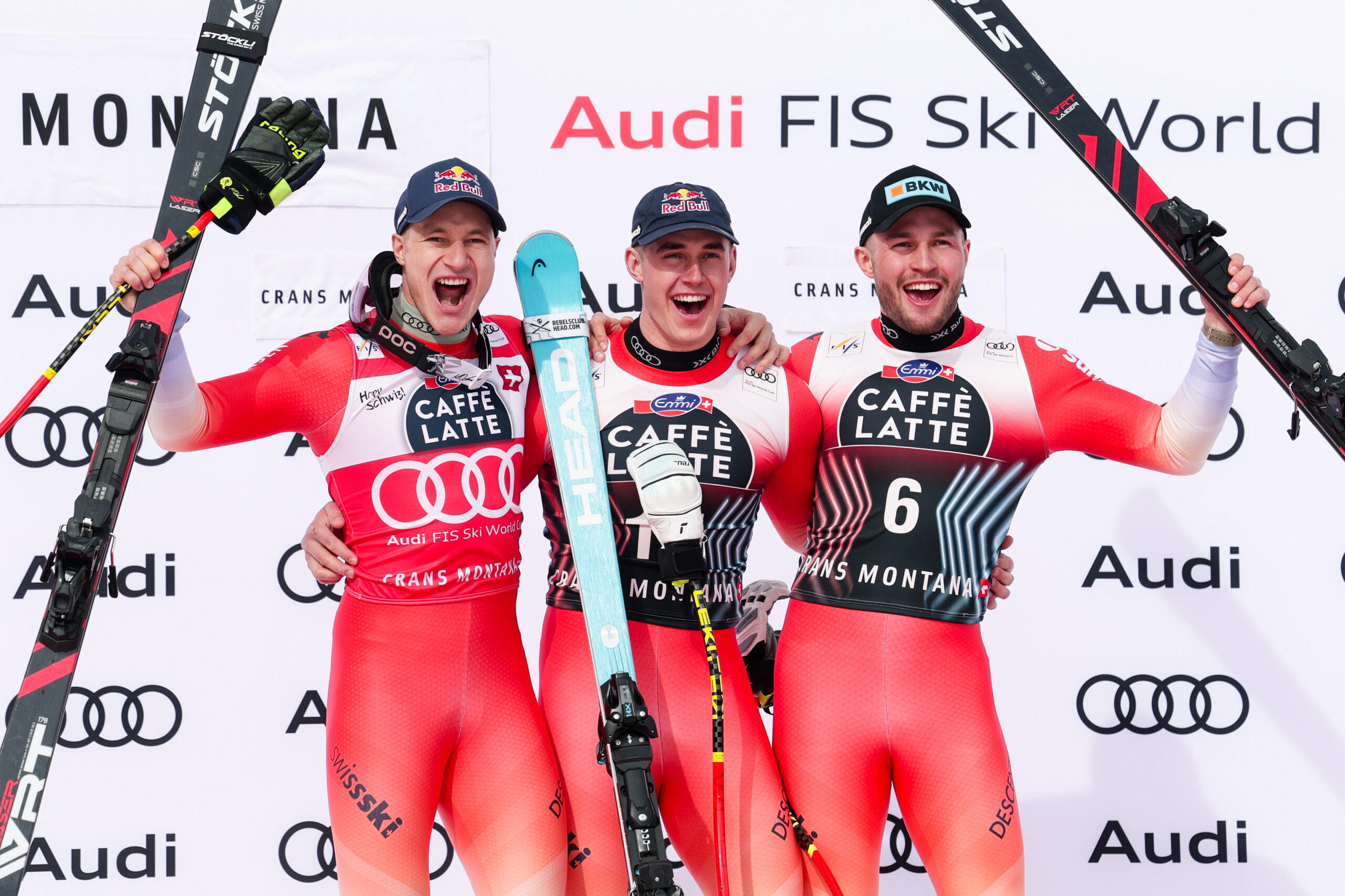
Nydegger spoke with Ski Racing Media during the men’s World Cup weekend at Kvitfjell, Norway, in March. Earlier that day, the Swiss men claimed their second World Cup downhill podium sweep of the season: von Allmen captured the victory, Odermatt finished second, and Rogentin took third.
What makes the Swiss team so successful this year?
With a friendly smile and positive presence, Nydegger said, “It’s a little bit of everything.
“The big part is the athletes.”
He also highlighted that the coaching staff plans ahead to fill the gap in the national team when seasoned star skiers end their careers, and he noted the work being done in clubs and ski gymnasiums.
“I think there is good work on the base, which I don’t have so much to do with. They do a good job in the clubs and the ski gymnasiums and so on,” he said.
Building One Team
Traditionally, there have been various factions within Swiss national teams. Nydegger emphasizes his work to unify the team.
“I try to bring in that we do not have ‘my group’ and ‘your group’, but rather this philosophy that we really go for one team. I think that helps them; they do not ski better but they feel better if they know everybody is working just for success, to win races, and how to win races. I learned a lot about this in Norway, to have this focus. What do you need to win races? It’s not just luck when you win a race. There is a lot behind [being victorious], and I saw that especially in Norway. I learned that from the athletes.”
We will return to this theme with input from Norwegian ski legends Svindal and Jansrud. But first, here is what Odermatt, Rogentin, and von Allmen shared about coach Nydegger during brief interviews with Ski Racing Media in the Kvitfjell finish area.

Odermatt: On the Same Level
“He’s such a nice guy. We can have a lot of fun with him, but he can still be serious and show us how to ski fast,” a cheerful Odermatt said.
The world’s best male alpine skier of recent seasons joined the Swiss World Cup team during the 2018-19 season. Since then, he has earned an amazing four World Cup Overall globes, nine World Cup discipline globes, one Olympic and three World Championship titles, and won 45 World Cup races.
“I think we can thank him for a lot of our success, because what he already did with the Norwegians was really impressive. And now, what he did with our team is also very impressive, especially now with the young athletes, Alexis [Monney] and Franjo [von Allmen]. I think he showed them the fastest and best way to ski fast in the downhill World Cup.
“He’s not a coach that looks down on the athletes. We are all on the same level and the same page, and this is for sure something that helps,” Odermatt added.
Rogentin: Calm and Direct
Rogentin, who finished second in the super-G World Cup standings and earned four World Cup podium finishes, as well as a World Championship bronze in 2025, smiled when asked about Nydegger.
“First of all, he’s a good guy. He’s always pretty calm, and I like that. Sometimes I get nervous, and then I have another person who’s calm, not nervous or stressful,” Rogentin said.
He also values Nydegger’s candidness. “He says what he thinks, and sometimes you need this feedback.”
To explain the team’s success, Rogentin pointed to the competitive level within the current group.
He also noted the change in team members during his eight years on the squad — from past teammates who were “good skiers and good teammates” to today’s team. Now, “we’re a little bit younger, and the really young guys are fresh and have a new and different mindset,” Rogentin added with a laugh.
Von Allmen: A Favorite
Von Allmen, one of the new speed stars, also praised Nydegger: “He’s one of my favorite coaches. He has calmness and experience. I really like to work with him.”
In 2024, von Allmen spoke about his rise—from his home ski club to the podium in his first World Cup season.
This past winter, he emerged as one of the biggest stars of alpine ski racing — winning two 2025 World Championship titles, three World Cup races, and finishing second in the downhill standings.
“Sometimes [team results] get better, and with all the team spirit, it’s really cool. We can push each other, and yes, we will see how far this goes. Maybe next year it’ll be a different country,” von Allmen said with a smile.
Summarizing Strengths
When asked about his strengths, Nydegger highlighted several key points:
- · Staying calm
- · Being organized
- · Sensing how to work with individual staff members and athletes
- · Trying to make the right decisions at the right moment
- · Planning all aspects of training and travel
- · Focusing on athlete development
He shared experiences from working with athletes: When Lara Gut [-Behrami] reached her first World Cup podium at nearly age 17, Nydegger, as her coach, recognized the added pressure she faced. “There was a lot of media, a lot of things coming on.” He believes this experience helps him guide the current team’s youngest fast-rising star. “Von Allmen — he’s also young and there’s a lot coming now. He was a ‘nobody,’ and now everybody wants him. I think I can help there.”
The Start
Nydegger built his coaching experience in Switzerland and Norway, after a brief stint in Australia in 1999.
In May 2000, the then-25-year-old began three years of coaching for the Berner Oberländischer Skiverband (BOSV), a regional ski association whose primary goal is to support young athletes.
Next, he spent 10 years coaching the Swiss-Ski national teams — starting with two years coaching the women’s C-team, followed by four years with the European Cup women’s team.
From May 2009, he joined the World Cup women’s team for a year, before moving to the European Cup men’s technical team for three more years.Then, in spring 2013, Nydegger left Swiss-Ski and went abroad to find new inspiration. A golden chapter followed with the Norwegian Ski Federation.
Joining the Attacking Vikings
Nydegger joined the Norwegian Alpine Ski Team as men’s European Cup head coach in July 2013. Nearly two years later, he faced a surprise during an April 2015 training camp in Kvitfjell.
When key contributors stepped away, a sudden void opened in the Norwegian World Cup coaching staff. Unaware of this, Nydegger traveled to Kvitfjell with his European Cup team for the ski federation camp.
“Here they told me, ‘Our coaches quit. They decided to focus more on their family life, and you are our new [World Cup speed] coach’. It was up here, from one day to another,” Nydegger said, his voice reflecting the excitement and challenges he faced when he became the head coach for the Norwegian men’s World Cup speed team overnight.
“The first thing I said was, ‘I don’t even know where to park the car in Kitzbühel; I haven’t been there.’ And then they told me, ‘We will tell you what you need’. That was really…”
The seasoned coach paused for a split second while possibly feeling emotional… or just searching for the right words.
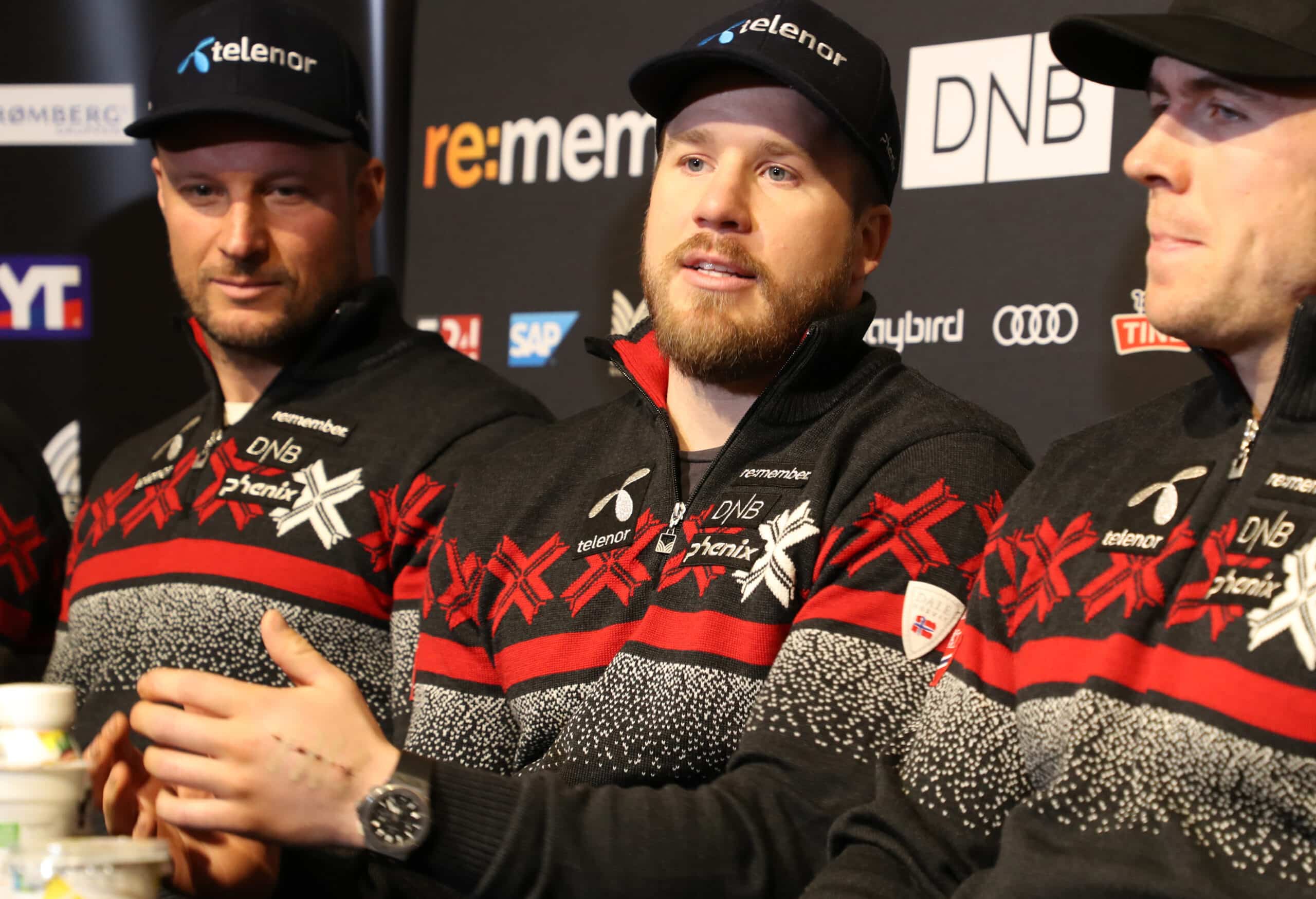
“That was, of course, a lot of work for me, but interesting, and I learned a lot. That was really special,” Nydegger said when describing the close cooperation with the Norwegian men’s speed team. Between 2015 and 2019, he served as the head coach for Svindal, Jansrud, rising star Aleksander Aamodt Kilde, and Adrian Smiseth Sejersted, who won the 2025 World Championship super-G bronze medal.
No Small Task
The unexpected transition to lead the successful Norwegian World Cup speed team was out of the ordinary, and the coach-athlete communication with then-superstars Svindal and Jansrud developed into a special two-way connection.
Jansrud recalled the situation: “To come in and take over the responsibility for the speed team in Norway was a fairly large task to take on. We’d had coaches Tron Moger and Håvard Tjørhom. There had been people involved who delivered quite good results. Then, we had to find the next one who could contribute to our team.”
During the four seasons before Nydegger became the head speed coach, Svindal and Jansrud had won an amazing seven of the eight World Cup speed discipline globes.
Additionally, Svindal secured the World Cup overall twice (2007, 2009). The two had claimed 13 Olympic and World Championship medals over the previous 10 years. Svindal tallied 24 World Cup victories, and Jansrud, three years younger, had 10 World Cup victories when Nydegger began as their coach.
In other words, Nydegger — whose background came primarily from European Cup technical teams and one year with the Swiss women’s World Cup squad — stepped in to lead one of the most successful speed teams at the sport’s highest level.

Definite Requirements
According to Jansrud, the Norwegian athletes already had set expectations for their coaches — and themselves — on how to organize and execute their training to achieve success.
“I think he [Nydegger] experienced how we worked as a team and the expectations we placed on ourselves. We were very self-driven at the time, but that isn’t necessarily unproblematic,” Olympic and world champion Jansrud said with a smile. “He saw how we worked as a team and adjusted quickly.”
Nydegger described it as a new experience to have athletes telling him, “This is what we need.”
“I didn’t know at first how to handle these superstars. They’d won everything, while I was a ‘nobody’ there. And they told me, ‘We want you to tell us what we do wrong, that you tell us immediately. You can also be firm. But we will tell you as well.’ And that worked,” Nydegger said.
“I like to tell the truth when I see something, and I think that’s important in order to take the next step,” he added.
“With Odermatt, for example, it was a bit different. He was a Junior World Champion, but he was not a superstar. He grew up as he joined the [Swiss] speed team, and he learned how to ski downhill and super-G in our group. That was a different thing from starting [in the Norwegian team] immediately the next day with the superstars. So that input was important for me; ‘We want you to tell us what we do wrong.’”
Young vs Experienced Coaches
Nydegger gained another experience he now applies in Switzerland:
“When I started in Norway, they told me, ‘You’re a bit old’. But I was [only] 40 years old; I did not feel old! Still, I was almost among the oldest,” he said with a chuckle.
He saw that bringing younger coaches into the national team system and educating them worked well:
“They take a young coach who really wants to learn and become better; he’s working for the team. Then, you can bring him into this culture. It’s much easier than taking an older coach, who tells you, ‘I never did that, I never did this.’”
Now that he is back with Swiss-Ski, Nydegger aims to bring younger coaches into the Swiss team. In his experience, coaches in Switzerland and Central Europe typically must work their way up in the team structure for many years before leading a World Cup team, especially a speed team.
“I showed in Norway that this isn’t that necessary. The team helps you. The athletes help you if you work together. I had no experience on the speed side [when starting] in Norway, and Aksel and Kjetil told me, ‘We will help you; we will make it together,’ and that was something new for me,” the successful speed coach said.
Coaches Who Listen and Learn
“Reto came across as curious and willing to learn,” Jansrud said when speaking with Ski Racing Media in Kvitfjell.
“You might get coaches who believe their way of thinking: ‘That’s how we do it. It’s my way or the highway.’ And there are some coaches who’ve had a good effect that way. On the other hand, the Norwegian team has mainly always had a flat structure. We have discussed, among both the coaches’ team and the athletes’ team, in which way we can best become the best. But, of course, we’ve had very clear roles regarding who’s in charge.”
Svindal described Nydegger as a worker, an experienced coach, and someone who gives the whole team stability.
“You’re always looking for coaches with experience, but you also want coaches that are part of building team culture,” two-time Olympic and five-time World Champion Svindal said.
The small Norwegian men’s speed team — consisting of three to four athletes, plus Nydegger and other staff — delivered impressive results. During the four seasons when Nydegger headed the team, they won three Olympic and three World Championship medals, three World Cup super-G discipline globes, and placed 13 times in the top three in the downhill, super-G, and alpine combined discipline cups. Additionally, the team won 27 World Cup race victories during the 2016-2019 seasons.
Team Working Together
When he returned to Swiss-Ski and their men’s World Cup speed team in April 2019, Nydegger encountered a more divided structure than in Norway and what we see in today’s Swiss team.
“When I started six years ago, it was not like this. It was Beat Feuz here, then there was Carlo Janka there, and Marc Gisin was here, so everybody was in his own little thing,” Nydegger said. The top racers typically had private coaches. “I tried to bring them together a bit.”
He worked to establish a culture similar to what he experienced in Norway.
Now, the dynamics have shifted within the Swiss men’s speed team. “Everybody works for that success, [that’s starting] already in the training,” Nydegger said.
Size Matters
Due to Switzerland’s greater number of athletes and staff, creating this shared focus within the Swiss team was more challenging than it had been with the smaller Norwegian men’s speed team.
Establishing a setting where “everybodyreally helps each other is easier when you have just three coaches and two service guys. Here we have ten coaches and ten service guys and other staff around,” he said.
The larger team also requires more organization on a daily basis. Still, Nydegger tries to keep a flat organizational structure. He believes a flatter structure and giving people responsibility has always been his coaching style, even before working with the Norwegian team.
Nydegger makes decisions and plans for the staff members but also assigns everybody responsibilities. One person is responsible for the equipment, another oversees the warm-up, and yet another checks the slope, he said.
“With that big group, some do GS in the morning, some do super-G, some need to go to the jury inspection, some need to do other things. The flat structure is still there, but in the bigger group, you need to make decisions. It’s important that that works.”
Planning and Logistics
Nydegger enjoys planning and logistics and views these tasks as crucial for team success.
“I’ve been in the business for 22 years now. I know many places. I know that the athletes need quality training, not just ‘something.’ We need to take care of safety, safe training. Logistics is also a part; trying to stay at the right place, having good food.”
Creating the right environment helps athletes perform their best.
Keeping a Positive Momentum
Additionally, maintaining momentum throughout the season is key. Nydegger noted that coaches tend to take it easier after significant events like Wengen and Kitzbühel and after this year’s World Championships, where the Swiss men’s speed team was very successful. However, there’s no time to relax or ease up on the job.
“I feel it is kind of my job to kick them a little bit in the behind and say, ‘Hey, now we have to continue with this; we are not giving up.’ That has not so much to do with skiing, but it’s more about how to build the group and keep the group together.”
According to Nydegger, athletes might be affected if the coaches do not stay positive, though some athletes may handle it better than others. Therefore, Nydegger believes it is essential to avoid negativity, especially in a large team.
“It is important that everybody goes the right way, and I try to bring that together, to keep the focus.”
The Importance of Odermatt
During Nydegger’s first years as Swiss head speed coach, the team shifted from having several racers nearing retirement to welcoming younger competitors. Nydegger encouraged the veteran team members to support the younger ones, as he had experienced with the Norwegian team.
“The last one [to retire] was Beat Feuz, and I always pushed him a bit to help the younger guys. We didn’t know when Odermatt came the first time if he was a superstar or not, but they kind of found each other. Also, Beat was always there to help a bit when someone asked,” Nydegger said. He believes Odermatt’s approach to leadership mirrors that of Feuz.
Nydegger highlighted Odermatt’s importance to the team and the Swiss federation:
“He is in this structure and shows that the structure from the federation works. I think that’s the most important point. If he went separately, that would be different for the whole team. It helps that he always stayed, he shared the dryland coach, he shared the normal coaches, speed coaches, he shares everything. It really shows that he is part of Switzerland, from the team, not just kind of a Red Bull team or whatever you would call it.”
Coaches Follow Teams, Not Athletes
Nydegger emphasized creating a structure within the speed team that allows racers to transition between the various discipline teams. He believes a coach should not follow a racer who shifts between the speed and technical teams; instead, the racer should come in and out of the speed team while the coaching staff remains within the team.
In other words, Odermatt, whose base is the national team’s World Cup giant slalom training group, and other multi-discipline athletes, work with the GS coaches when focusing on GS and with the speed coaches when focusing on super-G or downhill.
“Ten years ago, it was not like this in Switzerland. Then, a coach always had to follow [the skier between teams] because they didn’t trust the other group. ‘This group is my group, and this is someone from another group’,” Nydegger said.
“The big step is that Odermatt is part of the big team. It shows the young guys that this big team is working. We don’t need a private coach for this; we can win races all together.”
Building a Team
“I really enjoy seeing how they now have success with the Swiss team,” Svindal said.
“Looking at how they behave, and the kind of champion Odermatt is, I would almost call it the ‘Odermatt effect,’ what the Swiss team is doing. To have someone like that to build the team around, someone that waits for the rest of the guys in the finish area, doesn’t want a private team but he stays in the team — I think that’s a lot of credit to Odermatt. But it’s also a lot of credit to the Swiss ski federation and to the coaching staff, like Reto, for building an environment that actually allows and motivates Odermatt to be that kind of team player,” Svindal added enthusiastically. “Money can’t buy that; it has such high value!”
Svindal, a fantastic team player, said: “I think they do it in a way a lot of teams can learn from and also a lot of young racers can learn from.”
Jansrud described his impression of Odermatt as a team player who wants the team to succeed and who shares his experience with his teammates.
“So, they are copying what we have been good at all the time,” Jansrud said with a friendly laugh, referring to the Norwegian tradition.
Teaching Young Teammates
Ski Racing Media shared Svindal and Jansrud’s praise with Odermatt.
“This is nice to hear and something I try to live by and like to do, because I was also younger some years ago and I came into a team and was very welcomed by Beat [Feuz]. He really helped me a lot. He showed me all his skills in the downhills, and I could learn a lot from him. This is something I try to do to help the younger athletes,” Odermatt said.
Odermatt added that he enjoys the positive team atmosphere, “because it’s always more fun to share a good race, podium, victory together with your friends.”
These young teammates have become Odermatt’s biggest competitors, Ski Racing Media pointed out.
“Yes, that’s true,” Odermatt replied with a smile. “I think this is something new, obviously, but I hope we can keep this good atmosphere together.”
Make Each Other Better
What advice will Nydegger give to those who coach young racers?
“If everybody helps each other, I think that helps the most. That’s what I try [to teach] in the coaches’ education in Switzerland,” Nydegger said.
“Not everybody is doing everything, but if you talk together and try to make your other coach better, then you can build that philosophy.”
Nydegger noted that coaches have different strengths. Some are better at ski-technical input, others in different areas, and coaches communicate in various ways. It is essential to utilize strengths and differences in the best way possible.
He shared an example:
“In our team, the boys can go to the coach they like to go to. They can choose from four to five coaches. If they like to watch video with me today, they do it with me. If they like to do it with another coach, they do it with the other coach.
“Don’t try to hold [back] the athletes,” Nydegger said, as their experiences and form vary from day to day. This illustrates the importance of communication and working towards a shared goal within the team.
About the Author: Bente Bjørnsen Sherlock