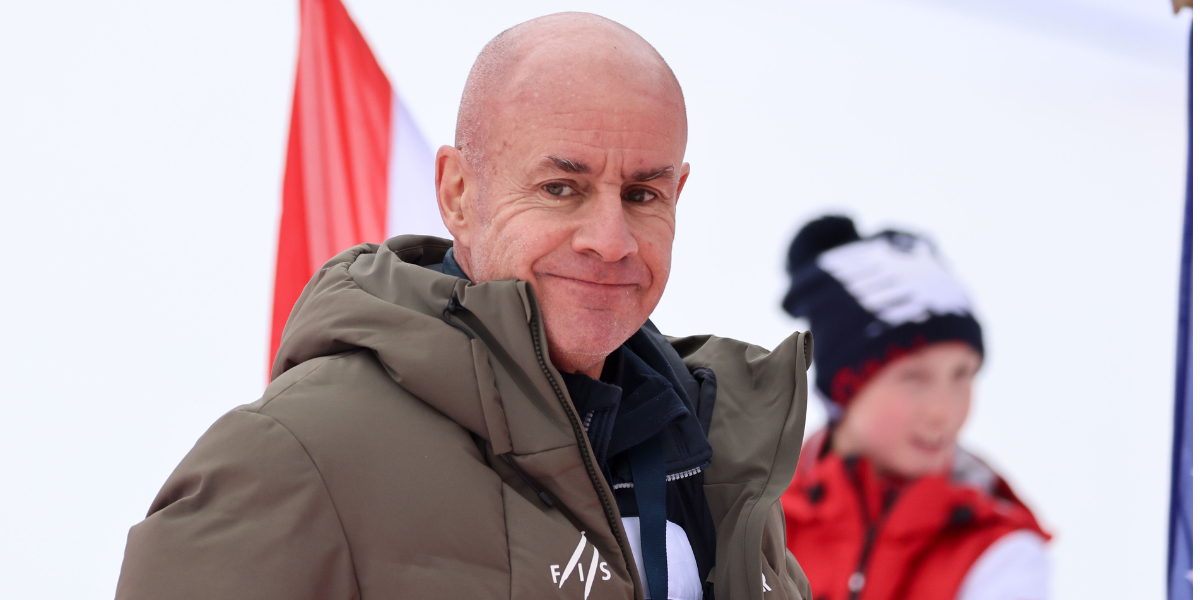
Johan Eliasch / GEPA pictures
Johan Eliasch does not sound like a man preparing to step away from international ski racing.
Nearly five years into one of the most ambitious and debated presidencies in FIS history, Eliasch says the work remains unfinished — and that belief is driving his decision to seek another term leading the International Ski and Snowboard Federation (FIS).
“I want to finish off what I’ve started,” Eliasch told Ski Racing Media in an exclusive interview. “We still have work to do. Once done, then it’ll be time for somebody else to take over.”
Since first taking office in 2021, Eliasch has pushed aggressive modernization efforts across FIS, including centralized media rights, expanded digital operations, new competition formats, broader athlete representation in governance, and international growth initiatives designed to expand snow sports beyond their traditional European base.
His presidency has not been without controversy. Some within the federation have questioned both the pace of change and Eliasch’s more centralized approach to the marketing of media rights.
For Eliasch, however, modernization is no longer optional.
He believes snow sports face increasing competition for relevance, visibility, and commercial value in a global marketplace dominated by soccer, basketball and other major entertainment properties.
“The biggest priority is to improve the product, improve the rights packages, improve everything to do with the sport and everything for the athletes, to make the sport safer and at the same time make it more exciting, he said. That is innovation, technology — you name it.”

Media centralization becomes the defining project of Eliasch’s presidency
No initiative better defines Eliasch’s presidency than the centralization of FIS media rights.
The project initially faced resistance from several federations and organizers, who were concerned about losing control over long-established broadcasting arrangements. Eliasch now points to the results as evidence that the federation needed a more unified commercial strategy.
“We have significantly increased revenues,” he said. “If we look at what we’ve done with the media rights centralization, that over the eight-year cycle should bring in more than 250 million in additional revenue in very challenging market conditions.”
According to Eliasch, centralization has given FIS greater long-term control over how the sport is packaged, distributed, and promoted globally while creating stronger value for sponsors, organizers and broadcast partners.
“It’s much easier to sell if you have a centralized package,” he added.
Eliasch said part of that financial growth strategy is designed to strengthen member national ski associations, particularly smaller and medium-sized federations that are critical to expanding the sport globally.
“We have put programs in place at FIS, particularly to help the smaller and medium-sized nations,” he said. “For us to significantly grow, we need to have global reach.”
The federation’s digital reach has expanded alongside those commercial changes. Eliasch said social engagement and global fan interaction have multiplied during his presidency, while Olympic participation has continued to grow. Beijing featured athletes from 78 nations. Milano-Cortina increased that number to 88.
Those numbers matter to Eliasch because they support the larger vision behind his presidency: transforming snow sports from a collection of regionally successful European events into a stronger global sports property.
Asia and China remain central to FIS growth plans
Eliasch repeatedly returned to international expansion as one of FIS’ most important long-term priorities.
While alpine skiing remains strongest in Europe and North America, he sees Asia — particularly China — as one of the federation’s largest future opportunities across multiple disciplines.
“We see great growth in Asia and we see lots of potential opportunity with China,” Eliasch said. “It’s not going to happen overnight. It’s a process.”
FIS has worked closely with Chinese sports authorities, resorts, and development programs since the Beijing Olympics in an effort to build participation and fan engagement. Eliasch identified freestyle skiing as a discipline with especially strong growth potential in Asia, while describing alpine expansion as a longer-term process tied to stronger continental cup competitions and increased visibility.
The trends are increasingly visible throughout the sport’s media landscape as well. During the 2025-26 season, China emerged as Ski Racing Media’s second-largest audience behind only the United States, reflecting the rapidly expanding international appetite for winter sports content.
Eliasch says FIS has evolved faster than ever before
Eliasch believes one of the federation’s biggest accomplishments has been transforming FIS from a traditionally structured governing body into a broader and more modern sports organization.
“We probably did more and grew the organization more in the last five years than it did the previous hundred years,” he said.
Founded in 1924, FIS has existed for more than a century, making Eliasch’s characterization reflective of how aggressively the federation has expanded and modernized during his presidency.
That growth has extended well beyond alpine skiing.
Under Eliasch, FIS integrated parasports and freeride into the federation structure, expanded digital and marketing operations, created an athlete health unit, and reorganized leadership through the addition of a CEO model designed to modernize management and commercial operations.
“One of the things that we needed to do now that the organization has grown a lot and the programs have become more ambitious is move from the old model,” Eliasch explained. “That allows for a more business-like approach, particularly when it comes to growing revenues.”
Athlete involvement has also become a larger priority during his presidency.
“They’re involved in the committee structure. They’re involved in the FIS Council,” he said. “I’ve really integrated them into the structure so they have a voice.”
Politics inside FIS remains one of the biggest leadership challenges
Despite the progress Eliasch describes, he acknowledged that leading a federation with more than 140 national members can be extraordinarily difficult.
“The big challenge has been to get people to come together and work together,” he said.
At one point during the interview, Eliasch described FIS politics as operating “on a different level” compared to conventional politics.
The challenge, he suggested, is not disagreement itself, but maintaining unity while trying to modernize a federation filled with competing priorities, financial realities and national interests.
“In a healthy democracy, you have different opinions,” Eliasch said. “If the majority is heading in a direction that may not be your first choice, you follow that.”
He believes the gradual acceptance of media rights centralization demonstrates that skepticism can eventually shift when stakeholders begin seeing measurable results.
“Now that this is working very well; people are incorporating,” he said. “It’s a good showcase of people finally coming together and working together.”
Technology and innovation remain central to Eliasch’s vision
Innovation remains one of the clearest themes of Eliasch’s presidency.
He pointed to developments including drone coverage, advanced television graphics, GPS tracking systems, cloud-based production tools, AI-assisted content creation, and new competition formats, such as the team-combined event introduced in Saalbach and Milano-Cortina.
Eliasch believes many of those technologies can improve the viewing experience while simultaneously reducing costs for organizers and broadcasters.
“There are lots of opportunities with new technology that can significantly improve the viewer experience and reduce production cost,” he said.
He specifically highlighted drone coverage and remote production technologies as tools that can both improve how the sport is presented and help smaller organizers manage the increasingly expensive demands of World Cup production. Eliasch suggested newer technologies could eventually help standardize broadcast quality across venues while lowering operational costs for hosts.
At the same time, Eliasch stressed that demand for hosting World Cup events remains strong throughout the sport.
“We’re fortunate because we have a great deal of interest,” he said. “Everybody wants to host World Cup events.”
Passion for skiing still drives Eliasch forward
Eliasch became an IOC member in 2024, strengthening his leadership role within international sport. While he views the IOC and FIS as fundamentally different organizations, he believes winter sports face growing pressure to remain commercially relevant in an increasingly competitive entertainment environment.
“We have a lot of competition from soccer, from basketball, from the NFL,” Eliasch said. “To be competitive, we have to be attractive.”
Some of his most meaningful experiences, however, have come away from boardrooms and commercial strategy meetings.
Eliasch described the Paralympics in Cortina as one of the highlights of his presidency.
“The bravery sitting in a chair like that, going downhill at 120 kilometers per hour and jumping 30 or 40 meters,” he said of para downhill athletes.
Despite all the debates surrounding his leadership, Eliasch ultimately returns to a simple reason for continuing:
“I am very passionate about snow sports,” he said. “I love them.”
Whether Eliasch secures another term or not, his presidency has already reshaped both the direction and ambition of international snow sports. The June election may ultimately determine not only who leads FIS over the next four years, but also how aggressively the federation continues to push toward a more global, digital and commercially ambitious future.
About the Author: Peter Lange