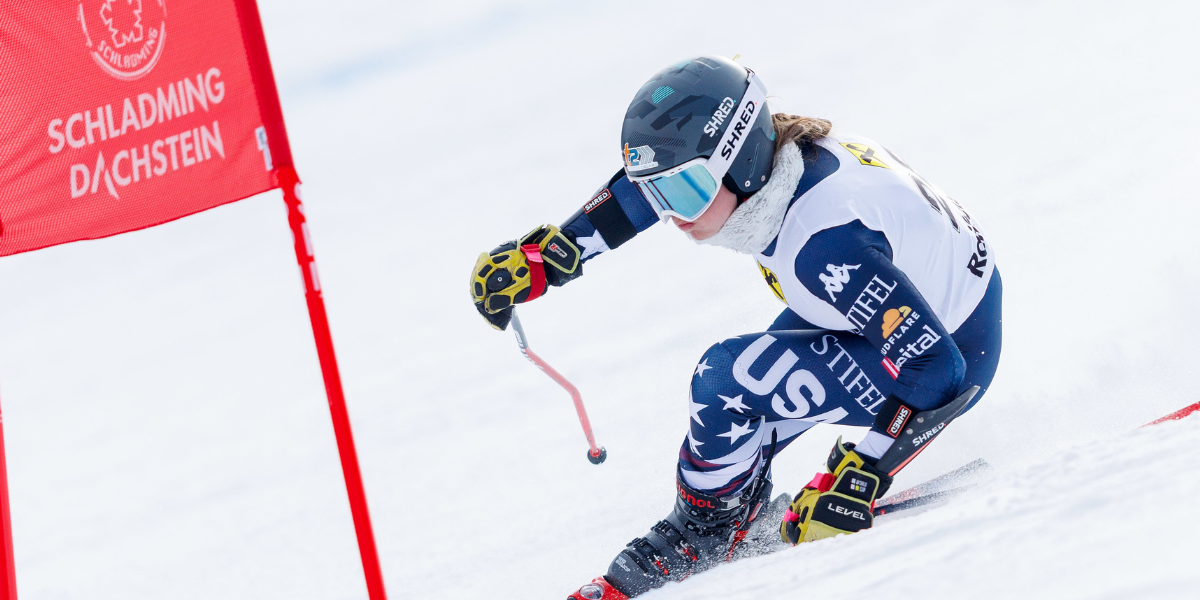
Katie Rowekamp Earns Stifel U.S. Ski Team Nomination at 16
Katie Rowekamp / GEPA pictures
Katie Rowekamp didn’t just make the Stifel U.S. Ski Team; she did it after just one season of FIS racing.
The 16-year-old from Girdwood, Alaska, finished her rookie season ranked 78th in the world in giant slalom and 105th in super-G. She placed 32nd in the Europa Cup giant slalom standings, earned a personal World Cup super-G start position by finishing second in the NorAm super-G standings, and qualified for the U.S. team at the FIS Junior World Ski Championships.
Along the way, she finished seventh in her first Europa Cup giant slalom from bib 54, won a NorAm super-G at Whiteface, and established herself as one of the most promising young skiers in the United States.
At just 16, her season results were extraordinary.
Her path to success began in Alyeska.
How did Alyeska shape Katie Rowekamp?
Rowekamp grew up in Girdwood, Alaska, where skiing was less about perfect conditions and more about making the most of whatever the mountain offered.
Long before she dreamed of Europa Cup points, Junior Worlds or the Stifel U.S. Ski Team, winter meant powder days, family ski days and countless hours at Alyeska Resort.
“Winter was kind of my off-season, and we would go powder skiing all the time, which was really fun,” Rowekamp told Ski Racing Media.
She raced with Alyeska Ski Club through the U12 level, but ski racing was not initially the focus.
“They would just pull me out of school and we would go powder skiing because we get a lot of snow here,” Rowekamp said. “And then ski racing kind of just happened.”

What lessons did Alyeska teach her?
Growing up at Alyeska taught Rowekamp lessons that still influence her skiing today.
The mountain is known for challenging visibility, changing snow conditions and weather that can force skiers to adapt quickly. Rather than viewing those days as frustrating, Rowekamp learned to embrace them.
“I would say dealing with visibility,” Rowekamp said when asked what skills from Alaska still help her. “There are a lot of days when we’re training in Norway or Burke or sometimes in Central Europe where it’s cloudy and foggy and the snow is soft and rutty.”
For Rowekamp, those conditions feel familiar.
“Growing up here and being able to turn those days into something that’s fun has helped me know how to get something out of those days,” she said. “The conditions don’t have to be great to still have fun and learn something.”
That mindset has followed her far beyond Alaska.
Whether training in Vermont, racing in Norway or competing on the Europa Cup circuit, Rowekamp has carried the same lesson with her: difficult conditions are not something to survive. They are another opportunity to improve.
That perspective may be one of the quiet reasons behind her rapid rise.
Why did Rowekamp leave Alaska for Burke?
Rowekamp left Alaska for Burke Mountain Academy for her U14 years.
At first, it was not a full relocation. Her parents rented a house near Burke because the junior program did not have boarding for U14 athletes. Rowekamp trained there in the winter, then returned to Alaska for the spring through fall.
She missed Girdwood at first.
“I did a lot, actually,” Rowekamp said. “Now I’ve been away so much that I don’t get homesick anymore. I definitely still do miss it, but back then it was pretty hard for me.”
The moves required a major commitment from the family.
“I don’t think a lot of other parents would be willing to move their whole lives across the country to help me ski race,” Rowekamp said.
Burke gave her something different from Alyeska.
Alaska had built adaptability, toughness and comfort in difficult conditions. Burke gave her volume, structure and technical precision.
“When I first went to Burke, I didn’t know how to ski on ice, and that’s almost all they have,” Rowekamp said. “So I learned really quickly.”
She also learned through repetition.
“With the T-bar, you could take, I don’t know, 14 runs on Training Hill in a day, which was a lot,” Rowekamp said.
How did Burke help Rowekamp grow beyond ski racing?
The Burke environment also changed her away from the hill. After starting as a day student, she later moved into the dorms. That experience helped her mature, become more independent and find a community that allowed her to be herself.
“Burke is such an open community and everybody knows each other,” Rowekamp said. “I think that kind of lets people embrace their weirdness. It’s a place where it’s okay to be weird and have quirks.”
For Rowekamp, that mattered.
“I think being around that sort of community has let me relax a little more when skiing and have more fun,” she said.
Burke helped her grow as a person, but it also accelerated her growth as a racer. Alyeska had taught her she loved all skiing. Burke taught her how to train at an elite level.
What made Oppdal a turning point?
Rowekamp had several breakthrough results during her first FIS season, but one race changed the way she viewed what might be possible.
She won a NorAm super-G at Whiteface, finished second in the NorAm super-G standings, and qualified for Junior Worlds. She also finished ninth in the NorAm giant slalom standings despite missing the NorAm Finals in Aspen.
Yet one result stands apart.
In her first Europa Cup giant slalom, Rowekamp started with bib 54 in Oppdal, Norway. After the first run, she sat 29th.
She was already thrilled to make the flip.
“The first run, I was so happy that I even made the flip,” Rowekamp said.
Then she attacked the second run with a different mindset.
“The second run I was just like, ‘Oh yeah, let’s just go for it,”” she said.
Rowekamp won the second run and finished seventh overall.
It was her first Europa Cup start. She was 16 and in her first year of FIS racing. She had just finished seventh in one of the deepest giant slalom circuits outside the World Cup.
More importantly, it was the first time she genuinely believed a Stifel U.S. Ski Team nomination might be within reach.
When did Rowekamp believe the Stifel U.S. Ski Team was possible?
“I was like, ‘What is going on?’” Rowekamp said.
Her father was there. Her mother was on FaceTime.
“I got down from my run and I went to my dad and he had my mom on FaceTime and we hugged, and so that was really nice,” Rowekamp said.
Even then, she did not know the result would hold.
“Because I ran early, I thought it was just going to be another 29th-place result,” Rowekamp said. “Then my time just kept holding. I thought, ‘This is great.’”
The result changed how she viewed the season.
“I remember thinking, ‘This is it. I’m in. Let’s go,” Rowekamp said.
Oppdal was not an isolated moment. Rowekamp scored Europa Cup points in all three giant slalom races she entered and finished 32nd in the Europa Cup GS standings.
For a first-year FIS athlete, that was a rare statement.
What did Junior Worlds mean to Rowekamp?
Click on the image to enlarge
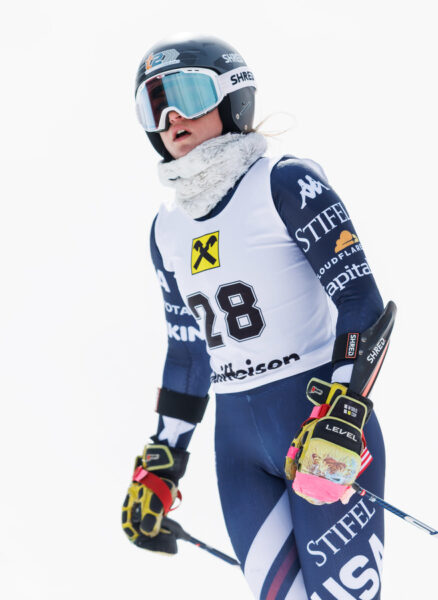
After Oppdal, Rowekamp continued to Narvik, Norway, for the FIS Junior World Ski Championships.
She finished 14th in giant slalom, 27th in super-G, eighth in the team combined and 11th in the team parallel. The results mattered, but Rowekamp spoke just as strongly about the experience of racing with the U.S. team.
She shared the experience with other young American athletes, including fellow Stifel U.S. Ski Team rookie Mari Renick.
“Mari and I have known each other for a long time,” Rowekamp said. “We’ve always been pretty competitive, but we’re still really good friends and I really like rooming with her.”
Junior Worlds strengthened that connection.
“It was super cool to be with her at World Juniors and to go through the entire series with her,” Rowekamp said. “Going through the same thing together was really awesome.”
The U.S. group also built a strong bond in Narvik.
“I think all of us formed this super strong, fun bond,” Rowekamp said. “The racing was definitely a big part of it, and that was super cool, but I also liked how much fun we had.”
That balance suits Rowekamp. She is serious about racing, but she also talks often about fun, relationships and the value of enjoying the work..
When did Rowekamp realize the Stifel U.S. Ski Team was possible?
Rowekamp first sensed the potential in Waterville Valley, New Hampshire.
She had scored her first 23-point result in giant slalom. The result did not secure anything, but it changed the way she viewed herpath.
“That’s when I realized, oh, this is possible,” Rowekamp said. “I mean, I hadn’t made anything yet. That was just a good result that could help me in the future.”
That confidence built gradually.
“Those small steps and accomplishments that fed a larger result kind of stoked this belief that, ‘Oh, yeah, this is possible and I can do this.’”
Oppdal made it feel real.
The seventh-place finish in the Europa Cup gave Rowekamp the feeling that she had done enough.
“I told myself, ‘This is it. I’m in. Let’s go,” she said.
That season also included a NorAm super-G win at Whiteface and a second-place finish in the NorAm super-G standings. Rowekamp learned about that ranking at dinner from her coach, Kyle Darling.
“I hadn’t really paid attention,” Rowekamp said.
Then Darling made an announcement.
“It turns out that I had gotten second in season’s super-G standings, which was really cool,” Rowekamp said. “And I had gotten a spot on the World Cup, which I honestly wasn’t really thinking about.”
This accomplishment surprised her.
“Hearing about it was really, really cool,”” she said.
What kind of skier is Rowekamp becoming?
Rowekamp’s results do not fit neatly into one category.
She won in NorAm super-G, earned a World Cup super-G start position, finished ninth in the NorAm GS standings, scored Europa Cup GS points in all three starts, finished seventh in her first Europa Cup GS, and ranked inside the top 80 in the world in giant slalom after one FIS season.
She likes super-G. She also loves giant slalom.
“I don’t know. I just really like GS,” Rowekamp said.
Her role models reflect that mix.
When asked which athletes she looks up to, Rowekamp named Lara Gut-Behrami and Alice Robinson.
She admires Gut-Behrami’s skiing, but also the way she presents herself.
“Her skiing is obviously phenomenal and I love her style and everything,” Rowekamp said. “But I also really like how she’s like, ‘Oh, yeah, social media today is…’”
Rowekamp supported the idea that athletes should be allowed to express both positive and negative emotions.
“I think being emotionally connected to the sport is super important,” she said.
Robinson appeals to Rowekamp for different reasons.
“I just always liked her skiing,” Rowekamp said. “I like how strong she is.”
Those influences help explain the skier Rowekamp appears to be becoming: powerful, aggressive, versatile and still searching for the consistency that separates good athletes from elite ones.
That search may compel her forward as she enters her second FIS season.
What is Rowekamp trying to improve?
Rowekamp knows the next step is not just producing great runs; it’s producing them more often.
She described her preparation focus clearly.
Tactically, she wants more depth, better patience and stronger turn building.
“Build the turn,” she said.
Why is consistency the next challenge?
Mentally, Rowekamp believes consistency may be the biggest challenge of all.
“Next season, my goal is to get my head in a consistent place because skiing isn’t consistent,” Rowekamp said. “The conditions change, the weather changes, the sets change.”
She has spent the past several seasons experimenting with different approaches to preparation, confidence and race-day mindset. Some worked. Others failed. Sometimes, the same approach seemed effective one day and ineffective the next.
That process has taught her there is no simple formula.
She knows she can perform at an elite level. Her first FIS season proved that. She won a NorAm super-G, finished seventh in her first Europa Cup giant slalom, earned a World Cup super-G start position and delivered strong performances at Junior Worlds.
The challenge now is performing more often.
“I had these random, just really good runs,” Rowekamp said. “I had one really good run at World Juniors, my one really good run in Oppdal, my one really good run in Whiteface or whatever, but I think getting those to be consistent is the real challenge.”
That challenge is part of what makes ski racing unique.
“It’s one of the few sports where you don’t know how you’re doing when you’re doing it,” Rowekamp said.
Unlike many sports, there is no scoreboard to check during a run and no immediate feedback beyond what the athlete feels beneath their skis. The uncertainty is constant. So is the search for the right balance of confidence, focus and aggression.
For Rowekamp, finding that balance may be the most important step between a remarkable rookie season and whatever comes next.
What does joining the Stifel U.S. Ski Team mean?
Rowekamp got an early look at the Stifel U.S. Ski Team environment during training in Mammoth, California.
She and Renick trained with members of the women’s speed group and watched how experienced World Cup athletes handled themselves.
“I just thought it was really cool to be surrounded by so many accomplished women who knew what they were doing,” Rowekamp said. “Just to watch and observe them and how they warm up and how they inspect and all this kind of stuff and learning from them I think was really cool.”
She expects that environment to help.
“I’m really excited to have the opportunity to do more of that and to actually, for a whole season, be surrounded by other girls who are older and more experienced and to be able to learn from them,” Rowekamp said.
She also attended rookie camp in Park City, Utah, where she joined other new U.S. Ski & Snowboard athletes across disciplines.
“It was really cool,” Rowekamp said. “It was nice too because there were four new alpine women, me, Beatrice May,, Annika Johansson, and Mari Renick. We had a lot of fun because we knew each other prior.”
For strength and conditioning, Rowekamp will work with Foreste Peterson. On snow, her program will be led by Miha Kürner, and Kyle Darling, her coach from Burke, will join the team as an assistant.
Rowekamp’s next major on-snow block is expected to be in Ushuaia, Argentina.
How will she balance Burke and the national team?
Rowekamp expects to remain enrolled at Burke Mountain Academy.
She said Burke’s academic plan will allow her to split her junior and senior years across three years, giving her more time to balance school and elite ski racing.
Last season, I took three classes, and then I think this next season and the year after that, I’m also just going to be taking two classes every year,” Rowekamp said.
That structure allows her to continue school while making more room for training and racing.
“I can focus more on skiing and have more time to put into my sport,” she said.
It is another example of the long view shaping Rowekamp’s path.
She is already on the Stifel U.S. Ski Team. She already owns a World Cup super-G start position. She has already scored Europa Cup GS points.
But she is still 16. She is still learning. She is still building.
What comes next for Katie Rowekamp?
Rowekamp has not decided whether she will use her personal World Cup super-G start position this season.
She would like to, but she also understands the bigger picture.
“I’m not sure if I’m going to use it yet,” she said. “I’d like to, but, I mean, I’m only first-year FIS, or I guess next year I’ll be second-year FIS.”
That patience may serve her well.
Rowekamp’s first FIS season has already shown what she can do when opportunity arrives quickly. Now the challenge becomes repeating standout moments.
She seems inspired by this challenge rather than intimidated.
She grew up in a place where bad visibility could still be fun, where soft snow could still teach something and where skiing did not need to be easy to be worthwhile.
Alyeska gave her that mindset. Burke sharpened it. Oppdal revealed it. Junior Worlds expanded it. The Stifel U.S. Ski Team will now test it.
Rowekamp’s first year in FIS racing did more than make her the youngest rookie nominated to the Stifel U.S. Ski Team.
It showed why one of the youngest athletes ever nominated to the Stifel U.S. Ski Team arrived there so quickly.
About the Author: Peter Lange
Related Post