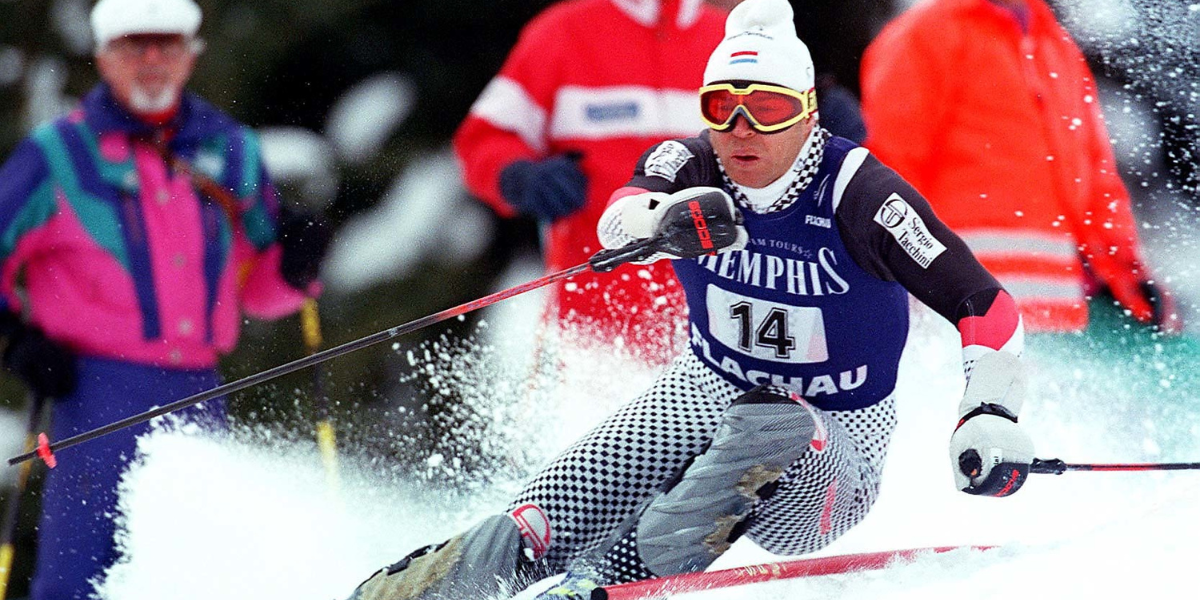
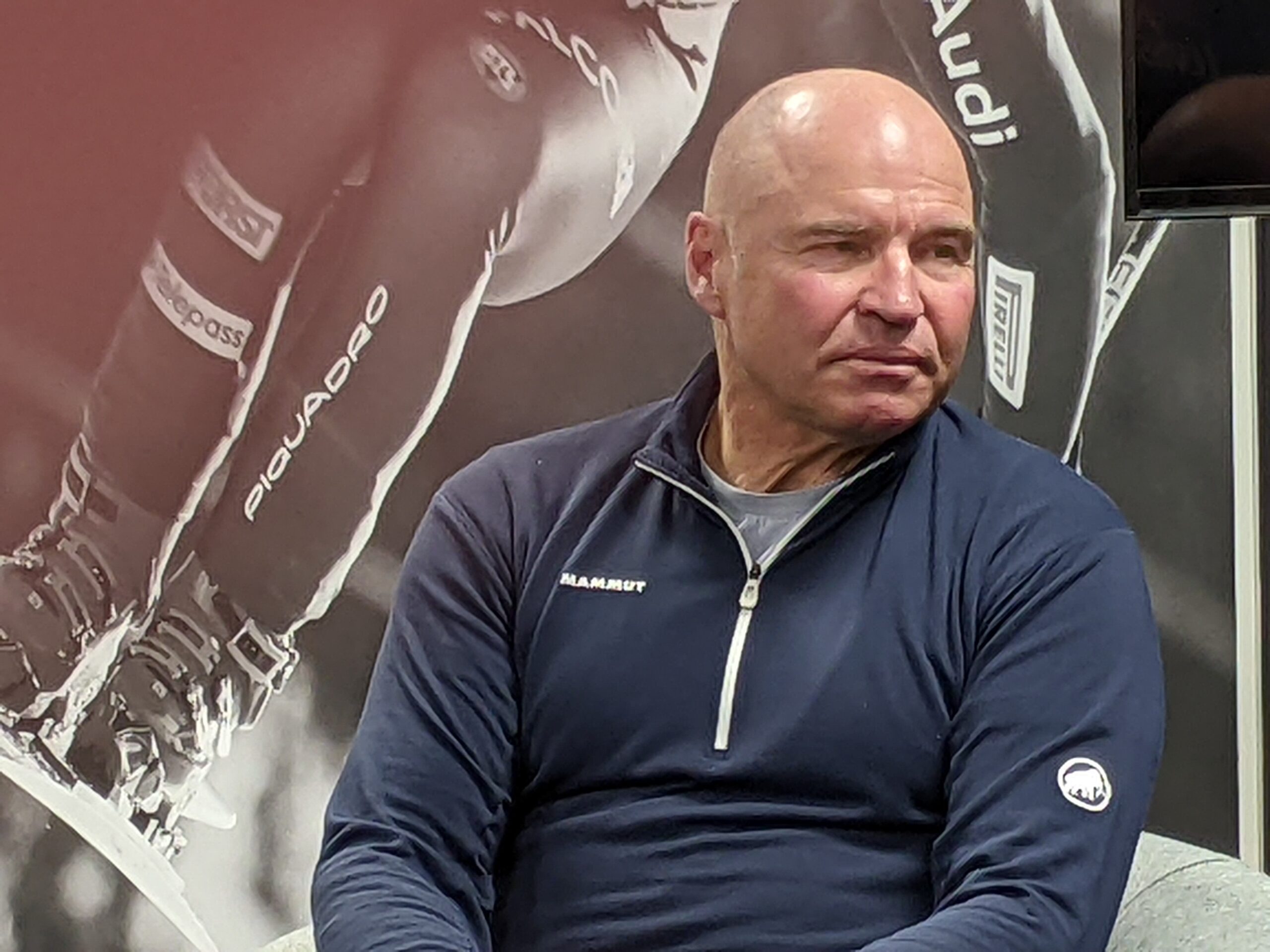
Marc Girardelli / GEPA pictures
BORMIO, Italy – On Friday, Luxembourg’s skiing legend Marc Girardelli, 63, fielded some rapid-fire questions on everything from Lindsey Vonn’s decision to race on a ruptured ACL to the new team combined format to darts, curling, and Ryan Cochran-Siegle.
You have some memories of your own here in Bormio. At the 1985 World Championships, you claimed silver in slalom and bronze in GS.
I don’t remember anything. Haha!
Can you compare between Bormio then and Bormio now?
There’s no change of the village, I can guarantee. Bormio was always a little hometown for me because for many, many years, I was on Passo Stelvio for training in summer and autumn. I think the championships in ’85 were not much different from the Olympics because when I visited the downhill on Saturday, there were not too many spectators. I estimate about 5,000, but the race was great. I think everybody who comes to Bormio leaves happy and is happy to come back.
Did you expect a performance like Franjo von Allmen’s three golds?
Everybody knew he was absolutely the top favorite in downhill. It was a good luck to have a very strong slalom skier in Tanguy Nef for the combined, but I wouldn’t have bet on him for the super-G. I thought Odermatt was stronger. The big surprise for me was Cochran-Siegle coming second. Maybe he also had a little advantage with the bib number. But if you win two gold medals I think you have such an emotional high, that maybe you can ski faster than normal in a super-G which is not your priority discipline. I’m happy for von Allmen. I think he’s going to remain the hardest rival for Marco Odermatt.
How do you see Giovanni Franzoni, after winning Kitzbühel, in this rivalry?
He proved already in downhill that he is on the same level as Odermatt and von Allmen. I was a little surprised that he was back in the super-G. He had two or three small mistakes, but with this high speed on the Stelvio slope, one slip anywhere in the course and you lose two or three tenths. It’s so difficult, especially with warm conditions, to make it up. You saw it with Odermatt and Franzoni that just one or two slides, and they lose a really big amount of time, which wasn’t the case on Thursday with the women. That was one of the most attractive and interesting women’s super-G races I ever saw. With the bumps and the course setting, I think we should make more races like that.
What did you think of the super-G winner, Federica Brignone?
You know, I was skiing with her mother. It’s bad enough. Haha. My problem is that 45-year-old women come to me and say, ‘Marc, my mother was your biggest fan.’ It’s a disaster! Her mother, Ninna [Maria Rosa Quario, a two-time Olympian], we call each other once in a while. During summer and autumn I asked how is Fede doing with the progress? I have quite some experience with heavy knee injuries, so if she had needed some advice, I would have been open to it. But she didn’t need any advice because she made everything absolutely perfect. Her knee didn’t win the race; her head won the race yesterday. I’m very proud of Fede. It is absolutely rare that an athlete comes back after such a heavy injury so quickly.
Speaking of comebacks: Lindsey Vonn
Lindsey was so good at the beginning of the season by not risking everything. She risked maybe only 80% of her potential. That was probably the recipe for success. As the Olympics got closer, the more she tried to risk – and I think that was a mistake. It was bad, bad luck, definitely, to catch the gate at the Olympics. But you already saw in the start, she had a different attitude than in the World Cups before. Maybe she was not ready in her mind to risk 100%. She already made success with 80 percent of a performance. She should have stayed. But it’s difficult. If you want to win, you risk usually more.
Sometimes, in special situations when you want to force a performance, it works the opposite way. For every athlete, success is a nice feeling, but the non-success is a much better school than victories. At the end, it’s not how big your trophy collection is at home. Racing is a part of our life. It’s a school, a development of body, soul and brain. We should use it as a school, as a lesson, and we shouldn’t measure it with trophies in the cupboard.
Vonn decided to race despite the injury. Do you have an opinion about racers taking responsibility for their own decisions? Or, if you were coaching Vonn would you have said, ‘Go for it?’
Yes, absolutely. Positive. She trained. Always on social media, I saw the videos. She was in a very good physical shape. Why shouldn’t she come back? She proved that it works. She was winning two races, and was eight times on the podium. It was bad luck here, but you cannot say – because of one accident – everything she did was wrong. I’m 100% sure everything she did was right.

If it was you and your knee, would you have made the same decision?
Certainly, and I would have won everything. I’m kidding. My body was worse than hers. But I admire Lindsey. She is a great personality. A lot of people turn on the TV because of her, not because of her World Cup races. We need personalities like that. One time, an Austrian journalist asked me. ‘Why is Lindsey more popular than the Austrian racers?’ I said, ‘Because she’s talking better, cleaner German than the Austrian racers. It’s not because of the performance, it’s because of the language. Haha!’ It’s also personality. It’s not all about skiing fast and being successful. It’s a little more.
Click Image to enlarge
In your day, you were a famous all-around skier. Is the era of the all-rounder gone?
No, I don’t think so. There will be again racers able to ski in all disciplines, from slalom to downhill. At the moment, I don’t see anybody. But Emma Aicher, she is the future champion of all the disciplines, definitely. I would bet a fortune that she wins the World Cup next year.
Italians seem to have been disappearing from the top positions in the technical disciplines. What happened with the Italian team?
Maybe you should ask Alberto Tomba to become a trainer. He still skis well. I know him. If you pay enough, he goes.
What do you think of the team combined format? Do you prefer this or the old way where one skier does both downhill and slalom?
Actually, when I first saw the program, I didn’t even understand the system for the combined because every two years, it’s a little different. Then I saw this race with men – and I have to say it was absolutely interesting. Then I watched the women: it was fantastic! I was so emotional! I couldn’t imagine the event could be so good. We should continue with this mode of racing because it is really, really interesting. It’s teamwork. I think team emotions are bigger than single emotions.
Do you think the FIS can do anything to get more teams to enter it?
For me, as a single racer for Luxembourg, it would have been a problem. But this team combined event in Bormio was really fascinating.
There’s been a lot of excitement about Lucas Pinheiro Braathen. There seem to be a lot of Brazilian TV cameras here. Your thoughts?
I think athletes like Pinheiro in the World Cup are the best. It’s like Alberto Tomba, 30, 40 years ago. People turn on the TV because of personalities. You see it on social media. Pinheiro has another level of attention compared to the other athletes. We need more people like Pinheiro Braathen in the World Cup to push our sport to the next level because otherwise we’re going to lose popularity to golf, to tennis, to soccer, to darts. I’m a dart fan, actually. I was two times in Ally Pally [Alexandra Palace] for the world championships. They drink some pints and they make a show. We have to look at what they are doing to make their sport attractive. We have to make our sport more attractive. We have to create more personalities like Pinheiro. I’m a big fan of his.
Are there any other sports besides alpine skiing you’re passionate about at these Olympic Games?
I love curling. It always reminds me of my housekeeping woman. I have to play curling in two weeks at a competition in Grindelwald. I’m a featured athlete. I have to do a ski race, cross-country, curling, swimming, and something else. I can swim, fortunately, so it won’t be a problem to drown. Curling I’m curious to play the first time.
What are you doing at these Olympics, and what have you been doing since you retired?
Actually, I like to do nothing. Haha. I’m here because I have a ski clothing line, which is not in the shops. We make team wear for ski clubs, ski schools, and whole ski resorts like Madonna di Campiglio, for example. I organize events. I am a consultant for Bansko Ski Resort in Bulgaria, and I make some speeches and write books, so I don’t get lonesome with my time. I’m three years from taking my pension, but I’m not sure if I’m going to go into pension. I always like to be with young people, finding new ideas, meeting interesting personalities. And I think skiing offers me all the possibilities of a fruitful life. That’s why I stay in the mountains with our sport.
Who Is Marc Girardelli?
Marc Girardelli (born July 18, 1963) is one of the most accomplished all-around skiers in alpine racing history. The Austrian-born racer competed for Luxembourg and built a remarkable career across all disciplines, earning 100 World Cup podiums and 46 victories.
He captured five overall World Cup titles and six discipline season titles — three in slalom, two in downhill and one in giant slalom. Girardelli also won four World Championship gold medals (three in combined and one in slalom) and claimed two Olympic silver medals at the 1992 Albertville Games.
He remains one of only five men in history to reach 100 World Cup podiums.
About the Author: Aimee Berg