
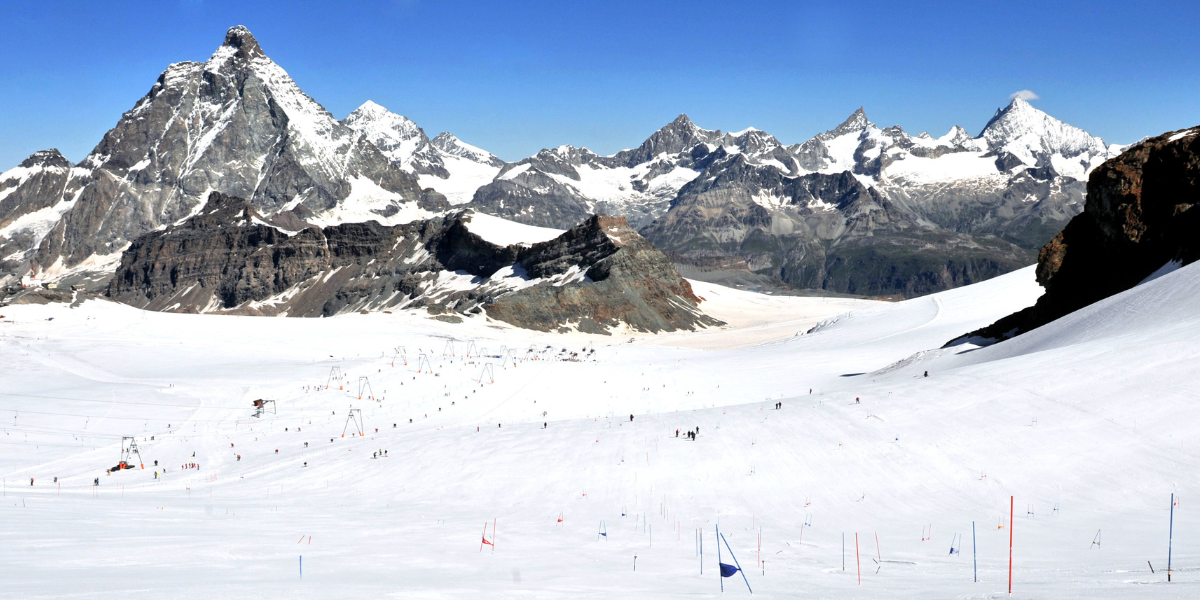
Matterhorn Glacier Paradise. GEPA pictures
The mountains that have defined alpine skiing for generations are changing — and some of the sport’s most accomplished athletes say the warning signs are becoming impossible to ignore.
During the 2026 Milan–Cortina Winter Olympics, Olympic champions Lindsey Vonn, Mikaela Shiffrin and Federica Brignone have spoken publicly about the rapid retreat of glaciers across the Alps. For athletes who spend their careers training and racing at altitude, the transformation of the mountain environment is not an abstract scientific debate — it is something they see firsthand every season.
Concerns voiced by athletes and scientists during the Games were detailed in a MediaFeed report by Liz Galst, syndicated on MSN, which examined how glacier loss and rising temperatures are increasingly visible across the alpine regions where winter athletes train and compete.
For elite ski racers, glaciers are not just scenic backdrops. They are essential training venues, particularly during the summer months when national teams travel to high elevations in Austria, Switzerland and Italy to find snow. Because athletes often return to the same glaciers year after year, they are uniquely positioned to notice long-term environmental changes.
Vonn said many of the glaciers she trained on early in her career have largely disappeared or shrunk dramatically.
Shiffrin said alpine athletes and staff often witness those changes more directly than most people because their sport takes place high in the mountains.
Snow sport athletes, she said, have a “front-row view” of how the alpine environment is evolving.
Across the Dolomites surrounding Cortina d’Ampezzo, the evidence is visible even to visitors. Glaciers that once stretched across large sections of the mountains have retreated significantly, leaving exposed rock and smaller ice remnants where permanent snowfields once existed.
How are alpine glaciers changing in the Dolomites?
One of the most visible examples of glacier retreat in northern Italy is the Marmolada glacier, the largest glacier in the Dolomites. Scientists have documented decades of shrinking ice coverage as warmer temperatures accelerate seasonal melt.
Researchers warn that many glaciers in the region have lost significant surface area in recent decades. In Italy alone, more than 200 square kilometers of glacier coverage have disappeared since the late 1950s.
The consequences are not limited to landscape changes. Glacier retreat can increase the risk of landslides and avalanches as mountain ice becomes unstable.
In 2022, a massive section of the Marmolada glacier collapsed, triggering an avalanche that killed 11 hikers and underscored the hazards linked to warming alpine conditions.
Why are winter sports particularly vulnerable to climate change?
Winter sports depend on reliable snow and cold temperatures — conditions that scientists say are becoming less predictable.
During the Milan–Cortina Olympics, temperatures at several venues reached the low 40s Fahrenheit. As a result, organizers relied heavily on artificial or “technical” snow to prepare race courses.
When the first Winter Olympics were held in 1924, competitions relied entirely on natural snow and ice. Today, refrigerated tracks, snowmaking systems and stored snow are increasingly common at major international events.
Climate scientists say mountain regions are warming faster than many other parts of the world. Shorter winters and more frequent freeze-thaw cycles can affect snow quality, race preparation and the safety of athletes competing at high speeds.
Inconsistent snow conditions can also create fairness concerns, as athletes racing later in an event may encounter softer or deteriorating surfaces.
How could glacier loss affect the future of the Winter Olympics?
The shrinking of glaciers and shorter winters raise difficult questions about the long-term future of winter sports.
Researchers studying climate trends have warned that fewer regions may be able to host reliable winter competitions later in the century if global temperatures continue rising.
The International Olympic Committee has already begun addressing the issue by implementing sustainability programs and pledging to reduce the carbon footprint of the Olympic Games.
For the Milan–Cortina Olympics, organizers produced roughly 1.6 million cubic feet of artificial snow to compensate for limited natural snowfall.
But scientists say technological solutions alone cannot fully offset long-term climate trends affecting mountain environments.
Why are Olympic athletes becoming climate advocates?
As environmental changes become more visible in the mountains, many winter athletes have begun using their platforms to raise awareness about climate issues.
More than 440 past and present Olympians have urged the International Olympic Committee to prioritize climate action when planning future Games.
Athletes have also worked with advocacy organizations such as Protect Our Winters and EcoAthletes, which promote policies aimed at reducing greenhouse gas emissions and protecting winter landscapes.
For many competitors, the motivation is simple: their careers — and the sports they love — depend on cold winters and healthy mountain ecosystems.
Athletes who spend years training on glaciers and high-altitude slopes say they see the changes firsthand.
And increasingly, they are speaking out.
What is at stake for the future of winter sports?
For athletes racing in the Alps today, glacier retreat is no longer a distant environmental concern.
It is visible on the mountains where they train.
Glaciers that once served as summer training grounds are shrinking. Snow seasons are becoming less predictable. And winter competitions are relying more heavily on artificial snow to maintain race surfaces.
The changes unfolding in alpine regions raise an important question for the global winter sports community:
How will the sport adapt if the mountains themselves continue to change?
For many in snow sports and the scientific community, the answer will depend not only on innovation within sport but also on broader global efforts to address climate change.
About the Author: SR Staff Report