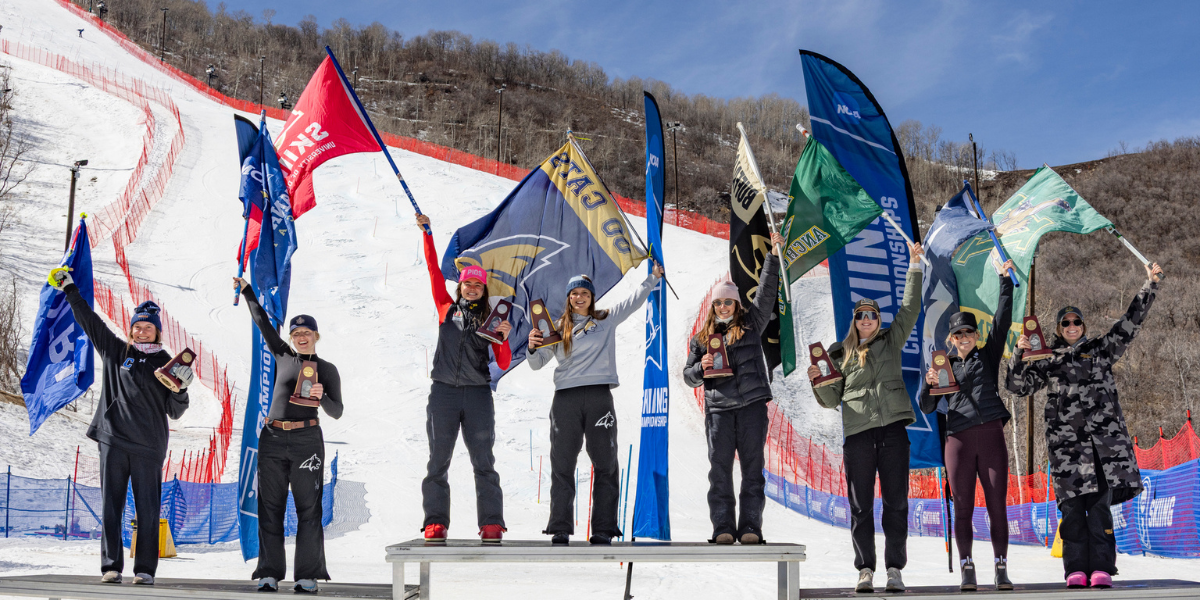
Women’s NCAA Podium 2026 | Photo by Stephen Cloutier
A proposed NCAA eligibility rule change affecting Division I programs is moving closer to adoption, and it could significantly alter how ski racers develop, time their careers, and enter the college system.
What Is Changing in NCAA Division I Eligibility?
NCAA president Charlie Baker said recently that the organization is advancing toward an age based eligibility model that would give athletes five seasons of competition at the Division I level, expanding from the current four seasons under the proposed system. That window would begin at the start of the academic year following whichever comes first: an athlete’s 19th birthday, actual high school graduation, or expected graduation date based on when they first enrolled in high school.
That distinction carries important consequences. By tying eligibility to both actual and expected graduation timelines, the model would effectively remove the ability to delay eligibility through prep years or extended schooling—an approach that has long shaped ski racing development pathways.
The proposal also clarifies that enrolling full-time at any collegiate institution—domestic or international—before those benchmarks would immediately start the eligibility clock. That detail could directly affect international athletes who take coursework while training in Europe.
What Else Would the Rule Change?
While the rule would not fully apply retroactively, current student-athletes with remaining eligibility could be evaluated under either the existing system or the new model, whichever is more favorable. However, waiver relief under current rules must be submitted by July 31, 2026, and will not extend to circumstances occurring beyond the 2025–26 academic year.
More broadly, the proposal signals a structural shift. It would remove several mechanisms that have historically provided flexibility, including clock extensions, medical hardship waivers, season-of-competition waivers, and delayed enrollment rules. Only limited exceptions, such as pregnancy, religious missions, or military service, would remain.
In ski racing, however, the impact is more complex because of the sport’s unique NCAA structure. Division I, Division II, and Division III programs compete together within the same conferences—the Rocky Mountain Intercollegiate Ski Association (RMISA) and the Eastern Intercollegiate Ski Association (EISA)—and qualify for the same NCAA Championships. Despite competing head-to-head, each division operates under its own eligibility rules.
The proposed age-based model applies specifically to Division I programs. Division II and Division III schools—including those competing in RMISA and EISA—would continue to follow their existing eligibility standards.
For ski racing, the implications reach well beyond eligibility rules alone.
How Would the Rule Impact International Ski Racers?
NCAA alpine programs have traditionally relied on international athletes—particularly Europeans—who often spend multiple years competing on FIS circuits before entering college in their early 20s.
An age-based eligibility clock would compress that timeline. Athletes would face earlier decisions about when to transition into NCAA racing, limiting how long they can contribute at Division I programs under the new rule. In response, programs may need to identify talent sooner or place greater emphasis on North American development pathways.
For older prospects, eligibility would still be determined by the NCAA Eligibility Center, which would evaluate cases under either the current delayed enrollment rules or the new model. Even so, the broader direction points toward earlier entry into Division I competition.
What Happens to the Gap-Year Development Path?
The proposal also challenges a common route for U.S. and Canadian athletes, who frequently delay college enrollment to gain experience at events such as the World Junior Championships, NorAm Cup, or Europa Cup.
Under the new Division I model, that timeline tightens. Athletes in sports like skiing would receive a one-year grace period after graduation before eligibility is impacted, but extended development beyond that window would likely come at the cost of NCAA seasons.
As a result, athletes and coaches at Division I programs may be forced to weigh development opportunities more carefully against long-term eligibility.
Will Coaches Lose Flexibility in Development?
For coaches, the shift reduces long-standing flexibility in how athletes progress through Division I collegiate programs.
NCAA ski teams have traditionally relied on redshirts, staggered progression, and long-term roster development. A fixed five-season window—combined with the removal of most waiver options—would increase pressure for athletes to contribute earlier in their careers.
That shift could influence recruiting strategy, roster construction, and how programs balance immediate performance with long-term athlete development.
A Simpler—but More Rigid—System
The proposed model introduces a more standardized and transparent framework, particularly for international athletes navigating NCAA eligibility rules. At the same time, it reduces the flexibility that has historically allowed for varied development timelines in ski racing.
Because Division I, II, and III athletes compete directly against one another in ski racing, differing eligibility structures could become a more visible factor in roster construction and competitive balance.
If adopted, the change would mark a clear turning point at the Division I level—one that pushes ski racing toward earlier entry, shorter development windows, and a more defined pathway from junior competition to NCAA competition.
According to ESPN’s Pete Thamel (April 27, 2026) and NCAA communications, the proposal remains under consideration.
About the Author: Katie Twible