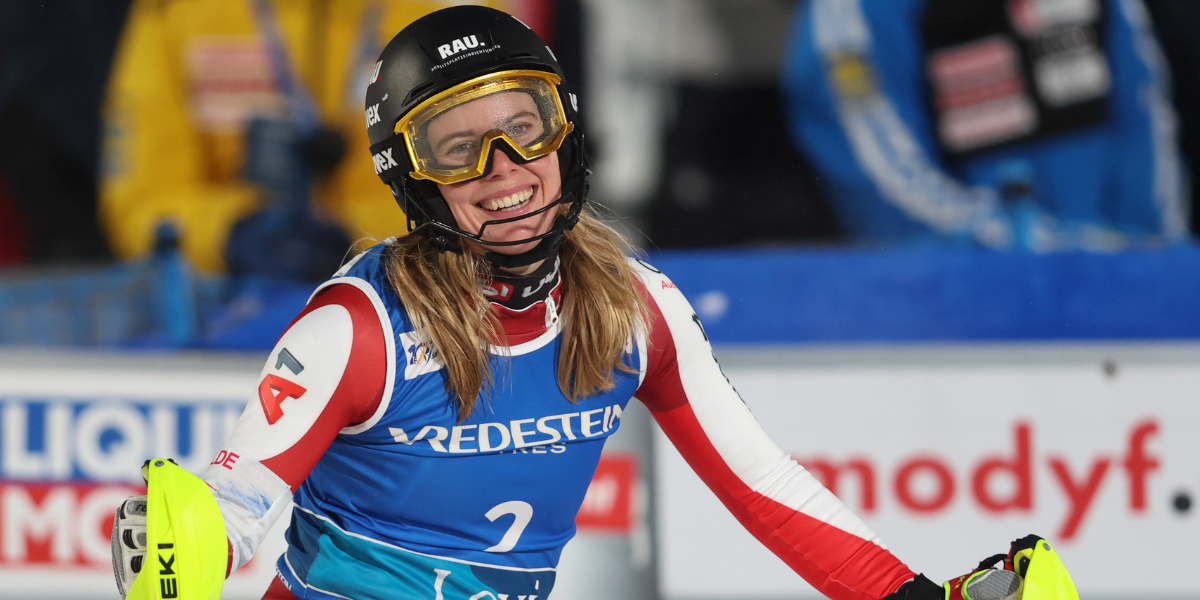
Katharina Liensberger Levi Finish: GEPA pictures
The Austrian Racer Looks to Double Down on Success from Finland at Home Race in Gurgl
A fresh outlook, revamped mindset, and critical staff additions appear to be making a difference. Austrian Katharina Liensberger is off to the best start of her nine-year World Cup career: a runner-up finish behind Mikaela Shiffrin in Levi, following an eighth-place finish at the season-opening GS in Soelden.
Liensberger captured the attention of the ski racing universe with an unexpected World Cup slalom title in 2020-21. She also upset Shiffrin and Petra Vlhová in this breakout season for world championship slalom gold on the 2026 Olympic piste in Cortina d’Ampezzo.
However, the 27-year-old Austrian’s results have dropped off over the past few seasons — until now.
“The focus this year has been to have a fresh mindset — I have simplified my approach to training and competition, focusing on the small steps rather than the big picture,” Liensberger tells Ski Racing in an exclusive interview. “We’ve also made some adjustments to my equipment, fine tunings to my set-up, which was possible overseas in Ushuaia, Argentina.
“Most importantly, I feel more mentally balanced, which has allowed me to also rediscover the joy of skiing,” she said.
Liensberger is optimistic that she can return to the echelon of her sensational 2020-21 season. Then, 23, the up-and-coming Austrian delivered clutch, late-season victories in Åre and Lenzerheide. She stole the slalom globe from Shiffrin and Vlhová, a feat only achieved twice over the past 12 seasons.
“To reach that level again, it’s about consistency and belief. In 2020-21, everything clicked because I trusted myself and I stayed focused — it just worked out,” Liensberger said.
“This season, I am working on regaining that mindset and confidence again. I’m feeling good and my team is doing fantastic work.
“Of course, to challenge Mikaela and the best in the world, I’ll need to bring my A-game every race, every day, every hour, and keep pushing my limits.”
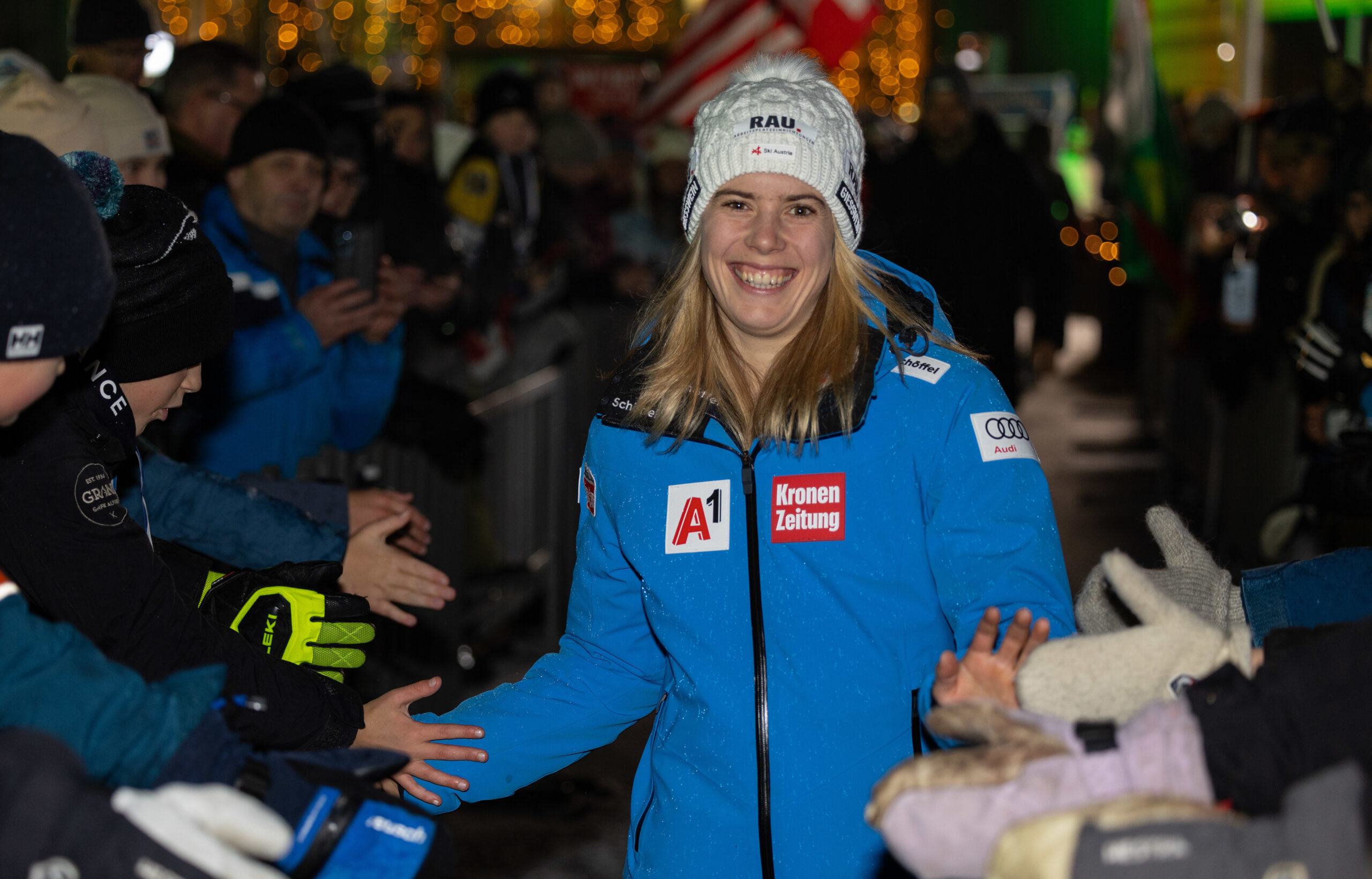
New Staff Additions Boost Confidence
Liensberger tackles this season aided by a new serviceman, Slovenian Dušan Kaps, and a new coach, German Christian Wanninger. The duo joins her core group of Austrian coaches, Alexander Berthold and Klaus Mayrhofer.
“He’s a great man and I really like working together with him,” Liensberger says about Kaps. “We really found a good way to prepare in the summertime and also with my ski company, Rossignol.
“There has been good communication, and that’s really important to bring it on the snow,” she added.
Although Liensberger’s World Cup results fell shorter than expected over previous seasons, her coaches have helped her thrive at marquee events in ski racing. She has garnered five Olympic and World Championship medals, including Olympic slalom silver at Beijing 2022.
Liensberger will have another chance to shine on the sport’s grand stage later this season and for the first time on home snow. Saalbach hosts the FIS Alpine Ski World Championships Feb. 4-16, 2025.
A Fresh Challenge Awaits in Gurgl
Liensberger seeks to carry the speed from her second-place finish in the far reaches of Lapland to more familiar surroundings in the Austrian Tyrol.
Liensberger, Shiffrin, and competitors will get their first taste of the new World Cup slalom hill, the Kirchkenkar, on Saturday in Gurgl. Located in the Ötztal Valley about a 15-minute drive from Soelden, the 548-meter race hill boasts a 210-meter vertical drop and a 62 percent maximum incline.
“It’s always great to race on a new hill that brings an element of unpredictability and challenges everyone equally,” Liensberger says about the piste that the men christened last season. “I know that slope is technically very hard, so it’s really important to have a good rhythm and maintain a good focus.”
Naturally, a raucous Austrian crowd will be urging on all of Liensberger’s turns.
The Austrian racer from Vorarlberg, the country’s westernmost state, has never won a World Cup on Austrian snow. However, she has claimed five podium finishes (three second-place and two third-place) in her country.
Liensberger believes she can thrive in front of the home nation fans in Gurgl.
“It’s fantastic to have a lot of people from your home area that will cheer for you and be on your side. It gives me a lot of energy and motivation, and it’s one of those things that makes skiing so emotional.”
Living Up to Lofty Austrian Expectations
Austria is a fanatical ski racing nation where expectations among fervent supporters of the Austrian Ski Team are always sky high, but Liensberger’s breakout season in 2020-21 quickly raised the bar.
Living up to them has not been a piece of Sacher Torte. Since her two World Cup wins and eight podiums that season, Liensberger added just one victory and four podiums over the next three seasons.
“The setbacks and periods of self-doubt have been the most challenging. It’s really hard when the results don’t reflect the effort put in during training,” Liensberger explains. “It has helped me to set small and achievable goals to rebuild confidence during tough times.
“The struggles have made me stronger and more appreciative of the highs afterward.”
Liensberger says that as she matures as a ski racer, now age 27, she has learned to temper those expectations and ski within herself with a solid mental acuity.
“Earlier in my career, I focused heavily on physical preparation and technical skills. Now, over time, I’ve realized the importance of mental strength and self-belief,” she says.
“I’ve worked on staying present and managing pressure more effectively.”
Liensberger says she has taken positive aspects from difficult moments. Those struggles included dropping to 19th and 20th in the slalom and GS standings in 2022-23. She also ended 20th in slalom and 24th in GS, a clear disappointment at the 2023 World Championships in Méribel.
“I’ve learned that the most growth comes from setbacks as much as the successes,” she says. “It makes you a more resilient athlete. These are maybe the most important parts of my career.”
Just Like a Religion, But Colder
There are certainly pros and cons to being an elite-level Austrian ski racer. Pressure is immense, the spotlight is bright, fans demand success, and media scrutiny can be unrelenting.
For North American sports aficionados, you might compare it to star athletes competing for legendary franchises such as the New York Yankees, Boston Celtics, or Montreal Canadiens.
“Representing Austria is a real honor, but it also comes with a lot of expectations,” she said. “It’s a country where ski racing maybe is almost a religion.
“There’s always pressure to perform, especially with such a rich tradition of success, but that’s also what makes it special. The passion and support from fans is unique, so it’s just amazing for everyone.
“As ski racers from Austria, when we wear the red and white suit, we’re ready to fight,” Liensberger says passionately. “Knowing that I’m part of this team motivates me to give my best every time I step on the hill.”
Follow Brian on Instagram – @brian.pinelli
About the Author: Brian Pinelli