

This article is part of the Rowmark Science Corner, a continuing series that explores evidence-based training principles, performance science, and long-term athlete development in alpine ski racing.
Introduction
Eccentric strength training plays a crucial role in athletic development, particularly in sports that demand a high level of control, stability, and power, such as alpine skiing. Unlike concentric training, which emphasizes muscle contraction under load, eccentric training focuses on the lengthening phase of the muscle, often with assistance during or elimination of the concentric phase.
This controlled lowering phase helps build strength and enhance muscular coordination.
For young athletes, incorporating eccentric-focused exercises with proper tempo and lighter loads offers a safe and effective way to build the strength and joint stability necessary for skiing’s physical demands. Numerous studies have shown unique muscular adaptations during eccentric contractions, including enhanced cross-bridging of myosin fibers. These changes contribute to greater force production and muscular efficiency.
This growing evidence highlights eccentric training as a key component in developing the strength, control, and durability required for success in alpine skiing.
What Eccentric Training Is and How the Muscle Functions
Strength training includes three primary phases: concentric, isometric, and eccentric. The eccentric phase occurs when the muscle lengthens under load, controlling the downward or returning portion of a movement. It happens when the external force exceeds the momentary force produced by the muscle.
This phase builds strength, stability, and mobility — all of which are essential for athletic performance. By improving joint stability around the knees, hips, and spine, eccentric training supports efficient movement and helps reduce the risk of injury during dynamic and elastic actions.
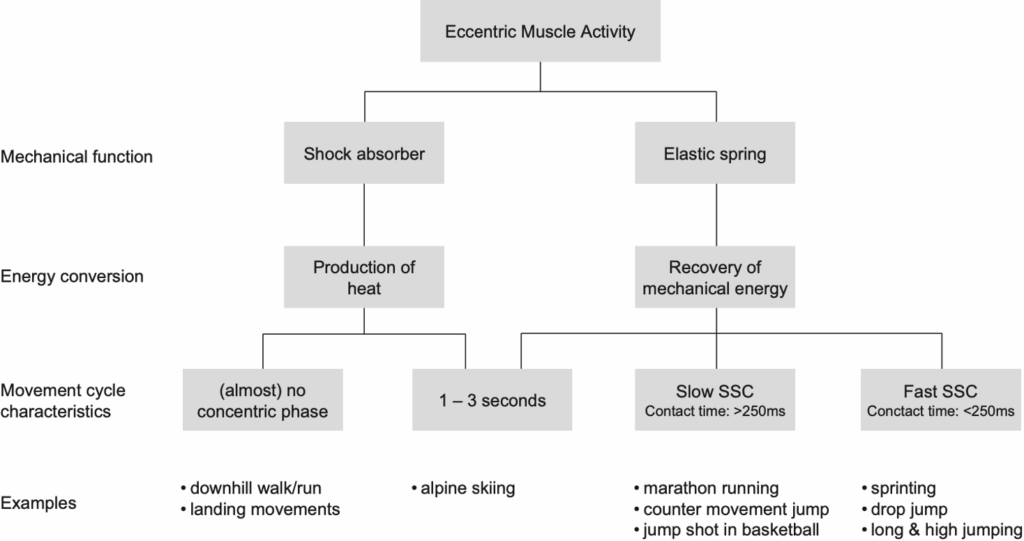
During the eccentric phase, the muscle lengthens under tension, absorbing mechanical energy through the muscle-tendon system. That energy can be reused for elastic response — up to 50% — or dissipated as heat during more prolonged contractions.
Eccentric contraction falls into two categories:
- The elastic spring type — short contractions (less than 250 milliseconds) that store and release elastic energy.
- The shock-absorbing type — more prolonged contractions (one to three seconds or more) where energy dissipates as heat rather than being reused.
Research shows that muscles produce more force during eccentric contractions than concentric ones, allowing athletes to safely overload muscles and build strength efficiently. This controlled overload enhances the stretch-shortening cycle — the process of storing elastic energy during eccentric motion and releasing it during contraction.
Applications in Alpine Skiing
In alpine skiing, longer contraction times (typically 20–70°/s up to 120°/s) likely mean that the knee extensors act more as shock absorbers than elastic springs. This has implications for off-snow training choices, suggesting that skiers’ strength programs should emphasize control and energy absorption over rapid recoil.
The outcome of consistent eccentric training is improved muscular power, control, and efficiency — essential qualities for skiers to possess. However, skiing involves complex muscle actions influenced by vibration and uneven terrain. These additional variables create further challenges in understanding how musculature functions during skiing, a topic the Rowmark coaching group will explore in a future article.

Implementation with Youth Athletes
Introducing eccentric training for athletes at or below the U16 level provides an excellent foundation for strength and conditioning. Early exposure helps athletes develop correct movement patterns and understand how their bodies respond to force.
Several safe and effective training methods allow young athletes to learn how to absorb force without using excessive loads. These methods include body-weight exercises, tempo-controlled movements, and unilateral training.
Body-Weight Methods
The simplest way to start eccentric training is by using body weight combined with gravity or assistance from a partner. This approach allows younger athletes to practice safe control while improving coordination for more complex lifts later on.
Because the load is submaximal, the athlete can focus on technique and muscle activation, learning how to engage proper firing patterns for flexion and extension. Submaximal loading also reduces — though does not eliminate — the risk of injury.
Examples include:
- Modified step-ups that emphasize the downward phase, using the non-loaded leg to assist the return to the starting position.
- Assisted hamstring curls performed lying down, with a partner providing gentle resistance as the athlete extends to the full-knee position.
Tempo-Controlled Movements
A second method is to manipulate the tempo of movement to change muscle loading. Slowing down the descent or return phase increases time under tension and challenges control.
Tempo training can target either elastic, quick contractions (for power and stretch-shortening efficiency) or slower, yielding movements (for strength and tendon resilience).
Most non-ballistic exercises can be adjusted for tempo. Examples for young athletes include:
- Counting through a slow descent in a body-weight squat, emphasizing control to the bottom position before returning at normal speed.
- Modified leg extensions where both legs extend together, but only one leg controls the 10–15-second return, strengthening the patellar tendon.
Unilateral Movements
The third method combines unilateral (single-leg) eccentric actions with bilateral or assisted concentric phases. This structure enables athletes to safely overload the eccentric portion while completing multiple repetitions efficiently.
Unilateral work also enhances balance and single-leg stability, both of which are vital for skiing.
Examples include:
- Sled-leg presses, where both legs push the sled up, but only one leg controls the return.
- Single-leg squats using TRX straps or hand support to assist the upward motion, emphasizing slow, controlled descent through the full range of motion.
Conclusion
Eccentric training can take many forms — from advanced supermaximal loading, flywheel systems, and plyometrics to simple body-weight and tempo-based movements. When simplified and properly loaded, it becomes an excellent teaching tool for strengthening muscles and tendons, preparing athletes for more advanced work in later years.
A well-rounded training plan should integrate mobility, flexibility, coordination, traditional strength training, and conditioning alongside eccentric elements. When applied thoughtfully, eccentric training helps young skiers develop the control, power, and durability necessary to excel both on and off the hill.
Explore more evidence-based insights on strength training, performance development, and applied sport science in alpine skiing in the Rowmark Science Corner series.
About the Author: Alexis Hollister


Coauthor Peter Girardi joined Rowmark Ski Academy in 2022 and serves as the Head Men’s FIS Coach and Head Conditioning Coach. With coaching and racing experience across the United States, Europe, and Canada, he brings a broad, global perspective to athlete development. A Montana State University graduate with a degree in industrial engineering, Girardi combines analytical thinking with hands-on coaching. He lives in Salt Lake City with his wife, Megan, and their son, Theo. Outside of skiing, he enjoys road cycling, fitness training, and time on the family boat. Girardi’s coaching style emphasizes strong relationships, technical execution, physical preparation, and recovery, helping athletes develop confidence both on and off the snow.No secondary author specified.