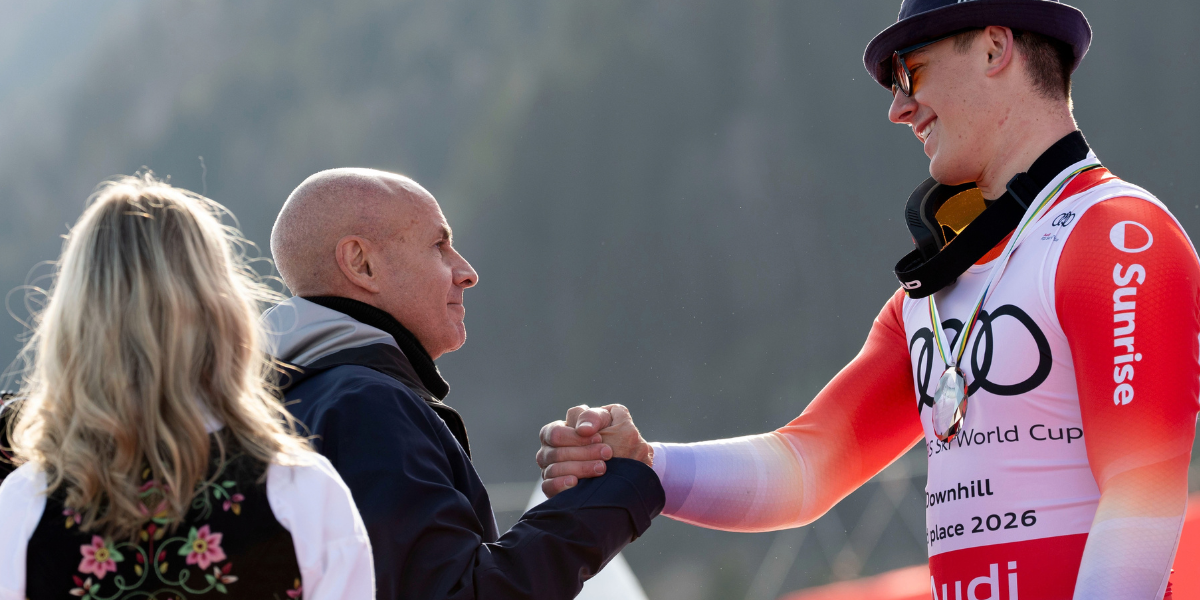

Paul Accola (SUI) GEPA pictures
Alpine skiing is facing a reckoning. The injury crisis that unfolded in Bormio during the New Year’s week, with four athletes suffering severe injuries, has reignited debates about safety and preparation in the sport. Paul Accola, one of Switzerland’s most decorated skiers and a former overall World Cup champion, has added his voice to the conversation with bold claims about what’s going wrong in modern training.
In an interview with Blick.ch, Accola questioned the priorities of today’s athletes and coaches, offering his perspective as a skier who thrived in a different era. With seven World Cup victories, 26 career podiums, and a reputation for thinking outside the box, Accola’s criticisms come with significant weight.
“Many Athletes Train Incorrectly”
Accola asserts that summer training programs are fundamentally flawed, focusing too heavily on building muscle mass without considering how it translates to skiing. “There is a lack of holistic training,” Accola told Blick.ch. “Many racers focus on making their thighs really thick in the weight room. But that doesn’t make the ligaments any thicker.”
Accola says the problem is that gym exercises don’t mimic the unpredictable forces skiers encounter on the slopes. He argues that this disconnect leaves racers vulnerable when they lean back on their skis, a position that frequently leads to torn ligaments.
Drawing from his career, Accola highlighted the benefits of unconventional training. “I often ran up the steepest hills and sprinted down them,” he said. This method built strength and forced him to react quickly to obstacles like stones or roots, sharpening his reflexes. According to Accola, such training prepared him and contemporaries like Mike von Grünigen (four GS titles) and Urs Kälin (13 podiums) to adapt to the more aggressive carving skis introduced in the late 1990s—without suffering major ligament injuries.
Problems Begin in Youth Development
Accola’s critique extends to how young skiers are trained. “The majority of ski racers cannot handle the element of snow properly because they train almost exclusively on perfectly prepared courses,” he told Blick.ch. He believes this over-reliance on pristine conditions leaves athletes unprepared for the bumps and holes they face on World Cup tracks.
Marco Odermatt, he said, is a rare exception because he spent significant time skiing powder and mogul slopes as a child. Accola credits this varied experience for Odermatt’s ability to adapt to challenging race conditions.
The problem isn’t just about training methods but also access. Accola criticized the increasing reliance on summer glacier camps, which he argued are expensive and take a toll on young athletes. “By the time winter begins, many kids are no longer enthusiastic about skiing,” he said. He also pointed out that the high costs of these camps disproportionately favor wealthier families, leaving less affluent talents without opportunities. “A farm boy like me hardly has a chance these days,” Accola said.
Revisiting the World Cup System
Accola also took aim at the World Cup points system, which he believes discourages young racers. “In my day, a top-10 finish could put you in the first slalom starting group. Today, you need at least 50 points to break into the top 30,” he explained to Blick.ch. The current system, he argues, forces young skiers to spend too much time climbing the ranks, leading many to abandon the sport prematurely.
Responsibility and Risk
Accola didn’t hesitate to blame the athlete when discussing recent crashes, such as Cyprien Sarrazin’s severe fall in Bormio. “Sarrazin only has himself to blame,” he said. “He went over that edge far too uncontrolled. As a downhill skier, you really have to eat an edge like that.”
This blunt assessment underscores Accola’s belief in personal responsibility and discipline. While some call for safer equipment and better course preparation, Accola insists that improving individual adaptability and training is the key to reducing injuries.
Revisiting the Causes of the Injury Crisis
While Paul Accola emphasizes flawed training and a lack of adaptability as the primary drivers of the injury epidemic, other experts offer different explanations. Austrian ski commentator and former racer Hans Knauss has pointed to equipment and slope preparation as critical areas for improvement. Knauss argues that current skis and boots, combined with increasingly icy and demanding course setups, create dangerous conditions for athletes.
Accola, however, believes that equipment alone is not to blame. “If athletes trained holistically and developed better adaptability, they’d be less likely to suffer injuries in these situations,” he contends. The contrasting perspectives of Accola and Knauss highlight the issue’s complexity, suggesting that a combination of training, equipment, and slope management changes may be necessary to improve athlete safety.
A Controversial Voice Worth Hearing
Paul Accola’s comments, as reported by Blick.ch, have sparked a heated debate in the skiing community. His success—a nearly two-decade career with Olympic and World Cup accolades—gives his opinions credibility, even if they challenge the status quo.
As alpine skiing grapples with its injury crisis, Accola’s insights call for reflection on the sport’s evolution. Whether his critique leads to meaningful changes or fuels further debate, his voice reminds us that skiing’s future depends on balancing innovation with past lessons.
About the Author: SR Staff Report