Wiley Maple Bormio 2023: GEPA pictures
Who’s Racing, When to Watch, and How to Tune In
Cyprien Sarrazin’s Dramatic Turn on the Stelvio
A year ago, Cyprien Sarrazin celebrated his first career World Cup victory on the Stelvio, mastering one of the most treacherous downhill courses in Alpine skiing. This year, the story took a tragic turn. During a training run on the same slope, Sarrazin suffered a serious crash and had to be airlifted by helicopter from the course. He was diagnosed with a subdural hematoma.
Currently in neurological intensive care, Sarrazin’s condition raises concerns about his season, though fans remain hopeful for his recovery. His crash underscores the Stelvio’s reputation as an unforgiving test of skill and endurance, where even champions can face its perilous challenges.
The Stelvio: A Legendary Course
The Stelvio course in Bormio, Italy, stands as one of the most iconic and challenging downhill tracks in Alpine skiing. Its history dates back to 1982 when it hosted its first-ever World Cup race, marking the beginning of a storied legacy. The Stelvio gained worldwide recognition during the 1985 Alpine Ski World Championships, solidifying its status as one of the premier venues in the sport. Since 1993, the Stelvio has been a regular fixture on the Men’s World Cup circuit, thrilling fans and testing racers year after year.
U.S. Success on the Stelvio
For American ski racing, the Stelvio holds a special place. In the 2004-05 season, Daron Rahlves and Bode Miller delivered a historic 1-2 finish at the 2005 Alpine Ski World Championships—the best day in U.S. downhill World Championship history. At the beginning of the 2005-06 season, Rahlves claimed a World Cup victory on the Stelvio, a fitting finale to his illustrious career before retirement. Miller added to the U.S. legacy with a World Cup win on the Stelvio in 2007. These remarkable performances underscore the Stelvio’s role as a proving ground for greatness.
A Course Built to Challenge the Best
With a vertical drop of 1,010 meters (3,314 feet), an average gradient of 34 percent, and a total length of 3,270 meters (10,728 feet), the Stelvio stands as one of the most technically demanding courses on the World Cup circuit. Its notable sections include the Carcentina, a twisting S-turn that demands absolute precision at high speeds; the San Pietro Jump, a breathtaking leap requiring perfect timing; and the infamous Folate, a fast, rough, and icy finish that tests skiers’ physical and mental endurance.
Adding to the challenge, the Stelvio’s flat light and hidden micro-terrain force racers to remain in constant physical tension, never able to safely relax their muscles as they anticipate the next jolt or bump. This adjustment highlights the flat light, unseen challenges, and constant need for physical tension, reinforcing the Stelvio’s reputation as a true endurance test. The Stelvio’s fearsome reputation and rich history make it a fan favorite and a proving ground for the world’s elite racers.

Previous Season Highlights
Last year, the Stelvio lived up to its reputation as one of the most grueling tests of skill and endurance in Alpine skiing. Sarrazin delivered a standout performance to claim victory, showcasing his mastery of the treacherous course. Switzerland’s Marco Odermatt followed in second, while Canadian Cameron Alexander secured the best North American result with a podium finish in third. Maple led the U.S. contingent with a strong 12th-place result, while Goldberg finished 27th.
The race also proved unforgiving, ending Sam Dupratt’s season after a severe injury. This year, the course’s reputation has been further underscored by Sarrazin’s serious crash during training earlier today, resulting in a subdural hematoma. Currently in neurological intensive care, his absence casts a shadow over this year’s race and serves as a stark reminder of the dangers of the Stelvio. As racers prepare to take on the iconic slope once more, the stakes remain as high as ever.
What to Expect on December 28th
The Stelvio will host the third downhill of the 2024-25 season. Known for its icy terrain, steep gradients, and technical demands, the race promises high-stakes competition. It also serves as a preview for next season’s Olympic test, making it a key event on this year’s calendar.
Current 2024-25 Men’s World Cup Top 15 Downhill Ranking
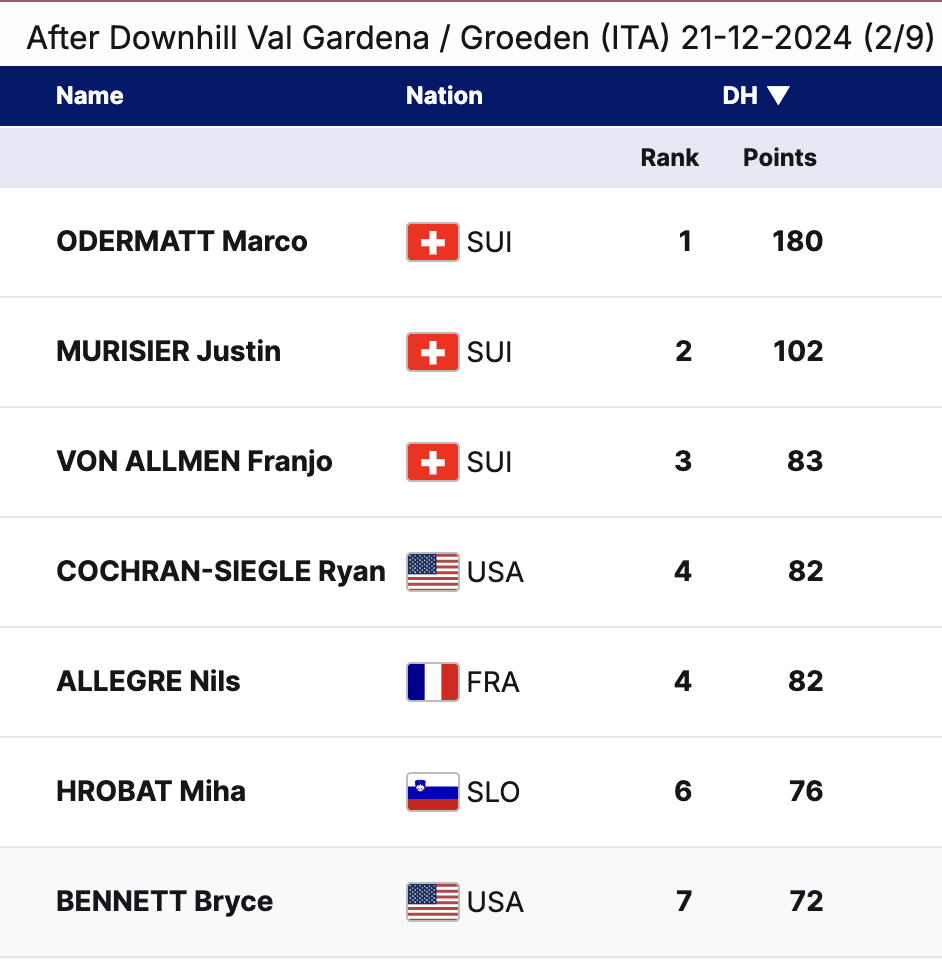
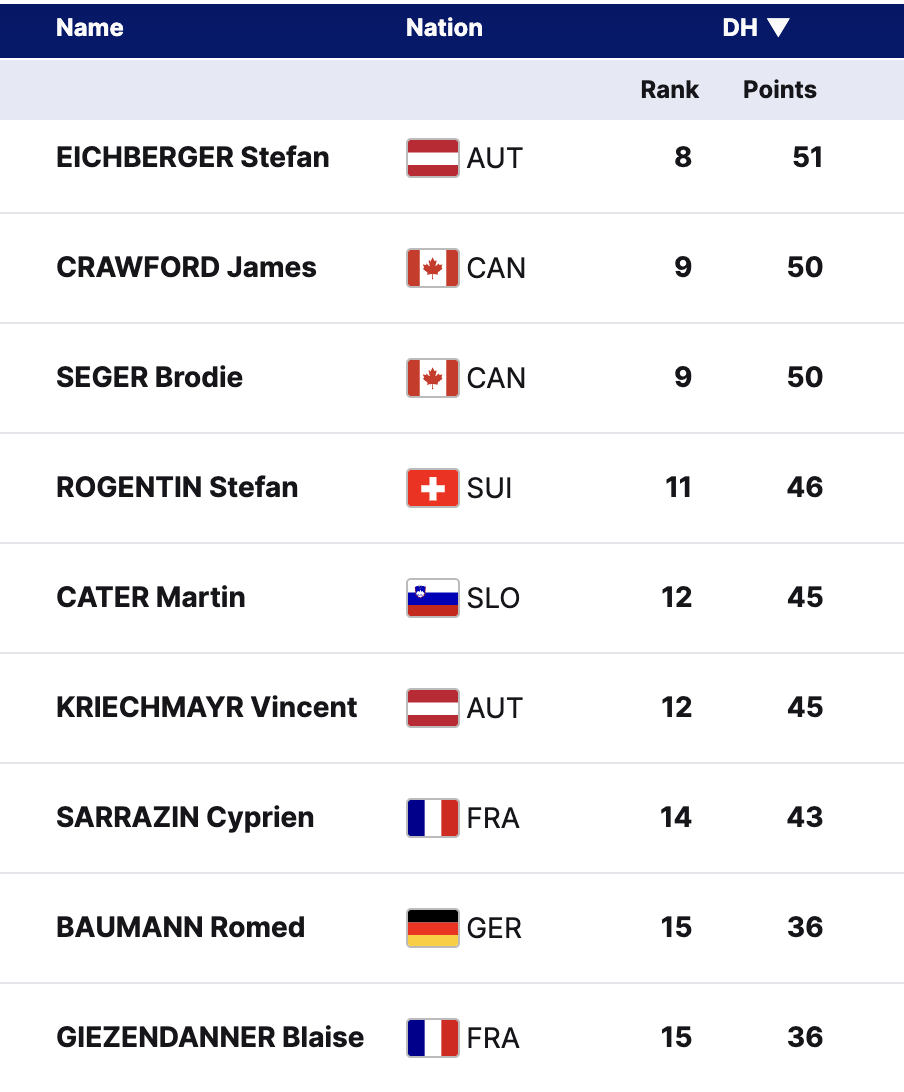
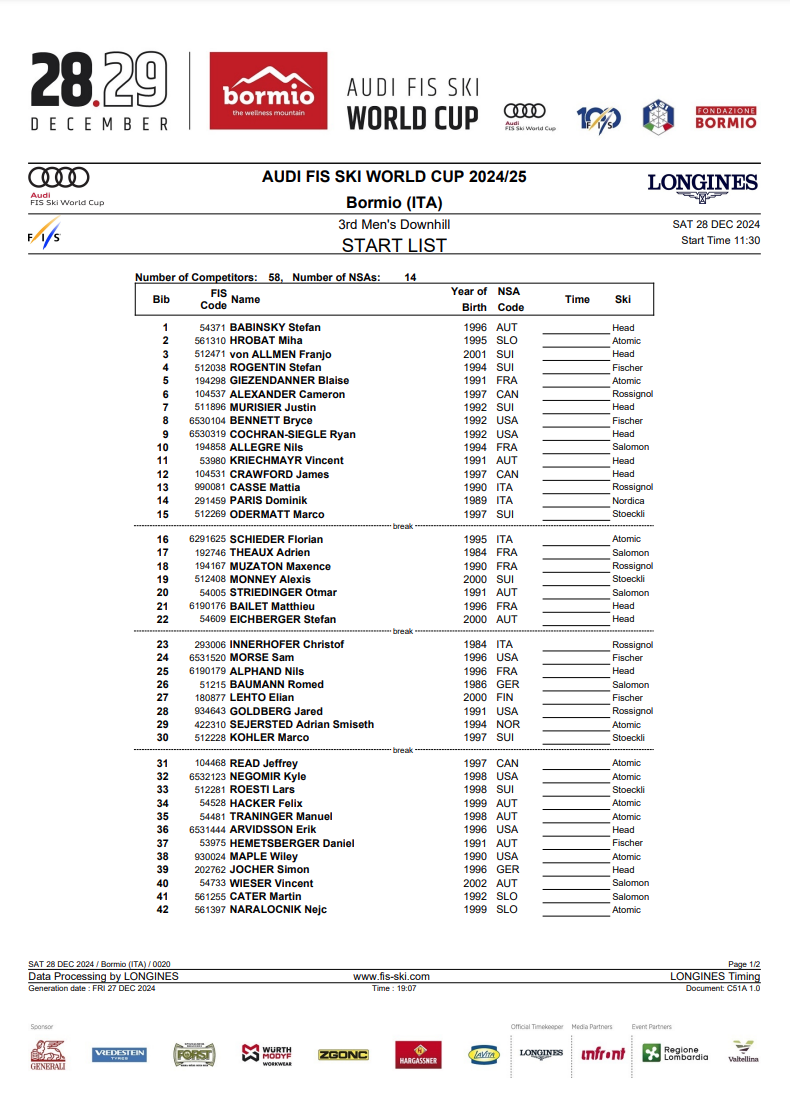
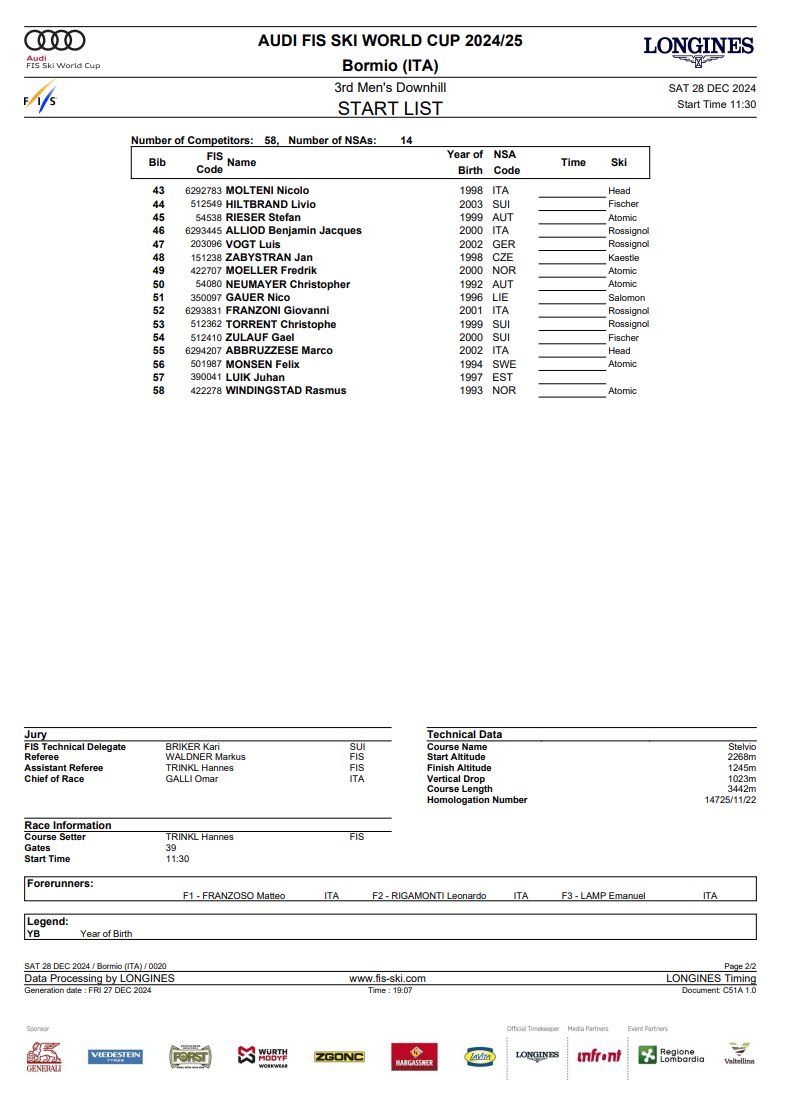
Fifty-eight racers from 14 countries will compete in the Bormio Stelvio Downhill, with Austria and Switzerland each entering 10.

This Season’s Downhill Contenders
The Swiss team has been unstoppable in downhill racing this season, claiming victories in both of the first two races. Odermatt, the reigning World Champion and current season-long downhill leader, won in Val Gardena and finished second in Beaver Creek. His teammate Franjo Von Allmen, a rising star at just 23 years old, secured second place in Val Gardena, while Justin Murisier triumphed in Beaver Creek. Remarkably, the Swiss occupy the top three spots in the downhill season standings and boast four racers in the top 15 overall—a testament to their depth and dominance.
As the Stelvio looms, the Swiss are not just chasing individual victories but also cementing their reputation as the team to beat this season. Odermatt will lead the charge, with Von Allmen and Murisier providing strong support on a course that rewards their precision and power.
Austria’s Struggles
Austria, a traditional powerhouse in Alpine skiing, has faced a challenging start to the season and remains without a podium finish. Last year’s Stelvio downhill not only tested the limits of the athletes but also marked the end of Austrian superstar Marco Schwarz’s season due to a severe injury. Schwarz, a versatile racer known for his prowess across multiple disciplines, has recently returned to competition, making his comeback in the Val d’Isère slalom. As Austria’s top contenders, Stefan Eichberger and Vincent Kriechmayr, prepare for this year’s Stelvio, they carry the weight of reviving the nation’s downhill dominance on one of the most demanding courses in the sport.
North American Hopes
North American racers have shown strong form this season, with seven athletes scoring downhill points so far. Ryan Cochran-Siegle (USA) leads the group, sitting fourth in the season standings after his podium finish in Val Gardena. Bryce Bennett (USA) is ranked seventh, showcasing consistency and a knack for delivering on challenging courses like the Stelvio.
On the Canadian side, James Crawford and Brodie Seger are tied for ninth, adding depth to Canada’s strong downhill presence. Alexander, who earned a podium at last year’s Stelvio downhill, currently holds 18th in the standings and will aim to replicate his past success on the course.
Two additional Stifel U.S. Ski Team members, Sam Morse (ranked 33rd) and Erik Arvidsson (ranked 35th), round out the North American contingent, with both skiers capable of breaking into the top 30 with strong performances. As a group, the North Americans bring a blend of experience, momentum, and grit to the Stelvio, making them athletes to watch on race day.
North Americans on the DH World Cup Start List (WCSL)
It is distinct from the current season standings
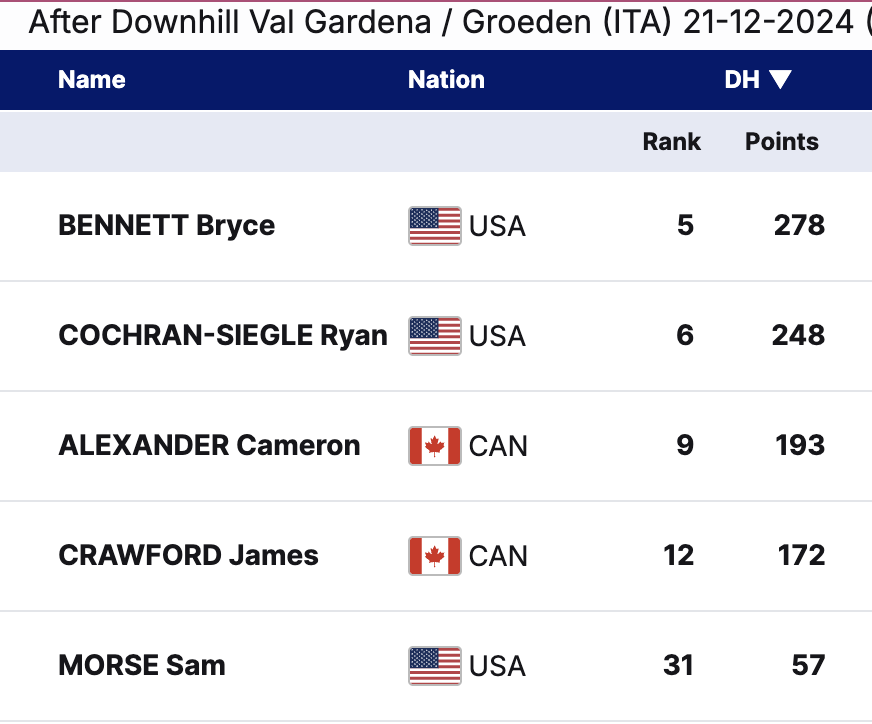
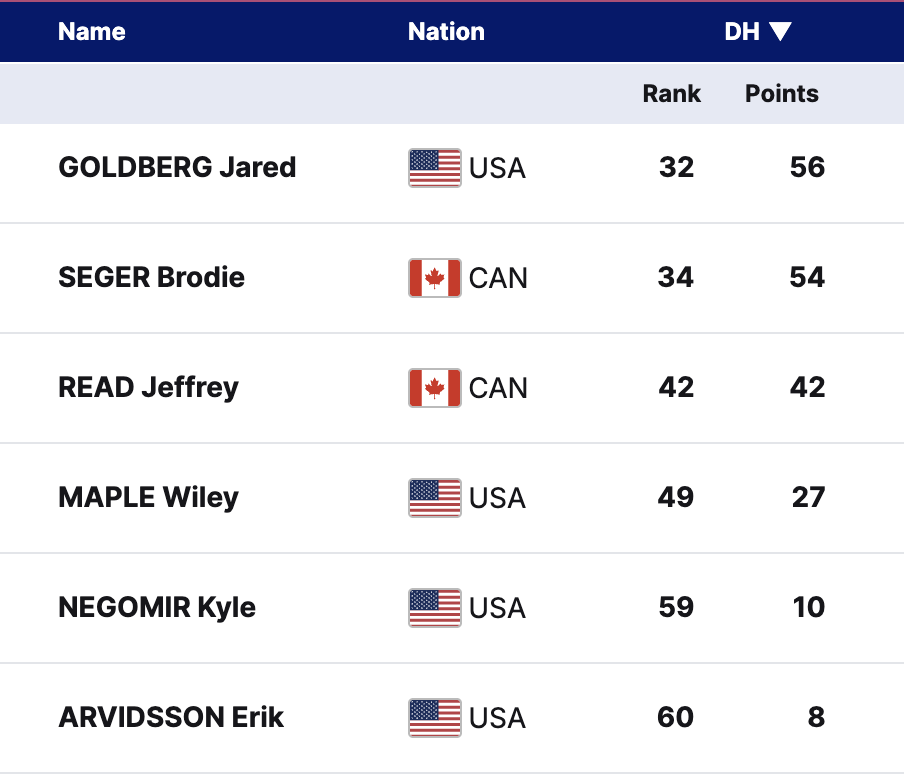
North Americans Seeking Downhill Success
In addition to the seven North Americans who have already scored downhill points this season, several others are aiming to secure their first points at Bormio. Jared Goldberg (USA), a member of the Stifel U.S. Ski Team, recently achieved his first World Cup podium, finishing just one-hundredth of a second behind the winner in Val Gardena’s super-G. This impressive performance underscores his potential, even as he seeks his first downhill points of the season.
Joining him are fellow Stifel U.S. Ski Team member Kyle Negomir, who has scored super-G points this year, and Maple, the fastest U.S. finisher at Bormio last season with a strong 12th place. On the Canadian side, Jeffrey Read, who had a breakout season in 2023-24 but has faced challenges early this year, will look to return to form on the demanding Stelvio. Their participation adds depth to the North American contingent, and their performances will be closely watched as they compete on one of the most challenging courses of the season.

North American Men Racing the Downhill
- Bib 6, Cameron Alexander, ACA, Whistler Mountain Ski Club
- Bib 8, Bryce Bennett, Stifel USST, Team Palisades Tahoe
- Bib 9, Ryan Cochran-Siegle, Stifel USST, Mt Mansfield Ski Academy, Cochran’s Ski Club, HEAD
- Bib 12, James Crawford, ACA, Whistler Mountain Ski Club, HEAD
- Bib 28, Jared Goldberg, Stifel USST, Snowbird Sports Educational Foundation
- Bib 31, Jeffrey Read, ACA, Banff Alpine Racers, Atomic
- Bib 24, Sam Morse, Stifel USST, Carrabassett Valley Academy, TOKO
- Bib 32, Kyle Negomir, Stifel USST, Ski and Snowboard Club Vail, Atomic
- Bib 36, Erik Arvidsson, Stifel USST, Team Palisades Tahoe, Middlebury College, HEAD
- Bib 38, Wiley Maple, USA Independent, Aspen Valley Ski and Snowboard Club, SYNC, Atomic, Oakley
How and When to Watch
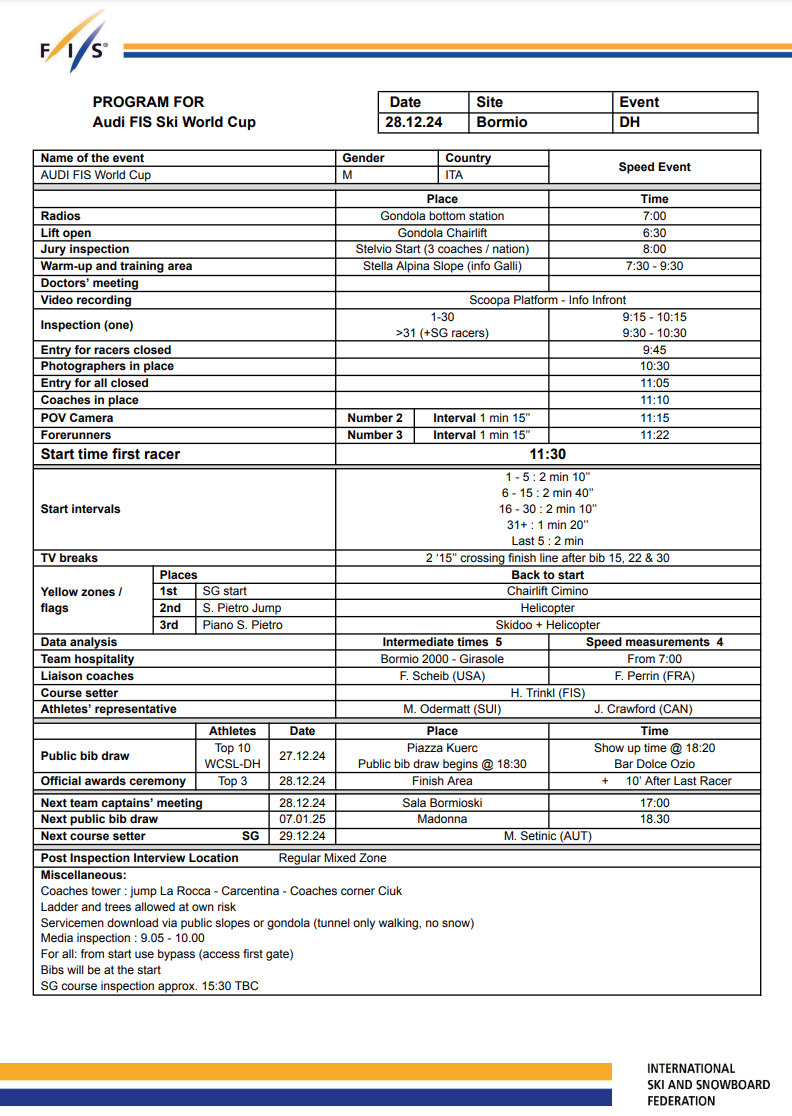
The race starts at 5:30 a.m. Eastern and 2:30 a.m. Pacific time,
U.S. audiences can watch the race live or as a replay on Ski And Snowboard Live.

Sports enthusiasts in Canada can watch the World Cup on CBC Sports.
Daily Program and Start List
Click the images to enlarge or download.
Start List
Related Article: Jared Goldberg Eyes Bormio World Cup After First Career Podium
About the Author: Peter Lange