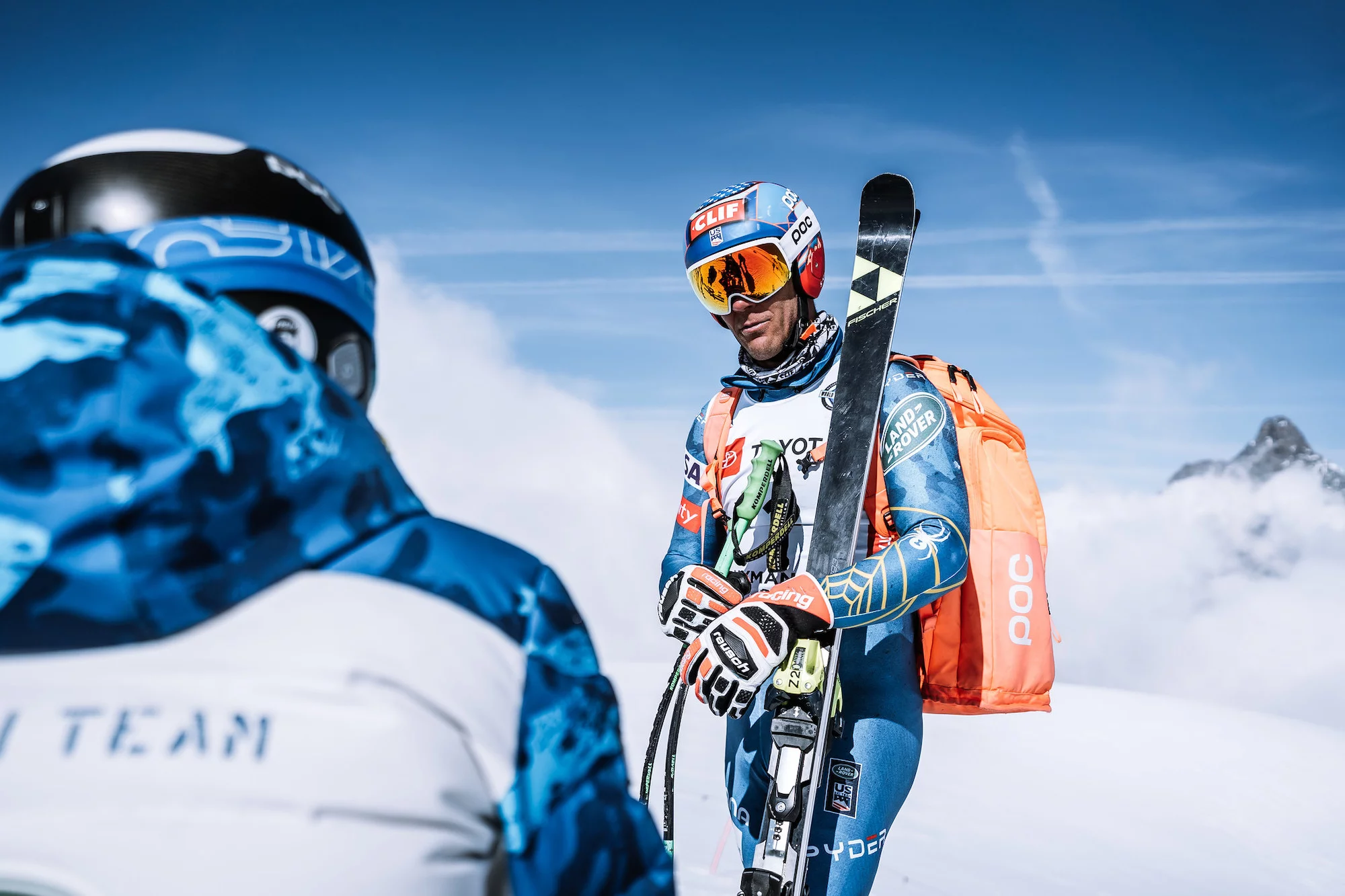
Steven Nyman progressing on snow at Zermatt camp, eyeing comeback season

Photo Credit: Marc Amann (@amarcster.sport) – U.S. Ski Team (@usskiteam)
Steven Nyman is accustomed to overcoming injury and adversity, however, he admits his latest quest to return to racing form has been tougher than expected. But older and wiser considering his nearly two decades experience on the U.S. Ski Team, Nyman is more calculated and determined than ever, bullish about his prospects for the Beijing 2022 Olympic Winter Games, now less than 150 days away.
Nyman returned to Zermatt, where the U.S. speed team is holding their second two-week training camp on the Swiss glacier following a two-week break. The Park City, Utah racer is pleased with his progress, still battling to overcome the effects of an Achilles tendon injury suffered at Mt. Hood, Oregon, in August 2020. He concedes, now at age 39 and the father of two daughters, recovery and return to racing speed require far greater patience.
“I’m feeling good – the first camp we had great conditions, beautiful sunshine every day, hard snow, a couple days canceled due to wind, but great conditions and was starting to get back into it, but to be honest I was not fast and out of balance,” Nyman tells Ski Racing Media on a call from Zermatt. “Apparently, it takes a lot longer to recover from Achilles injuries at 39, then at 27, or whenever I did it last.
“I had to realign some things, get equipment dialed again, get back up to speed according to the equipment, but once I knocked the rust off things started coming around. I’ve been fast of late – I feel comfortable and have a good setup.
“Physically, I feel great, but there are still many things to work and improve upon, but I’m really happy with the power that I can produce and overall, everything has gone well.”
Nyman’s comeback initially stalled last winter. After time on snow at home in Utah and in Jackson Hole, Nyman traveled to Europe with optimism, aiming to acclimate and achieve adequate speed in time to earn a spot at the Cortina world championships. However, he pulled the plug on that possibility just days prior to the February championships.
“As preparations started ramping up and with higher speeds, I was totally out of my element, I wasn’t prepared,” Nyman admitted. “I said I’m not going to hurt myself again, it’s not worth it – shift gears, focus on the Olympics and continue to rebuild myself.”
Considering the most recent nagging injury, Nyman has not competed in a World Cup race since the downhill in Kvitfjell, Norway on March 7, 2020.
PyeongChang 2018 disappointment
Along with his three World Cup downhill victories on the Saslong in Val Gardena, Nyman’s most formidable racing came over a stretch of four downhills in February and March of 2016, in which he sped to four consecutive podiums. Kicking off the streak was a third place result in PyeongChang, South Korea, on the future 2018 Olympic track. It was an indication that the experienced U.S. racer would be among the contenders vying for an Olympic gold medal come February 2018.
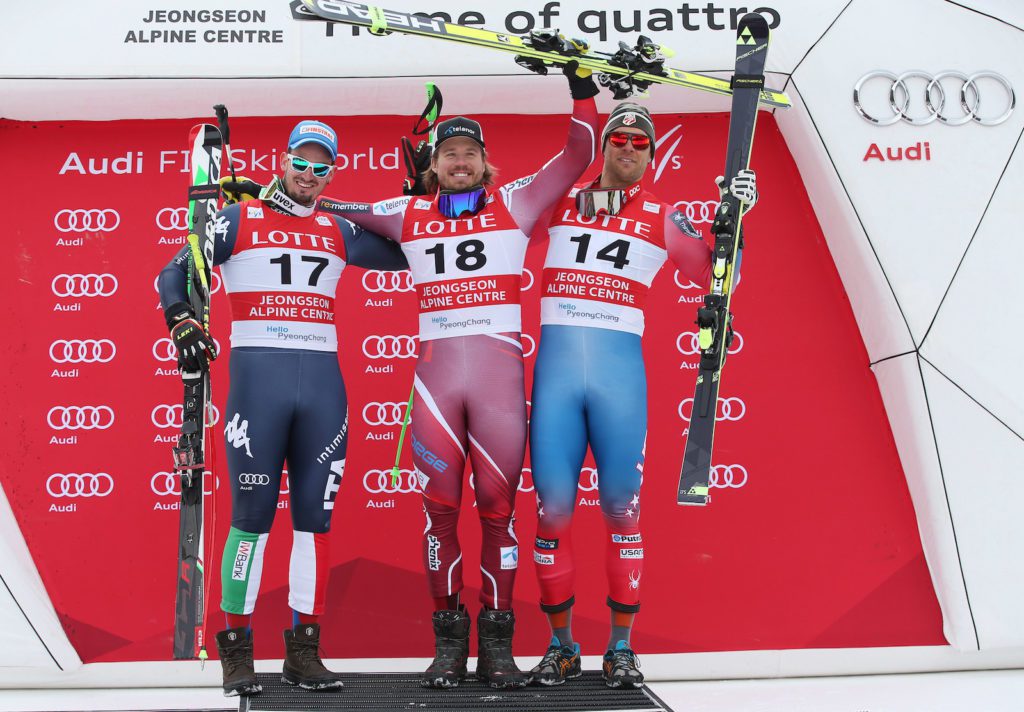
Nyman’s hopes and expectations never materialized as he suffered knee injuries in two separate incidents in Garmisch-Partenkirchen. After apparently recovering from the first, a second ACL injury was yet another unfortunate setback one year later and with about 10 days to go to the PyeongChang Olympics. It was a difficult pill for him to swallow, but something he is now using as added motivation for Beijing.
“I had high expectations – I was at the top of the world and skiing very well and then I had the knee injury. I fought back and then I blew my knee the next year so I guess I wasn’t meant to go there,” Nyman says.
“I would love to redeem myself and experience the Olympics one more time. … If I can get in the shape that I know I need to be in or close to it, I can compete for the top.”
Nyman’s Chinese secrets
The three-time Olympian believes he will benefit from a mindset and approach to the Olympics in China, similar to his outlook towards PyeongChang, before the knee injury wiped out his hopes.
Considering the many great unknowns about the Olympic track and venue in Yanqing – unproven and untested by international racers due to COVID-19 travel restrictions – Nyman likes his chances. He reveals that he has a strategy, although he will not divulge details, which he believes will give him an advantage over his younger competition.
“My approach that I took to PyeongChang was enlightening to me – I went in with a beginners’ mind, fully open to trying to understand everything and now I have a few tricks up my sleeve.
“I’m excited for Beijing for that reason and to create a conviction within myself of what I need to do. … I’ve seen video of the hill and the style of snow produced there is aggressive, cold and dry, and I think I’ll like it,” Nyman says about China’s first downhill course.
“It’s fun to be in new places and I know that a lot of Europeans get all bummed out when they’re not at home,” Nyman says, perhaps trying to give himself a psychological advantage. “I want to go in there and embrace this place, learn and figure out the hill, it’s a new puzzle.”
Nyman’s best Olympic result across three Winter Games was a tie for 19th in the Torino 2006 downhill. However, he says his latest comeback isn’t entirely driven by Olympic redemption in China. The American Downhiller is also excited to return to the classics in Wengen and Kitzbuehel in January, hopefully building momentum towards Beijing.
Mission Zermatt and onwards
In Zermatt, training in the shadow of the majestic Matterhorn, Nyman says the camp has also been productive for his fellow U.S. teammates, despite the glacier being overcrowded with the Swiss, Austrian, Italian and French ski teams, all in close quarters. The veteran Utah racer points out that prior to his Achilles injury, Travis Ganong, Bryce Bennett, Ryan Cochran-Siegle, Jared Goldberg and himself all cracked the top 30 in the standings, an unprecedented feat in U.S. ski racing history.
“We’ve had some good training here team-wise, everybody is skiing well,” Nyman says about the U.S. speed team coached by Randy Pelkey. “If everybody is skiing fast, it’s going to be a battle to get an Olympic spot this year.”
Nyman and teammates will seek quality training time at the U.S Ski Team Speed Center at Copper Mountain, hoping that snow conditions in November will be favorable in the final stretch towards the traditional season-opening speed races in Lake Louise and Beaver Creek.
Timing and achieving the right balance between skiing and strength training are essential to Nyman’s comeback.
“I feel like I can come here, stress myself, show my body what it needs to feel and produce, and then I have several weeks after this to rebuild my body physically in the gym,” Nyman says.
“I’ll get another solid block in the gym to address some of the weaknesses that I felt on the hill, and then I think I’ll be in a good place and prepared for race time.”
Follow Brian on Twitter – @Brian_Pinelli
About the Author: Brian Pinelli

Related Post