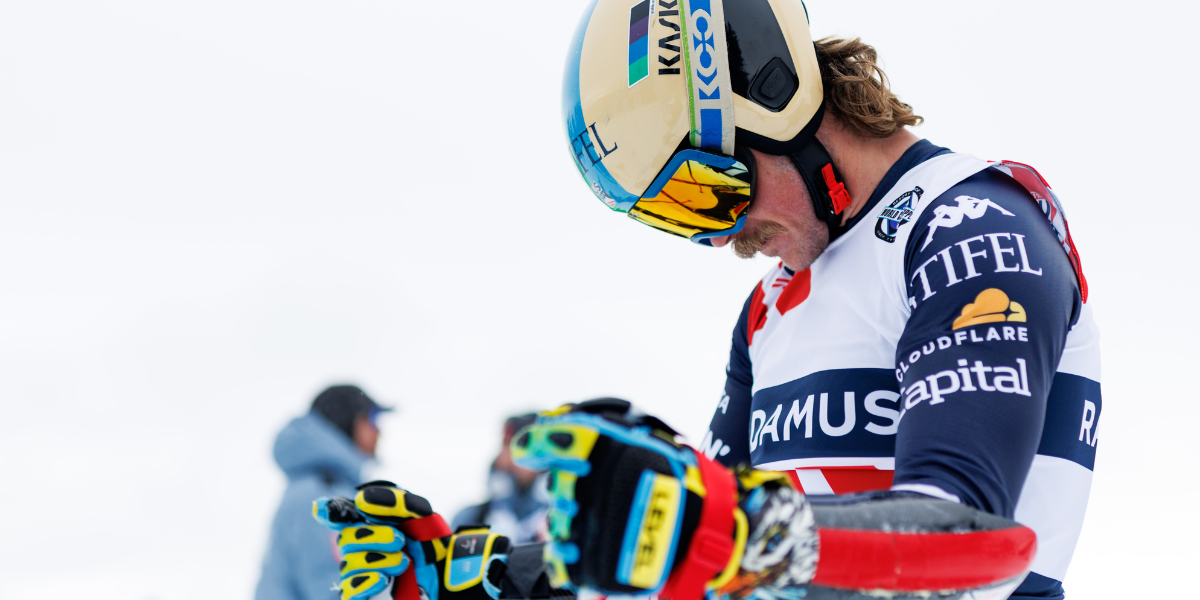
River Radamus Copper Mountain (GEPA Pictures)
A Demanding Arena at 9,712 Feet
The new Copper Mountain layout demands consistent power and balance. With a finish at 9,712 feet, racers will feel the altitude early, especially if they begin pressuring below the gate or fall behind the natural rhythm of the course. The profile requires skiing that builds momentum from turn to turn, using strong moves at the top of the turn and committed pressure into and through the fall line to stay dynamically efficient.
Because the slope is not very steep, the course will not deliver speed on its own. Athletes must create their acceleration, engaging the ski early and driving energy down and across the course. The altitude magnifies every movement — efficient power produces speed, while hesitation or extra time in the snow will drain energy and slow the skier in the final sectors.
The racers who manage the physical load, stay efficient, and maintain a clean edge through the fall line will put themselves in contention. The Stifel U.S. Ski Team trained on this race-arena configuration last spring, a familiarity that should provide a small but meaningful advantage.
The Big Three Arrive in Form — With Even More Depth Behind Them
Reigning World Cup giant slalom champion Marco Odermatt opened his season with a powerful win in Sölden, reinforcing his position atop the World Cup Start List. Austria’s Marco Schwarz and Norway’s Atle Lie McGrath completed the opening podium, each showing form that will make them dangerous again on Friday.
The depth of the Copper field is even stronger with the arrival of Raphael Haaser, the reigning 2025 giant slalom World Champion, adding another elite contender to an already stacked group.
The top five athletes on the men’s GS World Cup Start List enter Copper Mountain as the headliners:
• Marco Odermatt (SUI)
• Henrik Kristoffersen (NOR)
• Loïc Meillard (SUI)
• Thomas Tumler (SUI)
• Lucas Pinheiro Braathen (BRA), the Brazilian rocket ranked fifth in the world

North Americans Looking to Strike Back
Only one North American qualified for the second run in the Sölden opener: River Radamus, the Stifel U.S. Ski Team’s No. 1 GS skier. Copper provides a reset — home snow, altitude familiarity, and a fresh race arena where the group can build momentum toward Olympic qualification.
Canada enters only Erik Read, the veteran independent.
There will be no British racers in Friday’s GS.
North Americans Racing: World Cup Start List and FIS Rankings — FIS Rank Shown if Outside Top 30 on WCSL
- River Radamus, WCSL 16th, Stifel USST, Ski and Snowboard Club Vail
- Erik Read, WCSL,48th, FIS Rank 55th, World Racing Academy, Banff Alpine Racers, University of Denver, Atomic, SYNC
- Bridger Gile, WCSL 51st, FIS Rank 51st, Stifel USST, Ski and Snowboard Club Vail, HEAD
- Isaiah Nelson, FIS Rank 58th, Stifel USST, Buck Hill Ski Team, SHRED
- Ryder Sarchett, FIS Rank 61st, Stifel USST, University of Colorado, Sun Valley Ski Academy, Sun Valley Ski Education Foundation
- George Steffey, FIS Rank 87, USA independent, Global Racing, Stratton Mountain School, Marker/Völkl, SYNC
- Patrick Kenney, WCSL 42nd, FIS 88th, , Stifel USST, University of New Hampshire, Burke Moutain Academy, Marker/Völkl, SYNC, SHRED
With Olympic qualification and seeding on the line — and with the desire to rebound from Sölden — expect the North American effort to be urgent and committed.
Course setters — First run: Sergei Komarov (CRO) Second run: Niclas Kjelsli (NOR)
Men’s GS Race Friday
The men’s giant slalom is set for Friday, Nov. 28. Run one begins at 12:00 p.m. EST / 9:00 a.m. MST, followed by run two at 3:00 p.m. EST / 12:00 p.m. MST. Fans in Great Britain can tune in at 17:00 for the first run and 20:00 for the second.
How to Watch
United States: United States: Live coverage on Outside TV (free)
Canada: Stream on CBC Sports.
Great Britain: Stream on Discovery+
About the Author: Peter Lange