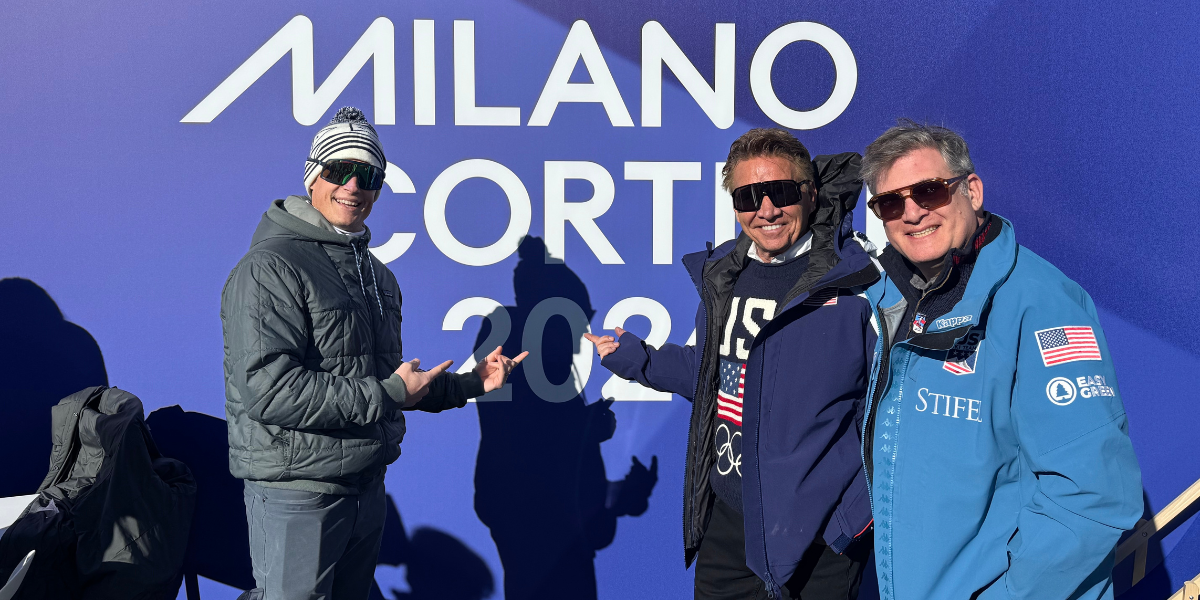
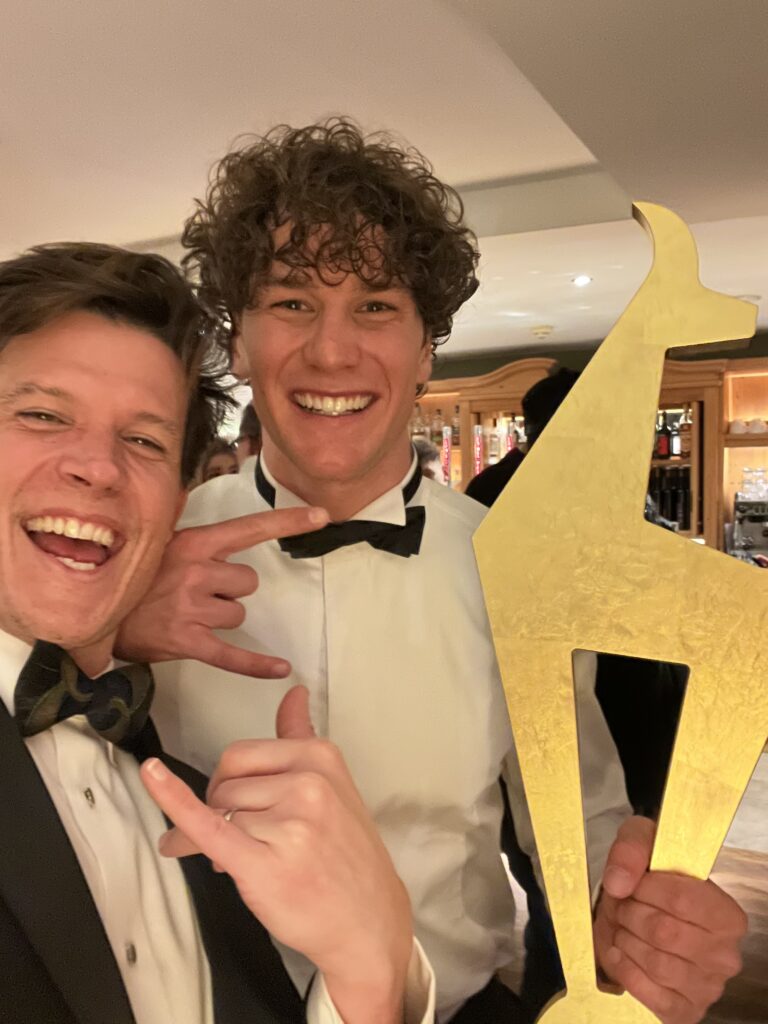
Featured Image: Pat Dimon (far left) with Ron Kruszewski (center), executive producer of On the Edge and
CEO of Stifel, and Morgan Hertzan (far right), CEO of Bright North USA/ Photo Credit: US Ski and Snowboard
How a lifelong skier set out to capture the chaos, control, and relentless grind of the World Cup tour.
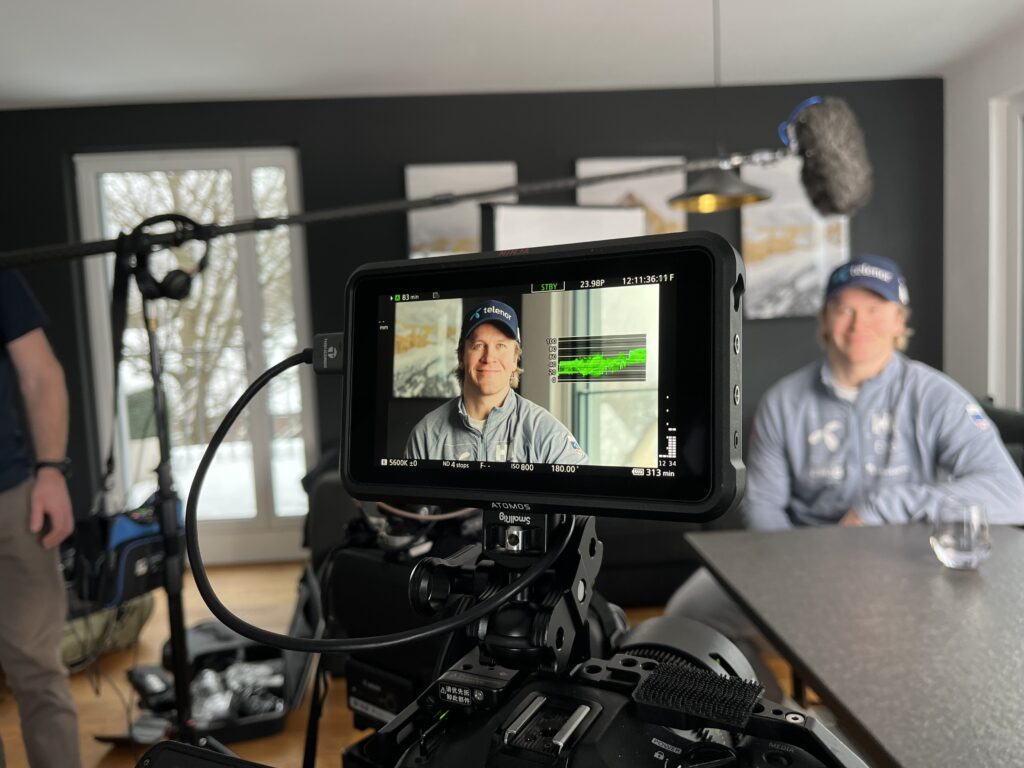
When filmmaker Pat Dimon set out to create On the Edge: World Cup Ski Racing, he wasn’t looking to expose the sport.
He was looking to honor it.
“We want to show skiing to the world,” Dimon said. “This isn’t a takedown or a gotcha situation. It’s about showing this beautiful, wild sport that hasn’t really been shown to the masses.”
A lifelong skier who spent much of his childhood and adult life between New Jersey and Waitsfield, Vermont, skiing at Sugarbush, home of the legendary Green Mountain Valley School, Dimon understands ski racing not just as a spectacle, but as a way of life. That personal connection shaped every frame of the series.
The Hardest Thing to Capture
Ask Dimon what was most technically challenging about making the series, and his answer isn’t logistics — though the World Cup schedule is relentless.
It’s the skiing itself.
“If you stand next to a race course and watch from 30 feet away, the sound, the speed, the violence of it — the camera never really does it justice,” he said. “Even the FPV drones people are talking about now — it’s still hard to translate what it actually feels like.”
Instead of trying to outdo broadcast coverage or create an IMAX style race recap, Dimon made a deliberate choice: capture enough of the action to ground the viewer, then lean into the people. The balance between race footage and intimate moments became the creative heartbeat of the show.
“How do you cover the action but also show the personalities behind it?” he said. “It’s like a puzzle. You try different pieces — different athletes, different moments — and see what works.”
Sometimes it’s the winner. Sometimes it’s not. Sometimes it’s the comeback. Sometimes it’s the slump. There are no bad characters in ski racing, just limited screen time.
Chaos and Control
One of the series’ most compelling themes is the duality of ski racing, something Dimon describes as “a dichotomy of chaos and control.” “It’s beautiful and graceful, but it’s violent as hell,” he said. “It’s hold on for dear life — but it’s also completely mapped out mentally.”
Even as an experienced skier, standing on injected downhill sections like Birds of Prey or the Streif gave him a renewed appreciation.
“If you fall from a standstill, you’re sliding 50 yards. It’s terrifying. And they’re doing it at 80 miles an hour.”
The chairlift moments, he says, were some of the most powerful to film. Sitting next to an athlete in silence before the most intense minute and a half of their life, cameras rolling but barely breathing.
“You don’t want to break their focus. You’re just sitting there thinking, ‘This is unbelievable.’”
The Grind Behind the Glamour
Having previously filmed three seasons of Netflix’s Full Swing, Dimon is familiar with the demands of global sports tours. But the World Cup circuit surprised him.
“The grind is so real,” he said. “You win a race, you’re in the car, bags packed, speed suit off, skis loaded, and you’re flying to Europe for the next race in three days.”
Unlike chartered NBA flights or NFL team buses, ski racing is vans packed with gear, late-night mountain drives, and constant cold-weather exposure. The travel is unrelenting. The margins are razor thin.
“You’re driving five hours at 1 a.m. through the mountains. You get maybe a training day. Then you race again.” The lifestyle, he says, reveals something fundamental about the sport. “It’s a passion sport. You can tell. The money and medals are great, but the grind behind the scenes shows you what it really is.”
More Team Than You Think
One of Dimon’s biggest surprises was how team-oriented ski racing is. “I pictured it being much more individual,” he admitted. “But it’s super team-heavy.”
Athletes share radio feedback. They train together. They eat together. After finishing a run, racers immediately relay information back to teammates.
“It’s not just you versus the world. It’s you and your group versus the mountain.”
The Norwegian men, Swiss team, and other national squads showcased that camaraderie in particular, a dynamic that adds texture beyond the start list.

The Olympic Effect
Filming during an Olympic year only amplified the stakes. “From Solden onward, it’s all gas, no brakes,” Dimon said.
Every result carries weight. Points matter. Selections loom. By late December, the pressure becomes palpable, and sometimes cameras become less welcome.
“It’s a double-edged sword. The intensity is incredible for storytelling, but when it’s game time, nobody wants a camera a foot from their face.”
Still, the Olympic backdrop helped elevate the series’ purpose: bringing ski racing to a broader audience, especially in North America, where the sport remains niche compared to Europe.
Guy Slattery, Chief Marketing Officer of U.S. Ski & Snowboard and an executive producer of On The Edge, believes the series represents a turning point for the sport’s visibility.
“We’ve always believed ski racing has the potential to reach a much broader audience. On The Edge is a major step in that direction. Pat and the team have done an exceptional job translating the sport’s intensity and nuance into something understandable and emotional that resonates far beyond the core fans.”
Putting Respect on Their Names
More than anything, Dimon hopes the series changes perception. “I want people to respect these athletes as much as NFL or NBA players,” he said. “They’re as elite as anyone I’ve ever been around.”
From injected downhill tracks to overnight travel marathons, from comeback stories to breakthrough seasons, On the Edge reveals the human cost behind the podium shots.
“I want to show that they pour their life and soul into this,” Dimon said. “They’re badass. It’s a total grind. But it’s also beautiful.”
And maybe, just maybe, it inspires someone new to fall in love with the sport. Because as Dimon sees it, skiing isn’t just for coastal elites or once-a-year vacationers.
“It’s something you can do your whole life. It’s about being outside, being with your family. And at the highest level — it’s absolute chaos and precision riding the same edge.”
About the Author: Katie Twible