Mikaela Shiffrin using imagery during inspection GEPA /Matic Klansek
The 2023-24 alpine race season is now underway. From Soelden to Copper to Edouard to many other race venues, it’s “go time” for racers from juniors up to the World Cup. So, now is the time to shift from training to race mode.
This transition requires several vital changes in your focus and in how you approach your training:
- From focus on technique and tactics to focus on going fast.
- From details of skiing to the big picture of skiing.
- From thinking and analyzing to feeling and trusting.
- From lower intensity to race intensity.
- From training preparation to race-like preparation for training runs.
Good Skiing vs. Fast Skiing
This difference between good skiing and fast skiing is a huge distinction for me and one that I work with racers on constantly. Over my many years in ski racing, first as a racer and then as a mental coach, I have seen many good skiers. They were technically and tactically sound and made nice turns. These good skiers were solid and consistent. But there was only one problem. They weren’t usually on the podium. Why? Because they were more focused on skiing well than skiing fast.
Here’s the problem: Good skiing doesn’t necessarily translate into fast skiing. I’m on the hill with young racers constantly every winter and summer and I see a misguided emphasis on good skiing among racers and coaches. Of course, technique and tactics are necessary to ski fast, but they alone are insufficient. The last time I checked, they don’t give style points in ski racing. All that matters is the total time between start to finish. You can have a beautiful run and be slow and a truly ugly run and be fast. Thinking back to my racing days, the races I felt I had skied well were inevitably slow, and the races where I hung on for dear life were usually fast.
Here’s how I think about good skiing:
- Stable
- Balanced
- In control
- Clean
- Comfortable
- Smooth
- Safe
- NOT FAST!
In contrast, fast skiing is a very different approach to racing. Good skiers focus on going around the gates during a race run. But fast skiers don’t think about going around the gates. The Mikaelas and Marcos of the World Cup only focus on getting from the start to finish as fast as possible. Of course, they know they must follow the rules and go around the gates, but that’s not what’s on their minds.
Here’s what I think about fast skiing:
- Unstable
- On the edge
- Ragged
- Risky
- Uncomfortable
- FAST!
It’s important to note that you can’t ski fast without good skiing. If you don’t, you’ll be fast for a few gates but will probably make a huge mistake or blow out because you didn’t ski well enough to manage the fast skiing from start to finish. An essential part of this shift from training mode to race mode is ensuring that you take your good skiing to the next level of skiing fast.
Speed is an Acquired Skill
Like technique and tactics, I don’t believe speed, that is, going as fast as you can, comes naturally to many racers. Instead, it needs to be practiced and learned. When you first start focusing on skiing fast, you’ll feel out of balance, out of control and uncomfortable. Your mind and body won’t be able to keep up with the speed and you will likely make mistakes, DNF, or crash at first. You need time (and a lot of reps) to figure out how to stay on top of a new level of speed.
When you shift to race mode, you do what you know you need to do to ski fast; for example, before a training run, you might increase your intensity, breathe aggressively, or fire yourself up to attack the course. You also need to embrace the perspective that you may make mistakes when you ignite the afterburners, and that’s a good thing because it means you’re pushing your limits. When this happens, remind yourself to be patient and stay committed because, in time, your mind and body will catch up with the new speed, and you’ll become faster and finish.
Find Your Speed Threshold
There is only one way to discover how fast you can ski: crossing the threshold and perhaps crashing and burning. Good skiing won’t allow that to happen; only fast skiing does. What defines the greats is their ability to consistently find that threshold and ski within it.. Finding and staying just within that line is a skill that takes practice and the willingness to fail and to get uncomfortable until the uncomfortable becomes comfortable and fast skiing gets faster.
Of course, continue to improve your technique and tactics. But don’t stop there. Once you’re feeling solid in those two areas and skiing well, set them aside and turn your attention to what ultimately matters most in our sport—fast skiing!—and let ’ er rip.
Train Like You Race, So You Can Race Like You Train
A vital part of this transition from training mode to race mode is to ensure that you train like you race so you can race like you train. Here are several key rules to ski by.
First, whatever you do in races, you must first do in training. This seems obvious, yet racers often neglect it. If you want to ski technically and tactically well in races, you better get that technique and those tactics down in training first. But, with race season upon us, you also need to ingrain the feeling of going fast in your training so it comes more naturally in races.
Second, whatever you do in training is what you will do in a race. Ideally, the goal of training is to develop effective skills and habits that translate into fast skiing on race day. It also means creating speed skills. But here’s the problem: racers often practice bad skills and habits in training, whether technical, tactical, mental, or speed.
So, think about what you do on race day to get ready and do the same in training as part of your training routine. For example, do a good skiing warm-up, inspect the course (don’t just slip it), get your body moving at the start, do mental imagery and focus on going fast. Of course, you’re not going to spend 15-30 minutes getting ready for each training run, but you should take key elements of your race routine and shrink it down to a 1-2 minute training routine.
The more you can make training like a race, the more you will ingrain in your body and mind the skills and habits to ski fast in a race. The ultimate goal is that when you enter the starting gate of a race, your body and mind automatically do what you do in training, and you will ski fast in the race just like you do in training.
Mindset
You’ll want to make a significant shift in your mindset. When I talk about mindset, I mean what you’re thinking 3-5 minutes before you enter the gate. In training mode, your mindset was probably focused mainly on technique and tactics. But in race mode, your mindset should change to focus on what you need to do to just ski fast.
With most racers I work with, this means adopting a more aggressive mindset. Critical tools for building an aggressive mindset include raising your physical intensity, intense breathing (forced exhale), aggressive self-talk (“Attack,” “Charge,” “Let’s bring it”), and aggressive imagery where you see and feel yourself attacking the course.
Use Mental Imagery
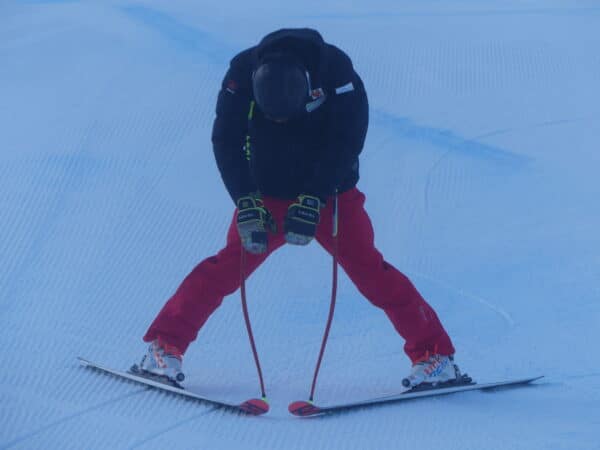
As you probably know from my writing about mental imagery, I believe it is a powerful tool to help you achieve your ski racing goals. It is also an essential tool in helping you get into race mode. So much of going fast involves a lot of repetition and getting comfortable with a new level of speed. Using imagery can accelerate that process.
As you get deeper into race mode, regularly (at least three times a week or more), see and feel yourself just plain skiing fast. For 5-10 minutes in each imagery session, imagine yourself preparing to ski fast before your training and race runs. Then, see and feel yourself being aggressive, charging down the course, and pushing your limits. With every imagery session, you will more deeply ingrain the image and feeling of skiing fast in your mind and body. So, on race day, those same images and feelings will emerge, put you in “full send” mode, and help you ski your fastest.
Exercises
To help you make this shift from training mode to race mode, here are a few exercises you can do in your on-snow training:
- Establish a consistent training routine that is a mini version of your race routine to ensure total “race mode” preparation before every training run.
- Equipment (boots buckled, armor adjusted).
- Physical (moving body, breathing).
- Mental (imagery, self-talk).
- Incorporate several “race” runs (i.e., focus on just going fast) into training sessions.
- Make the first two runs of training “race” runs to train your mind and body to go fast the first two runs (because that’s what has to happen on race day).
- Do off-snow imagery of aggressive and fast skiing.
- Focus on confidence, aggressiveness, and feeling (not thinking).
- See and feel yourself skiing extremely fast.
About the Author: Dr. Jim Taylor