
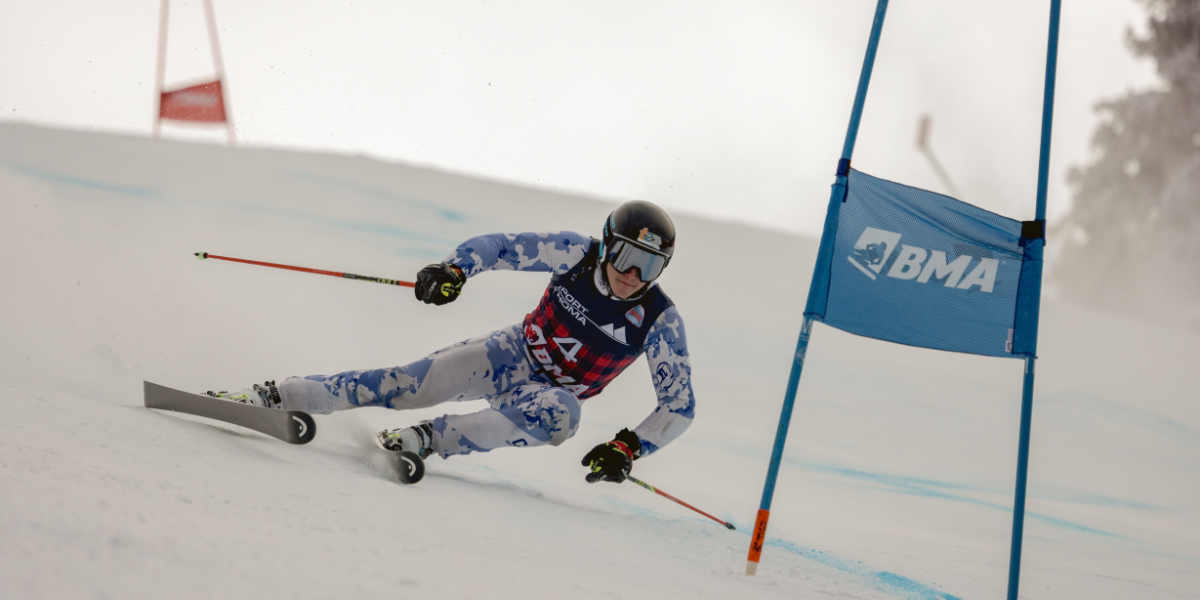
Nolan Sweeney: Photo Jay Riley @mr.jayriley
Hello! I am TOKO athlete Nolan Sweeney, and I am sharing my race day edge prep routine.
As race day approaches, I focus on how I will prepare my skis. As an independent athlete, I must ensure my ski preparation equals the quality of many of my competitors’—who work with professional ski technicians. The right tune for the right conditions is absolutely necessary to compete at the highest level. It’s not easy, but attention to detail and access to high-quality TOKO tools make it much easier.
Assessing Snow Conditions
Before working on my skis, I assess the snow conditions. Is it icy? Soft and slushy? Dry and abrasive? Snow conditions play a very significant role in determining how I will prepare my edges.
When I wrote this, I was racing in Burke, Vermont, on soft(ish) ice that was firm yet not slick. This surface is tricky because it requires finding the right balance between too much and too little grip.

Edge Preparation
Regardless of the conditions, I use my TOKO World Cup Sidewall Planner to pull back the slightest amount of the second edge (Titanal lamination). This ensures the file cuts smoothly at the intended angle.
Next, I grab my TOKO World Cup File Guide and WC File Chrome. I take short, smooth pulls, letting the file do the work. This resets the edge, making it sharp and free of burrs or nicks.
After clearing the metal shavings, I begin my diamond file progression. Lightly running the diamond files down my ski—again letting the tools do the work—I progress through 200 grit, 400, 600, and finally polish with 1000 grit.
Even when the side edges are sharp and smooth, a small hanger is almost always present. You can feel this by running your fingernail up the base to check if the edge overhangs.
Base Edge Polishing
So, I flip the ski base-up to polish the base edge. Using my base angle World Cup guide, ensuring it is the intended degree (I currently run 0.5 degrees in GS), I run an extra-fine diamond stone on the base edge.
This polishes the base edge to the exact angle, ensuring no slips while making sure no hanger exists to create excess drag or unwanted grip.
Detuning for Performance
Now, the base tune is complete—the ski is sharp and smooth from tip to tail.
Conditions play the biggest role during the detuning phase. If the ski is too sharp, too forward or back, it will bite too early and feel awkward rolling on and off the edges.
Taking light passes, I run the TOKO Edge Grinding Rubber (“Gummy Stone”) anywhere between 2 to 8 inches from the tip and tail of each edge, gradually lowering pressure as I approach the center of the ski.
This technique creates a tapered edge—where the sharpest part of the ski is under the binding and progressively dulls closer to the tips and tails. If the surface is grippy and aggressive, I will dull further down the ski. If it is slick, I will keep the ski sharper for a longer edge contact.
A perfectly tapered edge is the key to maximizing flow and making it easy to transition on and off the edges. While detuning preferences take time to perfect, it is absolutely necessary to maximize confidence in your equipment—allowing you the freedom to go full gas on race day!
About the Author: Nolan Sweeney