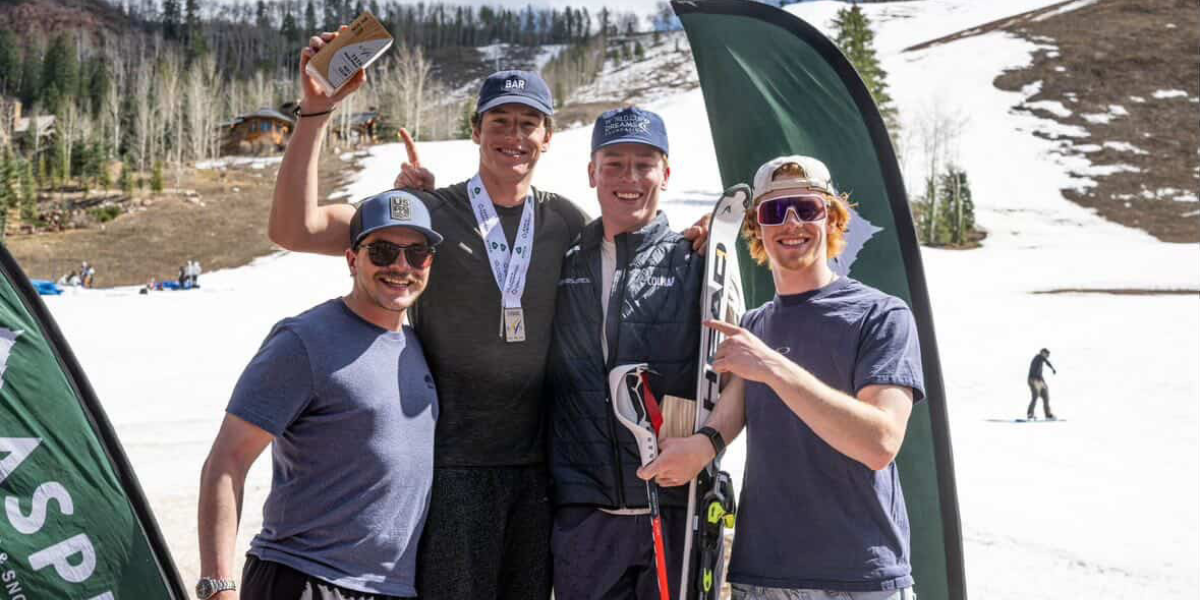
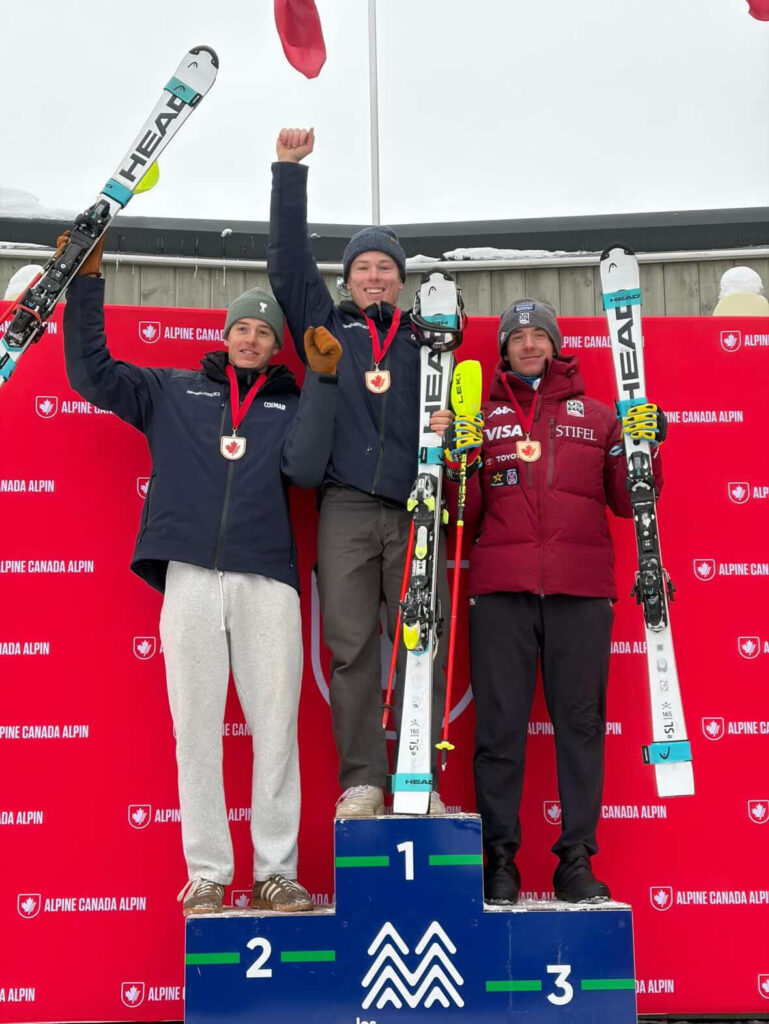
Featured Image: Alessio Bonardi, Maxi Hoder, Bradshaw Underhill and Aksel Lindenmeyr celebrating Maxi and Bradshaw’s season at NorAm Finals.
There is no single path in ski racing anymore, if there ever was.
Some athletes step straight into the international circuit, learning through experience and figuring things out as they go. Others take a longer route, building through college, stepping away from the spotlight before returning more complete and more certain of what they want.
This season, two American teammates, Maxi Hoder and Bradshaw Underhill, reflect just how different those journeys can be. Both have found themselves in the same environment at Apex Academy, a group built around athletes chasing the next level and pushing each other daily. But the way they arrived there could not be more different.
And in that contrast sits a bigger question that continues to surface in U.S. men’s ski racing: Not just how talent is identified, but what happens after.
Learning early, but on his own timeline
Maxi Hoder’s path hasn’t followed the traditional American trajectory, and that is by design.
He grew up in the Mount Mansfield system, fully immersed in ski racing from a young age. But when it came time to take the next step, he chose not to rush it—instead making a decision that would define his development.
Choosing not to rush the system
“I kind of decided I wasn’t going to do just one NorAm. I would either do all of them or none of them,” he said. “I didn’t quite have the point profile to have a good bib, so I decided not to do any.”
At the time, it was not just about points, but about being ready to actually compete. Hoder had seen the level up close and knew what it required.
“I never really committed to a season because I never thought I had the ability yet,” he said. “With my points, I’d be starting pretty far back, and to do one NorAm is pretty useless. You need a full season to make it count.”
So instead of forcing his way into the circuit, he stepped away from it.
A year of separation and progression
Last season, while many of his peers were chasing starts in North America, Hoder spent the winter in Europe with Apex Academy, focusing on training and progression. That shift allowed him to approach the sport more professionally.
“Separating my focus from school and skiing to just skiing for a year helped me out a lot,” he said. “Doing all the steps that a professional would do, I finally had the time.”
There were no shortcuts. Surrounded by high-level athletes, he was rarely the fastest in training—and that became part of what pushed him forward.
“I was getting beat just about every day, and I think it pushed me a lot,” he said.
At the same time, he was still developing physically, something he sees as a key part of his progression.
“I grew up pretty skinny for a while, and the last two seasons I’ve filled out a decent amount,” he said. “Getting in the proper shape helped me a lot.”

When patience pays off
When he returned to North America this season, his approach had changed. The goal was no longer just to gain experience, but to make the season count.
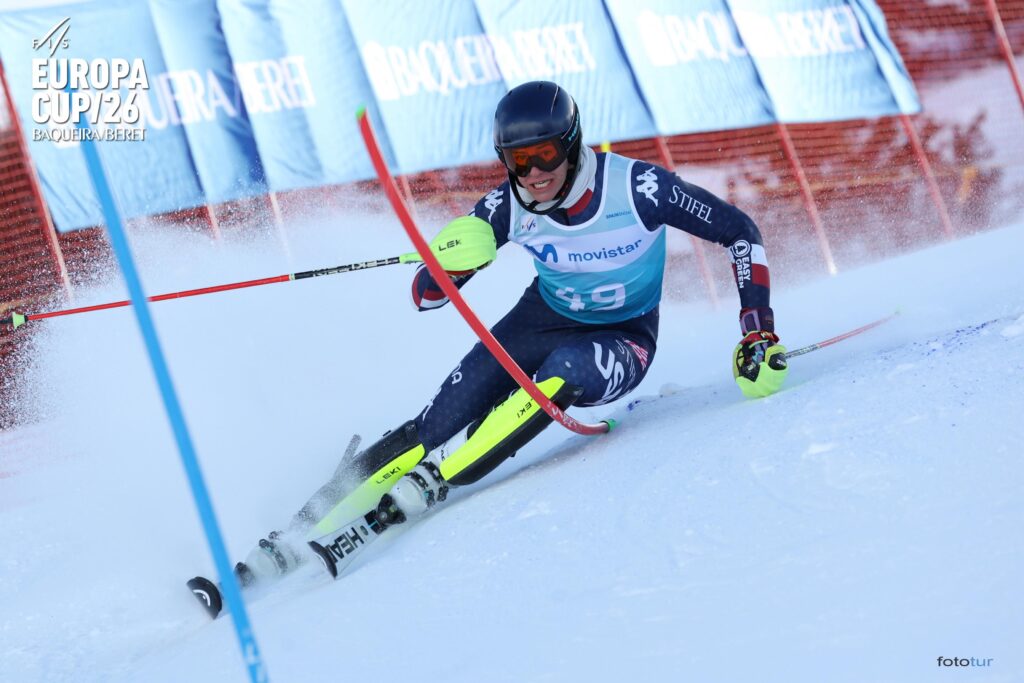
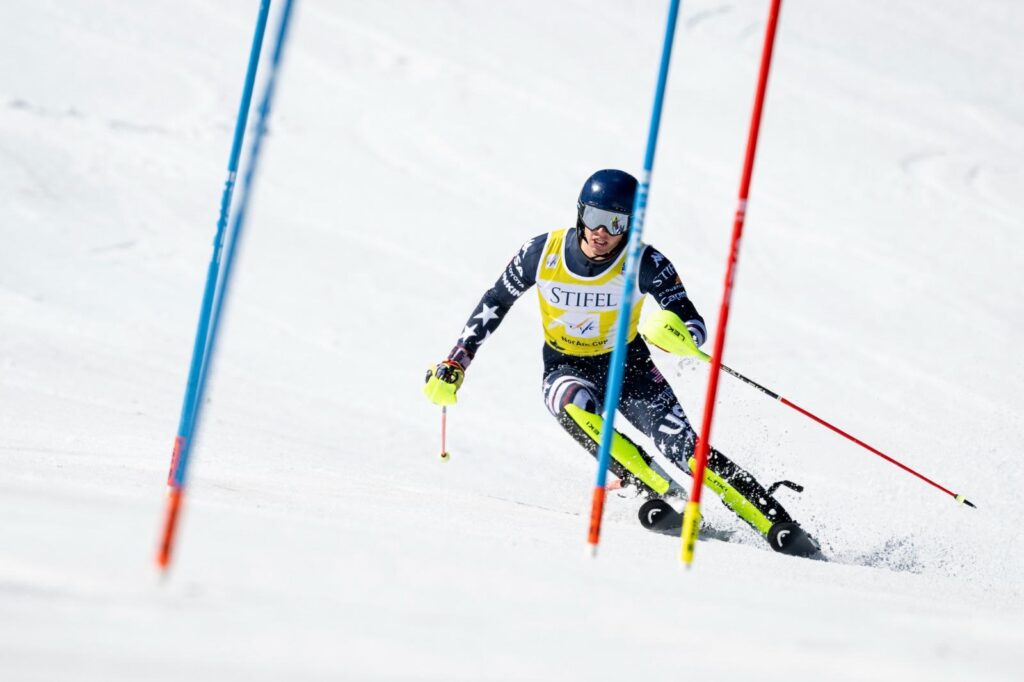
In his first NorAm campaign, Hoder delivered. He finished second overall in the slalom standings and secured a World Cup start position, a result that reflected not just his current level, but the patience behind how he got there.
For Hoder, it was never about a sudden breakthrough; it was about steady progression.
“My goal every year is just to improve a little bit,” he said. “So far, every year I’ve lowered my points.”
It is a simple philosophy, but one that has defined his path—not rushing the process, but building toward the moment when it matters most.
Time, setbacks, and a different kind of growth
Bradshaw Underhill’s path has been shaped less by early acceleration and more by time.
Where others moved quickly into higher levels, Underhill spent four years at Middlebury, developing within a system that has increasingly proven capable of producing athletes ready for the international stage. His final season was dominant, but the years leading up to it were anything but straightforward.
Early success, then setbacks
“My first year, I was quite successful,” he said. “Then I really struggled mentally and with some injuries.”
There were periods where things unraveled completely—the kind of stretches that force athletes to either step away or figure out how to come back.
“That season and those realizations, that I can actually pull myself out of a hole like that much quicker than I thought, really pushed me to mature mentally,” he said.
College as a development space
College gave him something that is difficult to measure in results. It gave him space to develop, both as an athlete and as a person, and to take on responsibility in a way that shaped how he approached the sport.
“I didn’t really know how the experience at Middlebury and having more responsibility for myself would help me mature,” he said. “It made me want to keep building myself as a person and as a ski racer.”
By his final season, that growth showed. He was stronger physically, more stable mentally, and part of a team environment that pushed everyone forward.
“I think a lot of it was mental strength and also having the teammates to rely on,” he said.
Learning how to recover faster
That perspective has carried into his skiing since leaving college. The biggest shift is not technical, but how he processes the inevitable highs and lows of a season.
“I can take a bad race and pull something good out of it much quicker,” he said.
Now back in a full-time training environment with Apex Academy, that steadiness has started to translate to the next level. Without school, the focus became singular.
“Apex really allowed me to focus more on my skiing,” he said. “Skiing was the only thing I was doing.”
The environment played a role as well—not just in structure, but in mindset.
“Having good guys that want to be there and want to push to get faster is always beneficial,” he said. “I think that helped me unlock more in my skiing.”
The moment it clicks
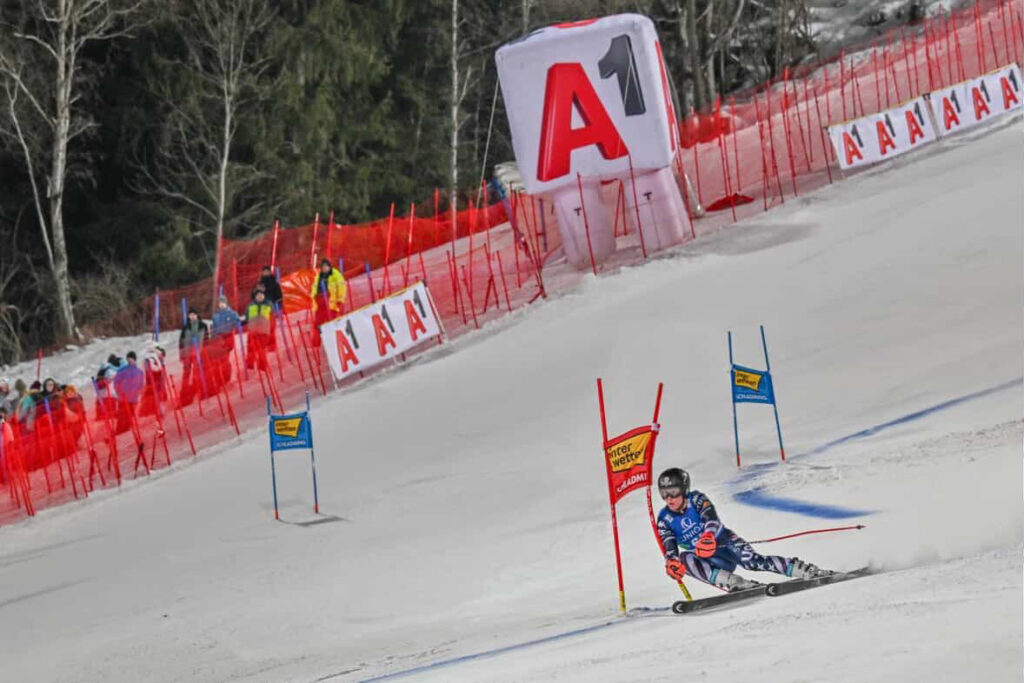
That progression showed itself in moments rather than all at once. In Turnau, it came together. Two clean runs in a Europa Cup GS moved him from 58th to 11th, a result that marked a shift in where he belonged.
“That felt like a big mark in my season,” he said. “Like, this is where I need to be.”
It was not a sudden breakthrough. It was confirmation of a trajectory that had taken longer to build.
Underhill’s path reflects a different reality in the sport, one where development is not linear and does not always happen early.
“I think a big misunderstanding is that development has to happen when you’re 20 or 21,” he said. “A lot of people mature at different rates.”
For him, the timeline has simply been different—not delayed, just built over time.
“I don’t know if I would call it delayed,” he said. “I think it was just a different path.”
And now, that path is starting to meet the level he always believed he could reach.
What happens after talent is identified
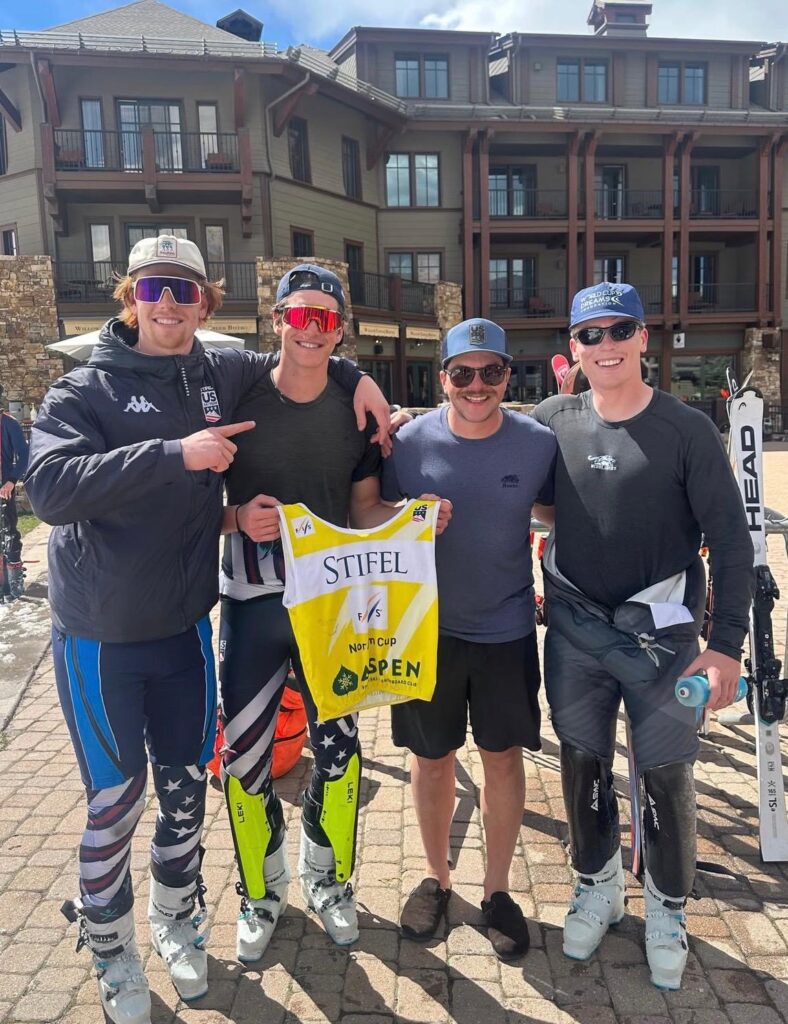
Training together at Apex Academy, the contrast between Maxi Hoder and Bradshaw Underhill is hard to miss.
Two paths, same environment
Their paths are different, but not just in how they arrived there. In some ways, they reflect opposite experiences of the same system.
In Hoder’s case, the system was never really part of the equation. His development happened outside of it, on his own timeline, without forcing early exposure before he felt ready to compete.
Inside vs. outside the system
For Underhill, it was different. He was identified early, brought into the system, and then, at a critical stage, moved out of it.
After time on the U.S. Ski Team as a U21, he was not re-named.
It is a moment that, for many athletes, defines what comes next. For Underhill, it meant stepping away at a point where development is often at its most uncertain, when results fluctuate, confidence can shift, and progress is rarely linear.
He moved into the NCAA system and spent four years building both his skiing and his mindset before re-emerging at a higher level.
The gap after identification
Together, their trajectories raise a sharper version of the same question:
What happens after talent is identified—and what happens when it is not?
In the U.S., there has long been an emphasis on spotting potential early. What follows is less clearly defined. Development rarely moves in a straight line, and it does not always happen on the timeline the system expects.
Hoder’s decision to wait before committing to a full NorAm season reflects one version of that reality. He chose not to chase starts before he felt competitive, then capitalized when the timing aligned.
Underhill’s path reflects another. His trajectory did not restart. It continued in a different environment, one that gave him the space to develop through the years that often matter most.
The rise of alternative pathways
That idea is not isolated. The NCAA pathway, once treated as secondary in U.S. skiing, is increasingly producing athletes who return to the international level more complete—and in some cases more competitive than when they left it.
At the same time, independent environments like Apex Academy are becoming an important part of that middle ground.
For some athletes, they provide a bridge out of college. For others, they offer a space to build before stepping fully into the next level. In both cases, they offer something that is not always consistent within traditional systems: continuity, autonomy, and a clear sense of ownership over development.
Development doesn’t follow a timeline
That may be the deeper layer of the conversation. Identifying talent is only part of the job. What happens next may matter more.
Development is not just physical or technical. It is shaped by time, by stability, and by whether athletes are given the space to progress when it is not immediately visible.
Hoder and Underhill are not outliers. If anything, they reflect a broader reality within the sport.
Different paths—but in the end, pointing to the same gap.
Finding the same level
Now, they find themselves in the same place.
Training side by side at Apex Academy, pushing toward the same next step, and building off each other in an environment that allows both approaches to coexist.
For Underhill, development has never been tied to a fixed timeline.
“I don’t think development is over until you’re 25 or 26,” he said.
It is a perspective shaped by experience—by setbacks, and by the understanding that progress does not always show up early.
For Hoder, the lesson comes from a different direction, but arrives at a similar conclusion. His path has been defined by patience and timing, by choosing when to step forward rather than forcing it.
Both approaches point to the same idea: progress is not defined by how quickly it happens, but by whether it continues.
Together, their stories reflect a broader shift in how success in men’s ski racing is being understood. The gap between early and late development is not as fixed as it once seemed. The line between traditional and alternative pathways is becoming less defined.
There is no single model. No perfect timeline.
Just athletes navigating a system that is still evolving, finding environments that allow them to move forward.
And in this case, two very different paths arriving at the same start line, ready for what comes next.
There is no single path in ski racing anymore, if there ever was.
Some athletes step straight into the international circuit, learning through experience and figuring things out as they go. Others take a longer route, building through college, stepping away from the spotlight before returning more complete and more certain of what they want.
This season, two American teammates, Maxi Hoder and Bradshaw Underhill, reflect just how different those journeys can be. Both have found themselves in the same environment at Apex Academy, a group built around athletes chasing the next level and pushing each other daily. But the way they arrived there could not be more different.
And in that contrast sits a bigger question that continues to surface in U.S. men’s ski racing: Not just how talent is identified, but what happens after.
About the Author: Katie Twible