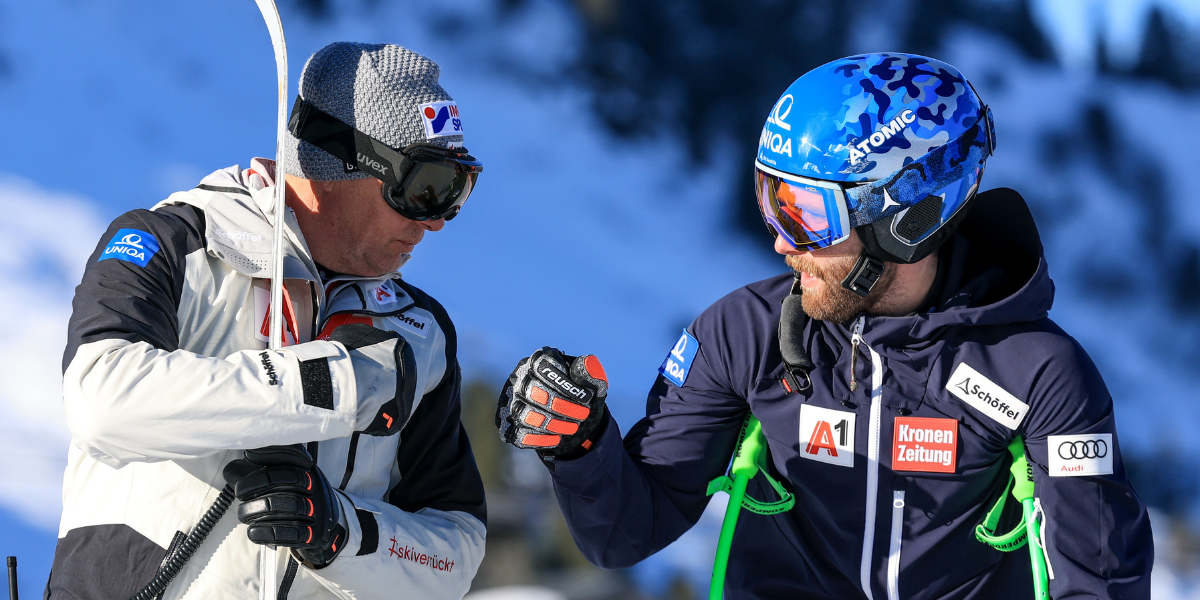
Coach Franz & Marco Schwarz / GEPA pictures
How and when athletes perform under pressure often has less to do with talent—and more to do with the environment coaches create. In this article, we break down how coaching language, structure, and daily habits shape the mental game in ski racing, and why that impact often matters more than any drill or course set.
Coaches Set Mindset, Not Just Courses
Ski coaches do far more than train racers physically, technically, and tactically. More importantly, they shape the psychological environment of ski racing more than any drill, workout, or training session.
Every word, cue, and reaction sends powerful messages to racers about what matters and how they should approach every aspect of their ski racing experience.
You don’t need a Ph.D. in sport psychology to coach the mental game effectively. In fact, I believe every great coach is an intuitive psychologist, because everything you say and do with your racers has a huge impact on them. Instead, what you need is awareness, consistency, and intentionality to help your racers develop a mental game that fosters fun, growth, and healthy attitudes, beliefs, and emotions.
The Daily Mental Environment
Ski racers learn the mental game primarily through experience, not instruction.
In daily training, the tone you set, how you communicate, the attitudes and behaviors you reinforce, and how you respond to mistakes and struggles all shape how racers think and feel—both on and off the hill.
As a result, the environment you create directly influences how your athletes ski. If your racers feel judged, they ski cautiously. On the other hand, when they feel safe trying and failing, they ski aggressively.
Language Shapes Mindset
Language is one of the most powerful tools you have as a coach.
At its core, process-based language emphasizes effort and execution, while outcome-based language emphasizes results.
When feedback focuses mostly on times (even on the Brower in training), results, qualifying, and comparison, racers begin to believe that results define success. Consequently, fear of failure increases and risk-taking decreases.
By contrast, when feedback centers on commitment, decision-making, and skiing “full gas,” racers learn to evaluate themselves based on what they can control.
That doesn’t mean ignoring results. Rather, it means putting them in context and helping racers understand that the way to get good results is to focus on skiing as fast as they can.
Coaching Mistakes and Risk
Mistakes are inevitable in ski racing. How you respond to them determines whether racers learn—or protect.
If mistakes are met with frustration, lectures, or visible disappointment, racers begin to avoid them at all costs. Over time, that leads to tentative skiing.
However, when mistakes are treated as information and signs of progress, racers stay motivated, focused, and confident because they understand it’s part of the journey.
Ultimately, the key question is not, “Why did you mess that up?”
It’s, “What did you learn from that mistake?”
Training Intensity and Psychological Transfer
One of the biggest gaps in ski racing is the difference between training and racing. Not surprisingly, it’s also one of the main reasons parents bring their racers to me.
Athletes may ski fast in training, yet struggle to transfer that speed into races.
From an objective standpoint, there’s little difference between a training run and a race run—same start gate, course, terrain, snow conditions, and weather. However, from a subjective perspective, there is one critical difference: races matter.
In other words, the gap is psychological.
Because of that, coaches play a critical role in helping racers make this shift by creating training environments that include pressure.
For example, timed runs, consequence-based drills, and simulated race scenarios teach racers how to manage intensity and trust under pressure. Just like technique and tactics, mental skills won’t improve without a lot of quality repetitions in training.
While race day will always feel different, building intensity into training helps close that gap.
Simple Mental Tools Coaches Can Reinforce
- Have the first two runs of training be “race runs” every day
- Use race imagery regularly
- Ensure consistent focus and intensity with a structured routine
- Encourage racers to reset after mistakes or DNFs
- Normalize nerves and pressure—it’s part of being a ski racer
- Model calm and confidence under stress
Managing Expectations
Coaches often, without realizing it, increase pressure by communicating expectations too clearly or too often—especially around podiums, points, or qualification.
At the same time, racers already know what’s at stake. Therefore, your role is to keep them anchored in process, not outcomes.
Here’s my biggest piece of advice: Never talk about results. Instead, talk about what racers need to do to get the results they want.
If racers bring up results after a race—good or bad—guide them back to what led to those outcomes and what they can do moving forward.
At the Finish Line
In the end, coaches are constantly shaping how racers think, what they feel, how they respond to challenges, and how they ski when it matters most.
You can’t fix their minds.
But you can create an environment that allows strong minds to develop.
About the Author: Dr. Jim Taylor