
BORMIO, Italy (AP) — The weekend’s ski racing in Bormio showed why the men’s downhill for the 2026 Olympics will be one of the toughest in the past 30 years.
American skier Bryce Bennett says he has “trauma” from racing down the fearsome Stelvio slope, while Italian veteran Christof Innerhofer—who has competed at four Olympics—can’t remember a tougher course.
The difficulty was underscored by a number of crashes during the World Cup weekend. Three skiers were airlifted to a hospital, including French standout Cyprien Sarrazin, who needed surgery to drain bleeding in the brain.
The Milan-Cortina Olympics will see the Games return to Europe after three consecutive editions in Russia, South Korea, and China. The men’s Alpine events will take place in Bormio, while the women’s races will be held in Cortina d’Ampezzo. The two ski areas are separated by a five-hour car ride.
“For sure, it will be special because the last Olympic Games were far away from here,” said 40-year-old Innerhofer, who won silver and bronze in the downhill and combined in Sochi in 2014.
“In the past 12 or 16 years, you’ve had some really tough slopes like Sochi, some easier slopes like Korea, some medium slopes like China. But this one will be the toughest one, I think, for the last 30 years.”
Unrelenting, knee-rattling, complicated by shaded sections, and producing speeds of up to 140 kph (87 mph), the Stelvio is a notoriously unforgiving track.
“Here, it’s really the limit,” Innerhofer said. “Nobody can imagine how difficult it is to ski down—with the light, the speed, the bumps, and the jumps.”
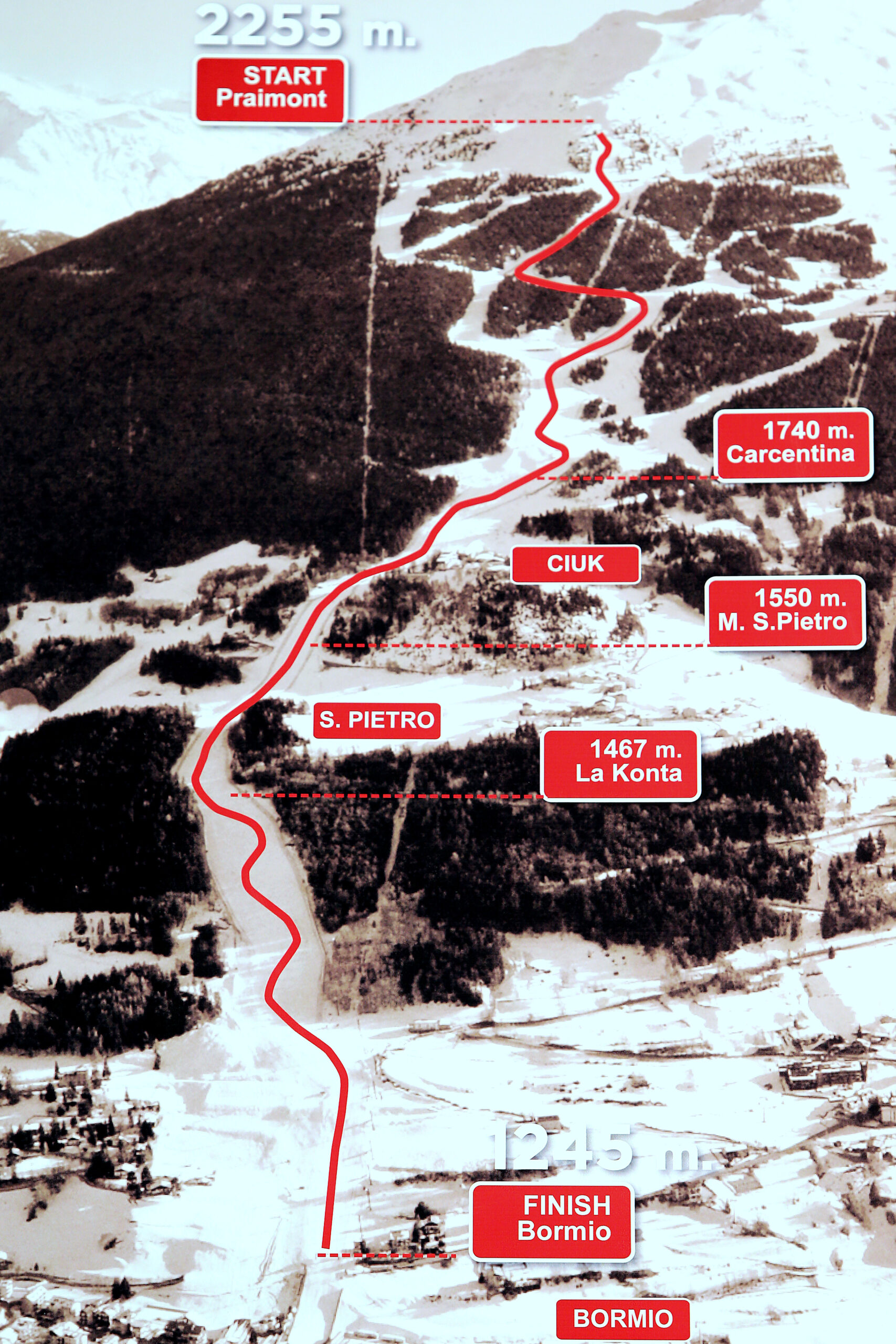
It is one of the most physically demanding courses on the circuit. It is almost 3,230 meters long, has a 986-meter vertical drop, and has a maximum gradient of 63%.
Click Image to enlarge
“I remember growing up, and old guys would just not come here. Now that I’m older, I get it,” said the 32-year-old Bennett, who finished fourth in a downhill in 2018 in Bormio but hasn’t finished inside the top 30 on the Stelvio since.
“I’ve had such bad feelings here the last three years, and I haven’t quite been able to shake them. I would call it like trauma almost. You have to take risks in the right way and be confident in the skiing and the feeling. It’s just hard for me to find it here.”
The downhill is so fast and dangerous that it’s the only one where athletes are usually given two opportunities to take practice runs before a race.
On Friday’s second training run, Sarrazin had his crash, leading his teammate Nils Allègre to criticize the preparation.
“They don’t know how to prepare a course,” Allègre said. “They don’t deserve to have the Olympic Games here.”
Race director Omar Galli refuted those claims, saying the organizers have “significantly upgraded safety features” and will further enhance them for the Olympics.
Three-time defending overall champion Marco Odermatt took a more measured approach to the slope’s difficulty.
“The Stelvio is like a constant fight for survival,” the reigning downhill champion said. “Eighty percent of the course is completely icy; 20% consists of aggressive snow. This irregularity makes it difficult to do the right thing with the skis. Yes, it is a fight for survival from start to finish.”
The Olympics will have one significant advantage over the World Cup: the events in Bormio will take place in February, not December.
That timing will help with the uniformity of the slope and, more importantly, the notoriously dark Stelvio piste will be mostly in the sun.
The last time it was raced in February was at the 2005 World Championships, where the downhill finished with a USA one-two as Daron Rahlves placed second behind Bode Miller.
“I am excited to ski this in the sun,” Bennett said. “It’s so dark. Having a little bit of light on the course, I think it will be fun to ski. I’ve heard from former athletes like Bode and Daron that it’s easier in the sun. I don’t think it’s easy, but it’s easier.”
About the Author: Associated Press