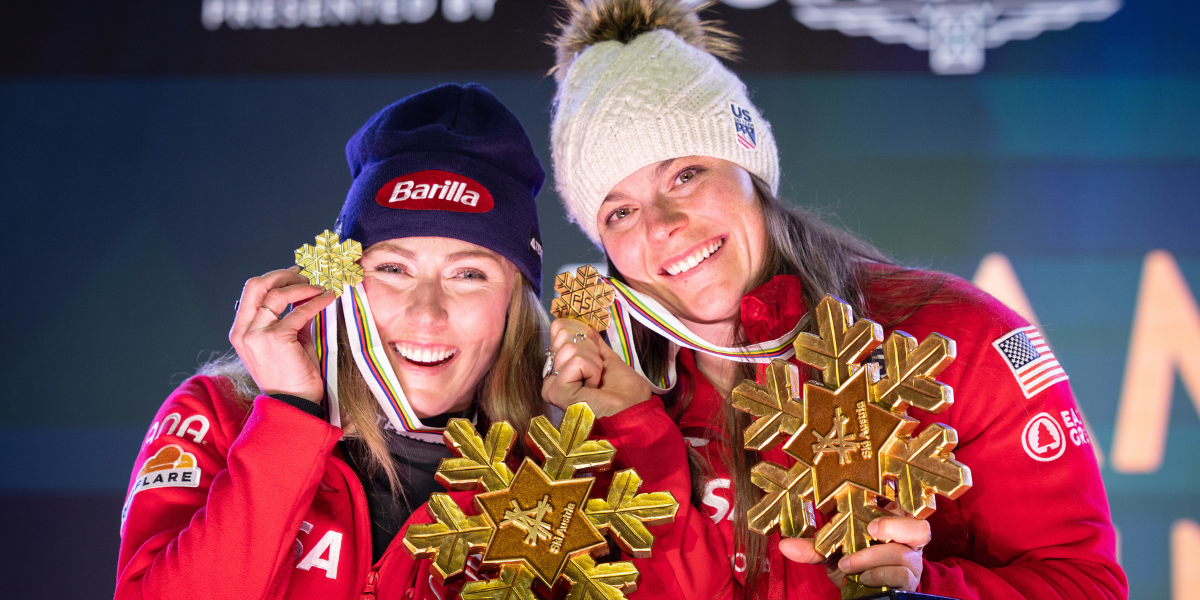
Mikaela Shiffrin, Breezy Johnson / 2025 Team Combined World Champions / GEPA pictures
This article includes the women’s team combined start list, confirmed pairings and bib order, an explanation of the Olympic team combined format, World Championships context, and nation-by-nation team breakdowns. How and when to watch.
The women’s Olympic alpine skiing competition begins Tuesday in Cortina d’Ampezzo, with the team combined opening the alpine program at the Milano Cortina 2026 Winter Games.
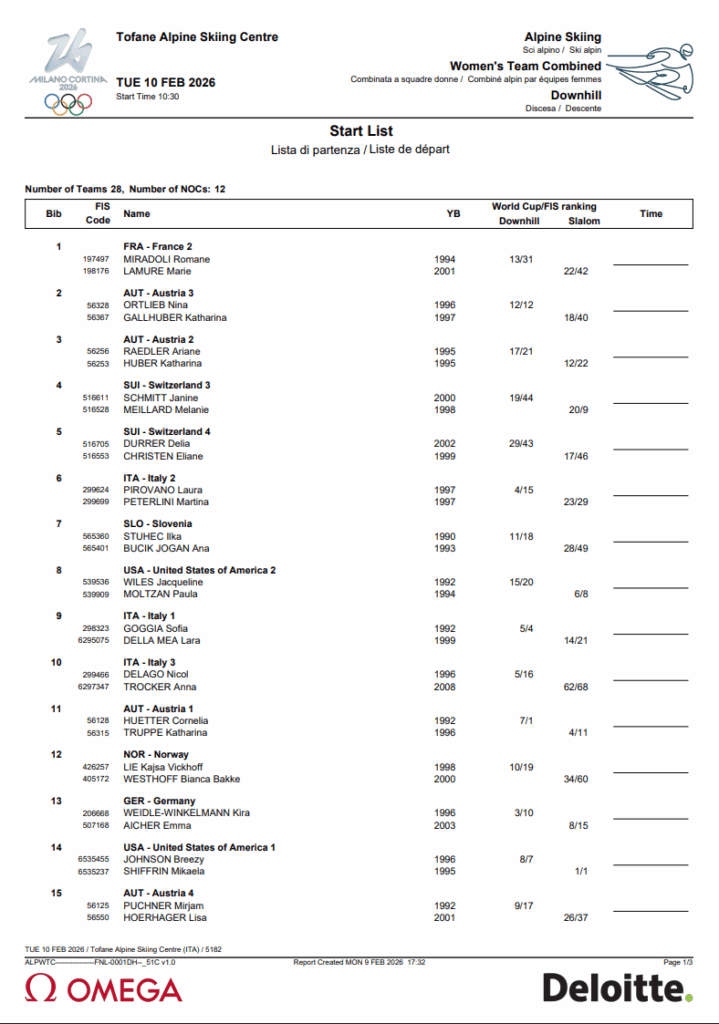
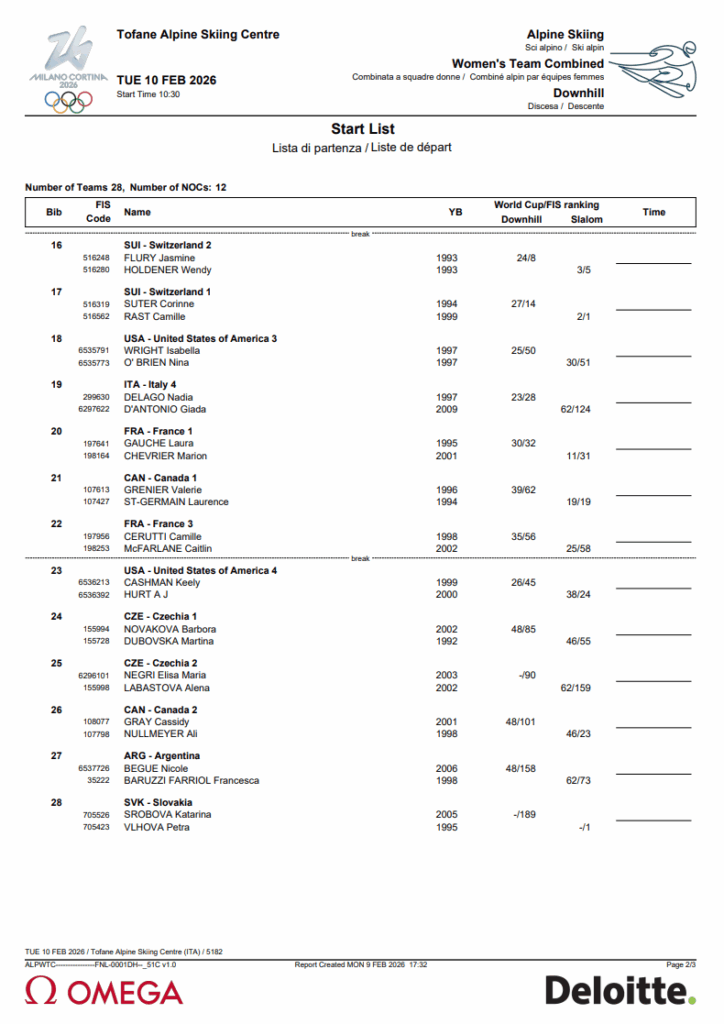
A total of 28 teams from 12 nations will compete, with each pairing made up of one downhill skier and one slalom skier. The downhill will be contested on the Olimpia delle Tofane, followed by the slalom later in the day. Combined time determines the final standings.
The format rewards balance rather than specialization. Speed sets the stage, but precision decides outcomes — particularly on a course as steep, fast, and unforgiving as Cortina.
Shiffrin begins Olympic campaign with Johnson
From the opening run, attention centers on USA 1, where Mikaela Shiffrin begins her Olympic campaign alongside World Championship and Olympic downhill champion Breezy Johnson.
The pairing is already proven at the highest level. Johnson and Shiffrin won gold in the team combined at last season’s World Championships in Saalbach, blending downhill power with unmatched technical excellence. Johnson’s courage at speed provides the foundation, while Shiffrin anchors the slalom leg as the most accomplished slalom skier in history.
The United States enters the race with four teams, underscoring its depth across both speed and technical disciplines.
How the women’s team combined works
Each team consists of two athletes:
- One competes in downhill
- One competes in a single run of slalom
Times from both runs are added together to determine final rankings. There are no second runs, no drop scores, and no margin for recovery. Any mistake in either discipline carries full consequence.
Cortina’s downhill amplifies the challenge. The Olimpia delle Tofane demands commitment from the first gate, forcing downhill skiers to manage speed while preserving enough margin for their slalom teammates to attack later in the day.
World Championships results remain the clearest benchmark
Last season’s World Championships offered the most relevant preview of how the team combined rewards balance and chemistry:
- 🥇 🇺🇸 United States 1 — Breezy Johnson / Mikaela Shiffrin
- 🥈 🇨🇭 Switzerland 1 — Lara Gut-Behrami / Wendy Holdener
- 🥉 🇦🇹 Austria 3 — Stephanie Venier / Katharina Truppe
- 4th — 🇺🇸 United States 2 — Lauren Macuga / Paula Moltzan
Several of those contributors will not be included in the Olympic race in Cortina. Lara Gut-Behrami (SUI) and Lauren Macuga (USA) are sidelined by injury, while Stephanie Venier (AUT) has retired. Their absence removes three proven performers from last season’s top five and reshapes the medal picture for Switzerland, Austria, and the United States.
Teams by nation
🇺🇸 United States (4 teams)
- USA 1 — Breezy Johnson (1996, Rowmark Ski Academy) / Mikaela Shiffrin (1995, Ski & Snowboard Club Vail / Burke Mountain Academy)
- USA 2 — Jacqueline Wiles (1992, White Pass Ski Club) / Paula Moltzan (1994, Buck Hill / Ski & Snowboard Club Vail)
- USA 3 — Isabella Wright (1997, Snowbird Sports Education Foundation) / Nina O’Brien (1997, Burke Mountain Academy)
- USA 4 — Keely Cashman (1999, Bear Valley / Team Palisades Tahoe) / A.J. Hurt (2000, Team Palisades Tahoe)
The Americans combine proven medal contenders with depth throughout the start order, giving them multiple podium paths.
🇨🇭 Switzerland (4 teams)
- SUI 1 — Corinne Suter (1994) / Camille Rast (1999)
- SUI 2 — Delia Durrer (2002) / Eliane Christen (1999)
- SUI 3 — Janine Schmitt (2000) / Mélanie Meillard (1998)
- SUI 4 — Flurina Furrer (1993) / Wendy Holdener (1993)
Switzerland’s strength remains central, particularly in the slalom leg.
🇦🇹 Austria (4 teams)
- AUT 1 — Cornelia Hütter (1992) / Katharina Truppe (1996)
- AUT 2 — Ariane Rädler (1995) / Katharina Huber (1995)
- AUT 3 — Nina Ortlieb (1996) / Katharina Gallhuber (1997)
- AUT 4 — Mirjam Puchner (1992) / Lisa Hörhager (2001)
Austria’s depth allows it to apply pressure across conditions and start positions.
🇮🇹 Italy (4 teams)
- ITA 1 — Sofia Goggia (1992) / Lara Della Mea (1999)
- ITA 2 — Laura Pirovano (1997) / Martina Peterlini (1997)
- ITA 3 — Nicol Delago (1996) / Anna Trocker (2008)
- ITA 4 — Nadia Delago (1997) / Giada D’Antonio (2009)
Racing at home, Italy pairs downhill aggression with deep familiarity on the Olimpia delle Tofane.
🇫🇷 France (3 teams)
- FRA 1 — Laura Gauché (1995) / Marion Chevrier (2001)
- FRA 2 — Romane Miradoli (1994) / Marie Lamure (2001)
- FRA 3 — Camille Cerutti (1998) / Caitlin McFarlane (2002)
🇩🇪 Germany (1 team)
- GER — Kira Weidle-Winkelmann (1996) / Emma Aicher (2003)
A compact but dangerous entry pairing elite downhill speed with emerging technical firepower.
🇳🇴 Norway (1 team)
- NOR — Kajsa Vickhoff Lie (1998) / Bianca Bakke Westhoff (2000)
🇸🇮 Slovenia (1 team)
- SLO — Ilka Štuhec (1990) / Ana Bucik Jogan (1993)
🇨🇦 Canada (2 teams)
- CAN 1 — Valérie Grenier (1996) / Laurence St-Germain (1994)
- CAN 2 — Cassidy Gray (2001) / Ali Nullmeyer (1998)
🇨🇿 Czechia (2 teams)
- CZE 1 — Barbora Nováková (2002) / Martina Dubovská (1992)
- CZE 2 — Elisa Maria Negri (2003) / Alena Labastová (2002)
🇦🇷 Argentina (1 team)
- ARG — Nicole Begue (2006) / Francesca Baruzzi Farriol (1998)
🇸🇰 Slovakia (1 team)
- SVK — Katarína Srobová (2005) / Petra Vlhová (1995)


Women’s Team Combined Race
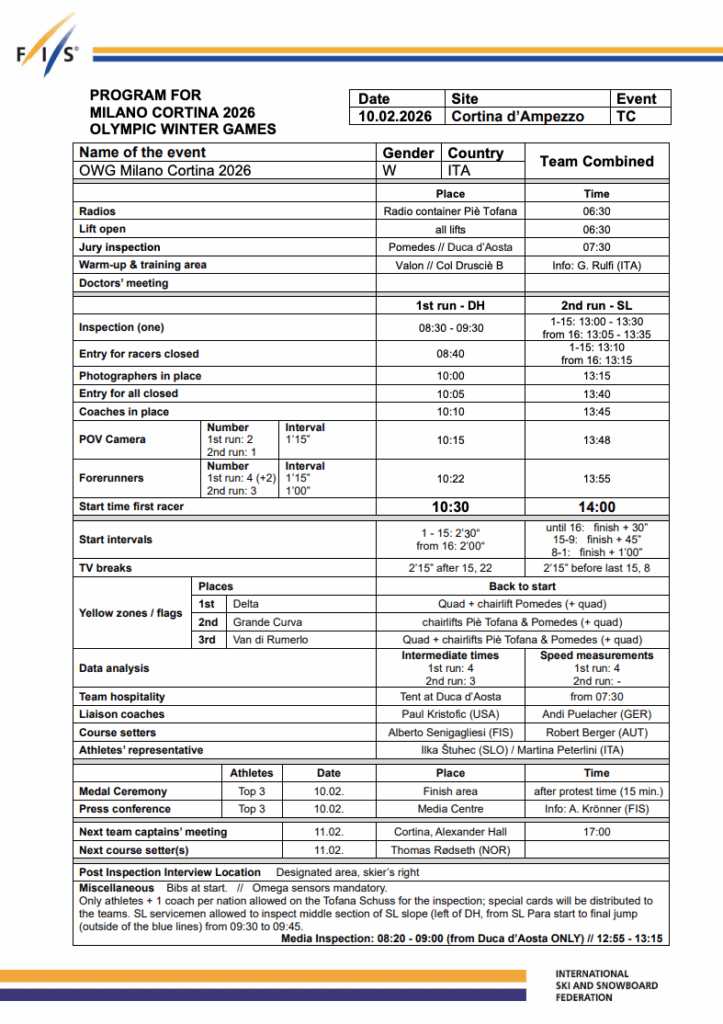
The Tuesday, February 10th, women’s team combined downhill begins at 4:30 a.m. ET / 1:30 a.m. PT, followed by the slalom at 8:00 a.m. ET / 5:00 a.m. PT. Fans in Great Britain can tune in at 9:30 for the first run and 13:00 for the second.
How to Watch
- 🇺🇸 United States: Live and replay coverage on PeacockTV / USA Network
- 🇨🇦 Canada: Live stream on CBC Sports
- 🇬🇧 Great Britain: Live coverage on Discovery+
Olympic Team Combined — Daily Program
Click on images to download
Olympic Team Combined — Downhill Start List
About the Author: Peter Lange