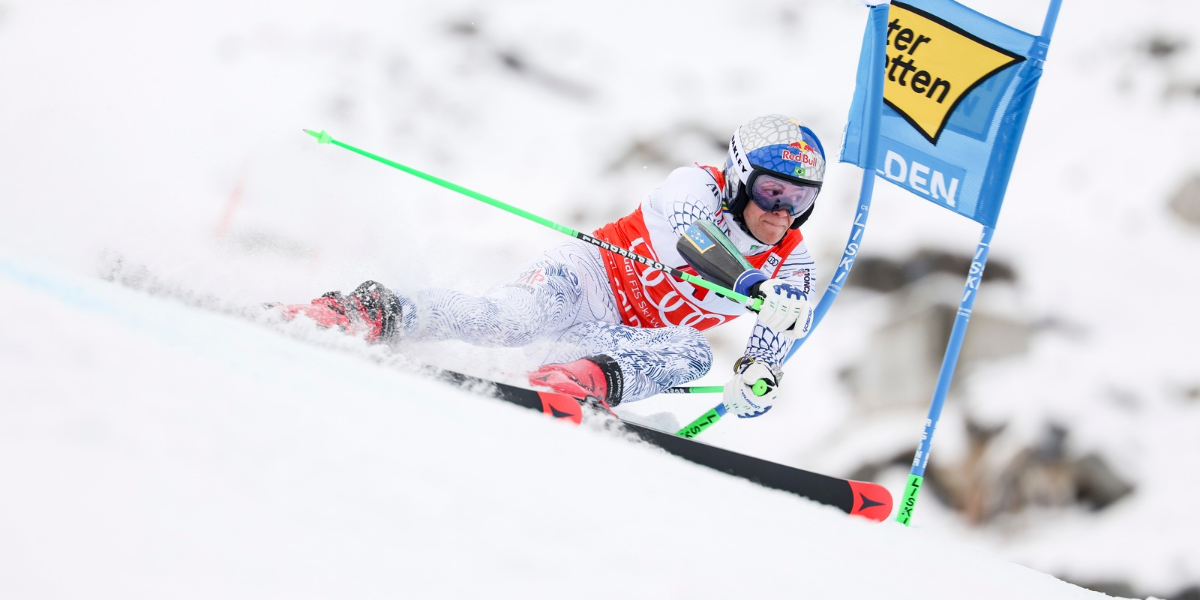
The Streif. Nine letters with so much meaning. Intense. Dangerous. Emotional. Death defying.
Everything about Kitzbuehel is cool. Go ahead and say it out loud in your best Austrian accent: Hahnenkamm. Zeilsprung. Mausefalle. The Strife.
Legendary words, legendary race.
With injuries to Cameron Alexander and Brodie Seger last month, the Canadian men’s speed team will be less of a threat to challenge the top spots this week (downhill races scheduled Friday & Saturday) but will be gaining the required experience to overcome the multi-faceted technical, tactical and psychologically wild beast that is The Streif.
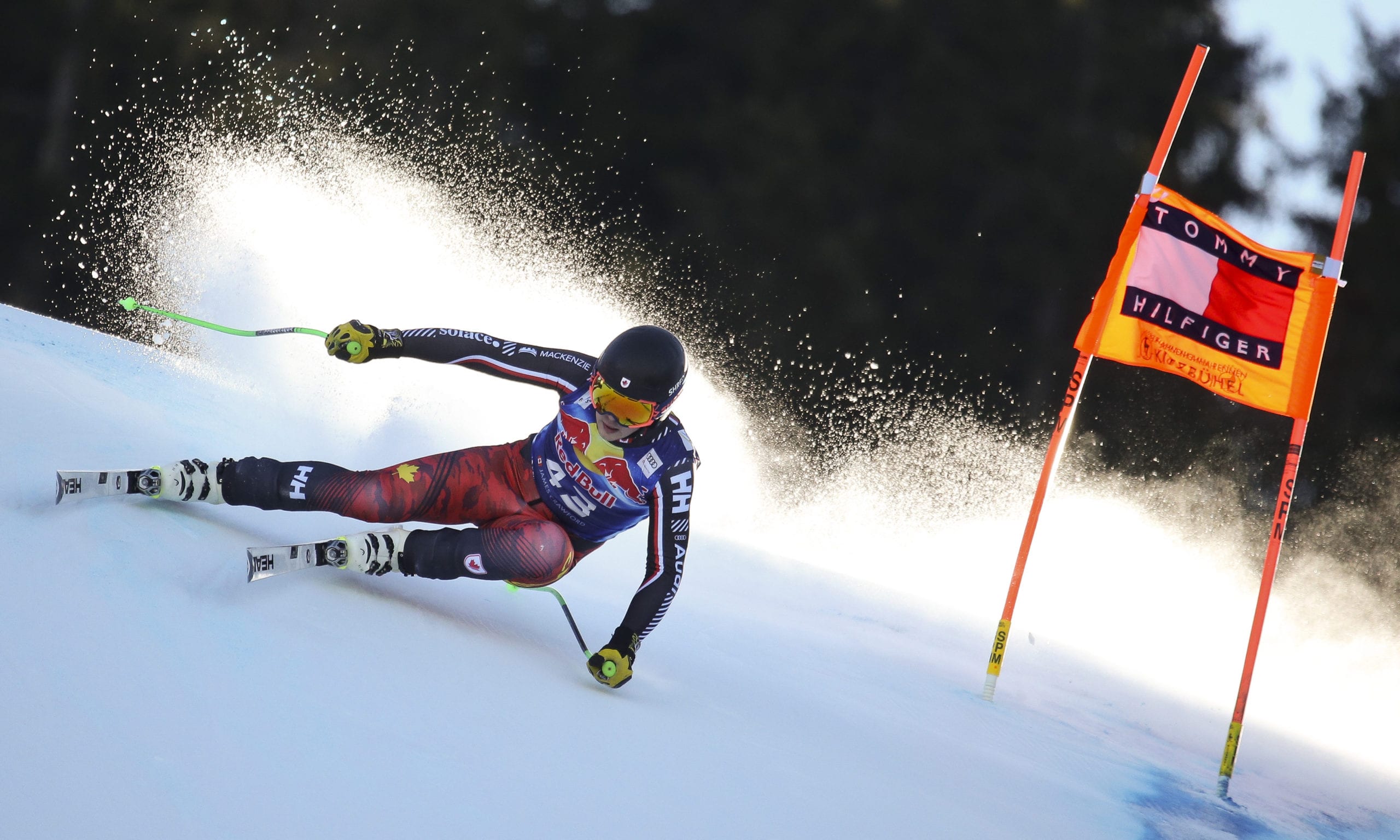
Jack Crawford and Broderick Thompson, both products of the Whistler Mountain Ski Club, and Jeff Read, from the Banff Alpine Racers, have a few year’s of experience at Kitzbuehel and are now looking to take the “next step,” according to the Canadian men’s head coach Mark Tilston.
“We’ll treat it like any other race to be honest. Obviously there’s a lot of history here and it’s a big hill, but a lot of guys will tell you Bormio is the toughest and Garmisch is no bunny hill either,” Tilston said. “We understand that Kitzbuehel is daunting especially the first time you go down it.”
Tilston and the coaching staff are tempering expectations to keep the focus on progression as main goal of the week for the young Canadian team.
“It’s a fine line between recognizing that it’s a big challenge and making realistic expectations,” he said. “We’re treating this race as part of the process … let’s get a couple more points in the bag and keep moving forward.”
Alexander and Seger were the top Canadians last season in Kitzbuehel – 27th and 29th respectively – and Seger finished an impressive 16th in 2019, 1.55 seconds behind the winner wearing bib No. 44. Crawford finished 24th in the super-G and 39th in the downhill last season, while Read finished just out of the points in 33rd in the downhill.
Tilston said that Thompson continues on a “return to performance” trajectory after he rejoined the team in the wake of a serious knee injury in 2019. “He’s had two years away so we have to be realistic,” he said. “It’s as much mental and emotional and we don’t expect top 10s for him by any stretch, next year that might be the conversation, but for now it’s really about getting back to it.”
‘Beautiful chaos’: Thomsen looking to capture old form
Canadian Ben Thomsen, racing independently, likely holds the best chance at a top 15 finish for the Canadians in this week’s race. Thomsen’s sixth-place finish in 2019 was perhaps a career pinnacle. He has 10 successful trips down The Streif since 2011 (along with five super-G starts) finishing nine times in the top 30.
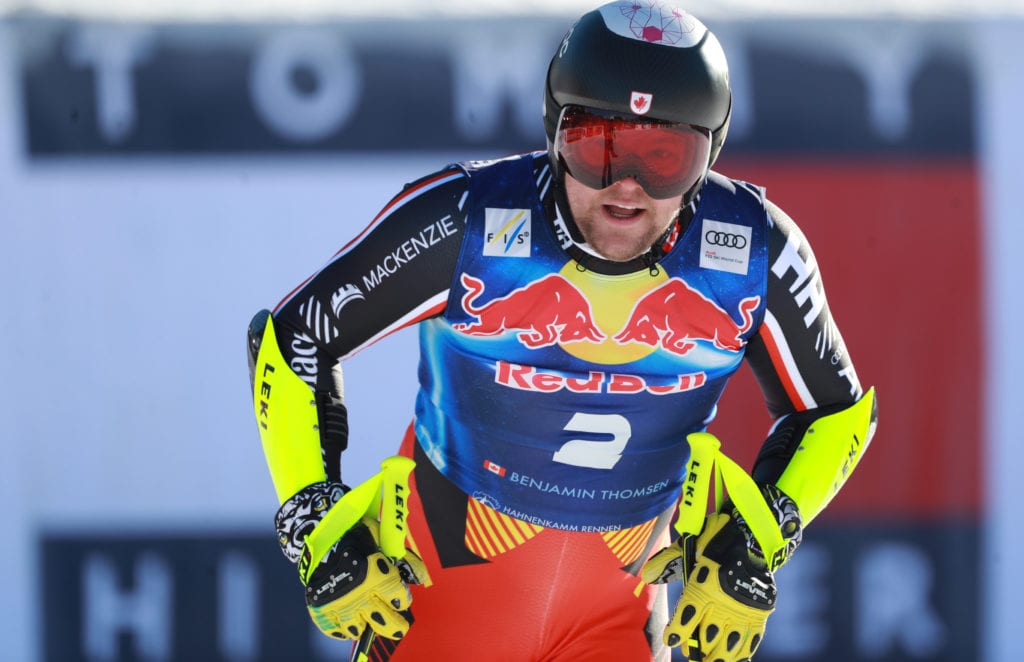
“It comes down to two words: beautiful chaos,” Thomsen stated in the past.
A lack of pre-season prep – after being dropped from the Canadian team last summer – and a season-best 37th place in Bormio, Italy, as well as a nagging knee injury are signs that he will not mix it up with the leaders this week. Thomsen, however, has shown many times that it’s not wise to bet against him and the 33-year-old covets the Hahnenkamm to the highest regard.
“It’s tough, I don’t think you can sugarcoat it’s a very different situation for Ben,” Tilston said. “He’s tuning his own skis and comes in with us sometimes but where he is at performance-wise, it’s a tough spot. He’s had some good sections and feeling a bit more confident, but he suffered from the summer – like all of us – and wasn’t fully prepared for the season. He’s still very much building up.”
When asked if he would be surprised if Thomsen returned to form this week, Tilston said, “I wouldn’t be surprised in the slightest. If you know the hill it really helps, and if you have some confidence from previous performances it can make a huge difference. The biggest problem with the start number in downhill will be fading light. But no, I wouldn’t be too surprised at all if he can get back to some results here this week.”
Epic Canadian moments at Kitzbuehel
Canadian history runs as deep as the Steilhang is steep. Non-Europeans have won it just five times since Austrian Ferdl Friedensbacher descended in just over four-and-a-half minutes to claim the first title in 1931 (Kitzbuehel joined the World Cup in 1967).
The Crazy Canucks became local and international legends winning four in a row in the early 1980s (Ken Read 1980, Steve Podborski 1981 and ’82, Todd Brooker 1983). Americans Daron Rahlves won it in 2003 on a shortened course and Buddy Werner (1959) took the coveted title.
But that’s it, the Europeans have won the rest. Bode Miller came awfully close in 2008, after riding the safety netting near the bottom of the Steilhang and finishing in a second-place tie with Mario Scheiber of Austria. Canadian Erik Guay finished second in 2013, a razor-thin 0.13 seconds behind Italian Dominik Paris.
Canadian impact on the event and its folklore is not solely defined by victories, or near victories.
At the top of that list is Todd Brooker’s infamous and hard-to-watch crash in 1987, which nearly overshadows his tremendous win in 1983 on the same course. And Brian Stemmle’s near-fatal crash in 1989, which resulted in a severely broken pelvis, a five-day induced coma, 25 blood transfusions and a lawsuit against the resort.
It’s safe to say that Canadian blood, sweat and tears – and victories – have cemented its status as a nation to watch at the world’s most famous ski race. Commentators get animated when a Canadian skier is on course, bellowing, “Kanadischer skifahrer auf course!”
But ever since Read, Pod and Brooker rattled off those wins and crashes, Canadians haven’t really tested the winners, outside of Guay. The current Canadian speed team are in the experience stage of Kitzbuehel; traditionally racers require years of testing the waters before challenging the leaders, particularly on this course.
Tilston commented that, overall, the speed team is progressing but the injuries to Seger and Crawford were “painful” for the team.
“They’re very young and with no established role models like we’ve had in the past … Broderick is the closest we have to that but he’s lost a couple years to injuries,” said Tilston, who joined Alpine Canada in May 2020 to oversee all men’s programs. “But the boys are working their way through the rankings and continuing to learn the ropes.”
Taming the untamable
The winner of Kitzbuehel requires a level of precision and perfection in a highly imperfect environment. The turns are severe and unnatural, the steeps are so steep that snow barely holds on its 40.4 degree gradient (Mausefalle), sidehills are essentially an icy mogul field, speeds are teeth-chatteringly high.
Concentration, technique, focus, bravado … they all need to redline simultaneously.
Careers have been made and lives dramatically altered. Frenchman Jean-Claude Killy became a global superstar after his sole win in 1967. Franz Klammer won three years in a row from 1975-77 (also 1984) confirming his status of the greatest Austrian alive. Swiss gentleman Pirmin Zurbriggen dominated the 1980s with three wins and Franz Heinzer (Swiss) and Luc Alphand (France) were the 1990s standouts, also with three wins apiece.
Swiss great Didier Cuche could perhaps be the greatest at Kitzbuehel with four wins between 2008 and 2012. Alongside teammate Didier Defago, Cuche and the Swiss flag owned the scoreboard and podium.
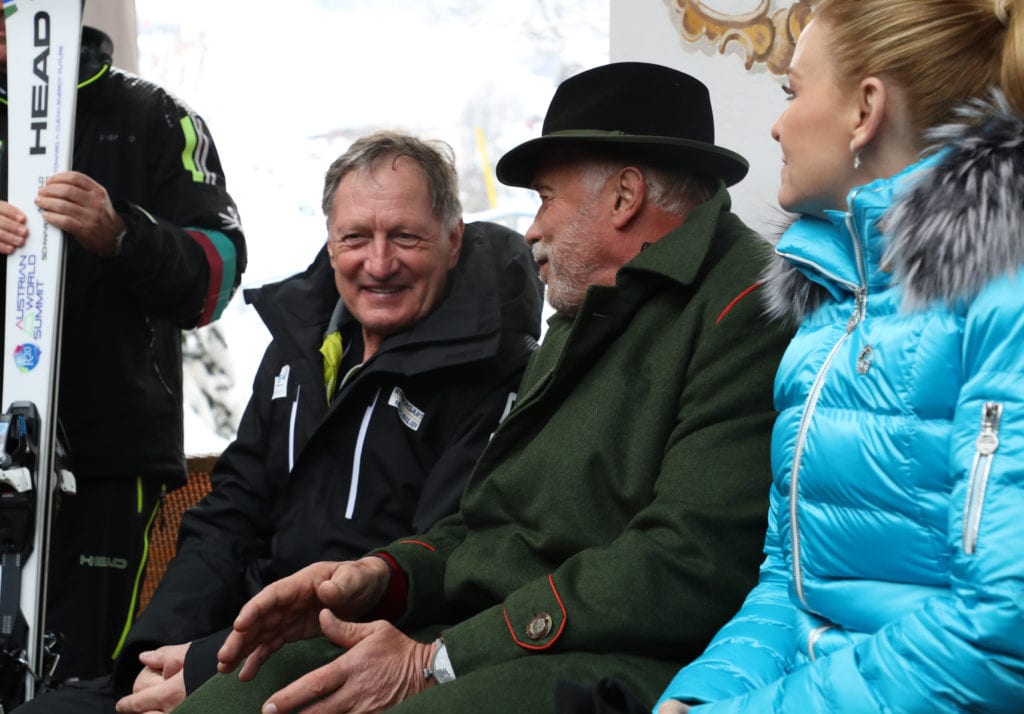
Outside the fences, the appeal and luster of this spectacular event is as strong as the race itself. The Austrian national broadcaster ORF puts forward an impressive show, which garners over 250 million viewers in Europe alone, with close to 100,000 fans usually attending in person. Of course, COIVD protocols will prevent spectators this year.
With the recent cancellation of the legendary Lauberhorn downhill in Wengen, Switzerland – usually the perfect lead-in event for Kitzbuehel – a downhill race has been added to the schedule, giving The Streif even more global display, to the pleasure of ski racing fans worldwide.
This year the engagement between fans, celebrities and their skiing heroes will be held to a bare-bone minimum, given the realities of COVID-19, particularly given the announcement of FIS Race Director Markus Waldner testing positive.
“It’s a much different vibe. I was in Cortina last night and it’s like a ghost town,” Tilston said. “You’ll see the flashy graphics and the Red Bull bridge at Hausberg and I’d be surprised if we didn’t see the sky divers and all that but I don’t think you’ll see much more than that,” he explained. “There’s pretty much a taboo on showing off as people wonder how we’re traveling around ski racing when people can’t even go into the shops.”
“But we have to be thankful that we’re even ski racing.”
Kitzbuehel: By the numbers
- Streif course length is 3.312 km
- Fastest speed: Didier Defago (SUI) 142.3 km/h in 2009. Canadian Cary Mullen reportedly clocked 150 km/h in the early 1990s.
- Average speed: 103 kmh
- Maximum grade is 85% (40.4 degrees) at the Mausefalle
- Canadians won races four consecutive years from 1980–83
- The Streif course was first used in 1937; eight years without Hahnenkamm races followed (1938–45) until the return in 1946.
- Kitzbuehel joined the World Cup in 1967
- 45 TV stations and 30 radio stations broadcast from Kitzbuehel, reaching 2.6M viewers.
About the Author: Gordie Bowles