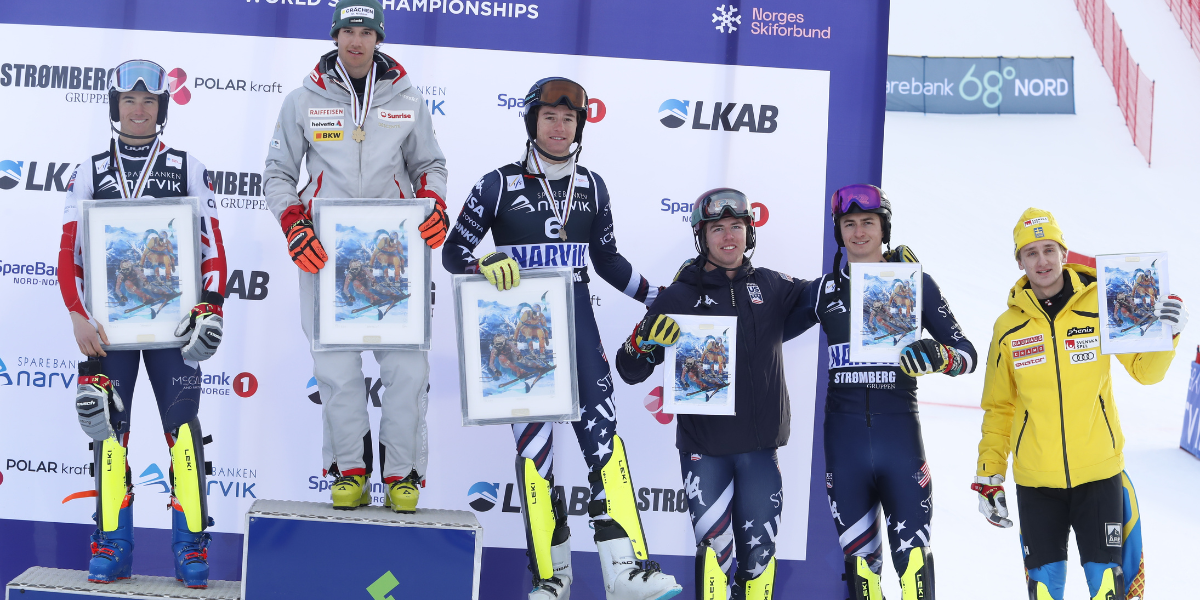
Featured Image: Men’s Slalom podium at the World Junior Championships, with three U.S. athletes finishing in the top five. Photo: Marius Gulliksrud.
For several years, the conversation around the United States men’s slalom has been uncomfortable but unavoidable. The discipline that once produced Olympic medalists and World Cup winners has struggled to keep pace with the world’s best.
In fact, the last American man to win a World Cup slalom was Bode Miller in Sestriere on Dec. 13, 2004. Miller recorded 12 World Cup slalom podiums in his career, including five victories, and also finished second on Nov. 16, 2008, marking the only U.S. podium in the discipline between his final win and the next breakthrough. Even more striking, the last U.S. men’s slalom podium came March 6, 2011, in Kranjska Gora, when Nolan Kasper finished second. In the 15 years since, American men have yet to return to the podium in the discipline.
That reality was underscored again this winter when the U.S. failed to qualify a single male slalom skier for the World Cup Finals, a stark indicator of the depth gap at the highest level of the sport.
But if the 2026 FIS Junior World Ski Championships in Narvik, Norway, are any indication, the next chapter of American slalom may already be taking shape.
On the final day of racing, the U.S. men delivered one of the strongest junior slalom performances in recent memory:
- 3rd 🇺🇸 Maximilien Hoder (USA, YOB)
- 4th 🇺🇸 Jevin Palmquist (USA, YOB)
- 5th 🇺🇸 Stanley Buzek (USA, YOB)
- 8th 🇺🇸 John Kerbaugh (USA, YOB)
Four Americans in the top 10—and three inside the top five—was not just a strong showing. It was something the U.S. has rarely seen in the discipline in recent years: depth.
For a program that has struggled to place even a single skier on a World Cup slalom podium for more than a decade, the Narvik results raise an important question:
Is American men’s slalom on the verge of a new era?
Understanding the Slalom Gap
Despite success in speed events and occasional breakthroughs in giant slalom, the U.S. men’s program has struggled to consistently produce top-level slalom skiers in recent years.
The historical contrast makes the drought even more notable.
During the 1980s, Phil Mahre won nine World Cup slaloms, while his brother Steve Mahre added three more victories. Even earlier, pioneers like Billy Kidd, Tyler Palmer, and Spider Sabich helped establish the United States as a competitive nation in the discipline.
But since Miller’s 2004 victory, American men’s slalom results at the World Cup level have been limited primarily to scattered top-10 finishes, with Nolan Kasper’s 2011 podium remaining the last breakthrough.
Several factors have contributed to that gap.
A Thinner Pipeline
For a period, development in the U.S. leaned more heavily toward athletes who could compete in speed and giant slalom, leaving fewer specialists coming through the slalom pathway.
In contrast, traditional slalom nations such as Austria, Switzerland, and Norway often develop athletes in slalom almost exclusively from a young age, building deep national pipelines where multiple athletes push each other daily.
Without that same density of specialists, American athletes have often progressed through the system with fewer direct slalom rivals driving internal competition.
The European Technical Arms Race
At the same time, the discipline itself has evolved dramatically.
Modern World Cup slalom demands:
- faster decision-making
- aggressive line adaptation
- high-level tactical awareness
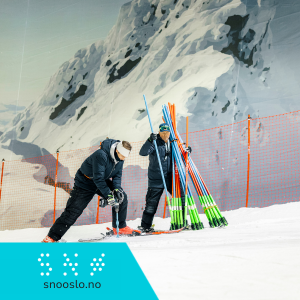
European programs have responded by designing training environments that constantly change, forcing athletes to react rather than memorize patterns.
The result is a discipline where adaptability is often just as important as raw technical skill.
The Missing Bridge to the World Cup
Another challenge has been the transition from junior success to World Cup performance.
Many promising American juniors have struggled to gain:
- consistent Europa Cup opportunities
- strong World Cup start positions
- enough high-level race repetitions
Without that bridge, talent often stalls before reaching its full potential.
The Narvik Signal
What makes Narvik so encouraging is not simply the podium result.
It is the depth of the group.
Three Americans finishing 3rd, 4th, and 5th in the same race suggests something rare in U.S. technical skiing: a cohort of athletes pushing each other forward.
Often, strong slalom nations succeed because they produce clusters of talent, not isolated stars.
That pattern may finally be emerging again for the United States.
The Key Question: What Comes Next?
The Stifel U.S. Ski Team now faces a critical moment.
The challenge is not simply producing talented juniors. It is building a system that allows them to thrive at the World Cup level, something the program has struggled to do consistently since the early 2010s.
Several solutions are already being discussed within the broader alpine community.
1. Rethinking Training Environments
One debate gaining attention across the sport is whether athletes are spending too much time training on perfect, controlled surfaces.
Indoor facilities and glaciers allow for high repetition and efficiency, but they often lack the variability of real race environments.
World Cup slalom courses today are rarely predictable. Athletes face:
- injected ice
- changing snow textures
- terrain transitions
- rhythm disruptions
To prepare for that reality, some programs are prioritizing training on varied surfaces and conditions rather than perfect lanes.
For American athletes, increasing exposure to:
- European race hills
- different snow textures
- steeper terrain
could help close the gap.
2. Increasing Variability in Training
Another key shift across elite slalom programs is course variability.
Modern World Cup setters are becoming increasingly creative. Athletes must deal with:
- rhythm changes
- flush combinations
- delays and offsets
- terrain-based sets
Programs like Norway and Switzerland intentionally design training sessions where every run is different.
The philosophy is simple:
If athletes see the same set repeatedly in training, they struggle when courses become unpredictable in races.
Developing American slalom talent may require more:
- unpredictable course sets
- mixed rhythm training
- tactical decision-making exercises
3. Coaching Innovation
Another factor in successful slalom programs is coaching diversity.
Many of the strongest European teams actively recruit coaches who bring:
- different technical philosophies
- varied course-setting styles
- experience from multiple systems
This creates training environments where athletes constantly face new challenges.
For the U.S., expanding coaching collaboration at home and abroad could help accelerate athlete development.
4. Training for Faster Change
Slalom is often described as the discipline of rapid problem-solving.
The best athletes are not just technically precise, they are able to adjust instantly when the course demands it.
Training environments that encourage quick adjustments—such as:
- varied surfaces
- different course rhythms
- terrain-driven sets
can help athletes develop that skill.
Programs increasingly talk about training athletes who can “change fast” rather than simply ski perfectly.
A New Opportunity
The results in Narvik suggest that the United States may finally have the foundation needed to rebuild the discipline.
But junior success alone does not guarantee future World Cup results.
The next step will be to ensure these athletes have the right training environments, sufficient high level racing opportunities, and coaching structures that challenge them daily.
With the recent hires of Paul Epstein as men’s head tech coach and Sasha Rearick as alpine director, there is added reason for optimism. Their experience and recent success could play a key role in shaping this next phase, though their long term impact will depend on how that structure evolves.
At the same time, the emergence of this younger group could have an impact beyond the future pipeline. A wave of motivated junior athletes pushing into the system has the potential to elevate the internal standard across the team. For current World Cup skiers like Ben Ritchie, Jett Seymour, Luke Winters, and Cooper Puckett, Ritchie and Winters have shown they can finish inside the top 30 over a full season and qualify for the World Cup Finals, while Seymour and Puckett have demonstrated the ability to score points. That added competitive pressure could act as a powerful catalyst.
In strong slalom nations, internal competition is often what drives progression. When athletes are consistently pushed in training, the standard rises. The question now is whether this new generation can help create that same dynamic in the U.S., not just build depth but push established athletes from consistent top 30 finishes toward top 10s and, eventually, podium contention.
If the pieces come together, the group emerging now could form the foundation of a new American slalom era.
For the first time in many seasons, the conversation around U.S. men’s slalom may be shifting from drought to possibility.
About the Author: Katie Twible