Preparing the Mountain: What New FIS Climate Guidance Means for Alpine Racing

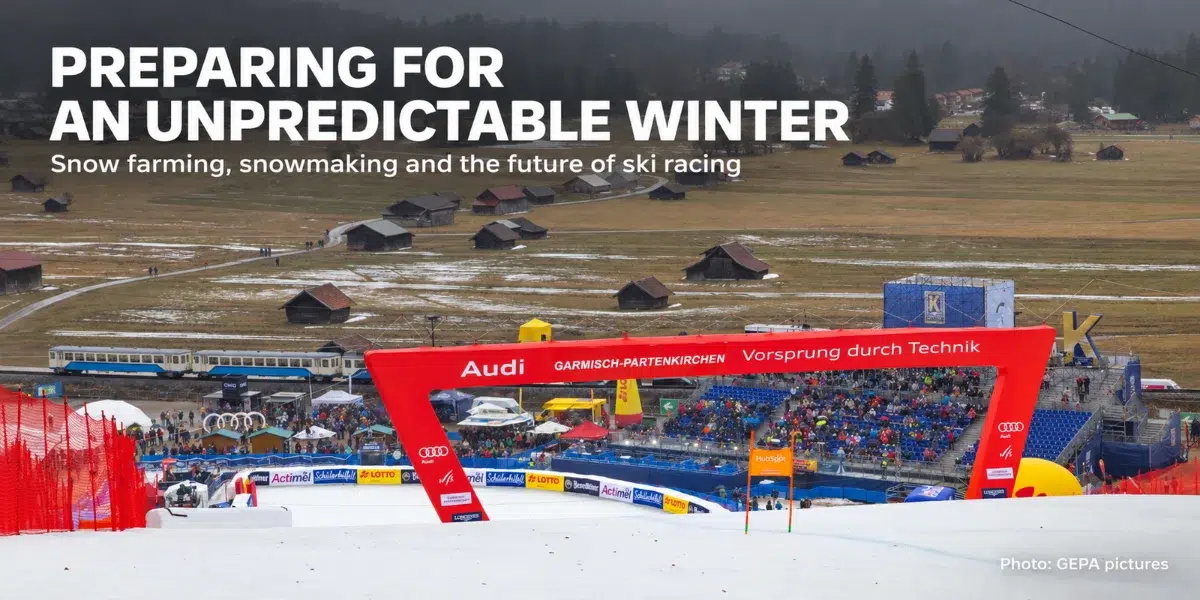
Featured Image: The men’s World Cup super-G venue in Garmisch-Partenkirchen, Germany. Photo: GEPA pictures.
New guidance from FIS and the World Meteorological Organization examines how ski venues can use weather and climate information to prepare racecourses, manage resources and plan future investments.
Long before athletes arrive in Levi, Finland, crews have already spent months preparing the snow that will cover the World Cup slope. At Beaver Creek, Colorado, new automated snowmaking equipment is designed to help crews take advantage of favorable conditions on the lower section of Birds of Prey. These venues operate in different environments, but both face the challenge of preparing a racecourse for a fixed date while working with conditions they cannot control.
That challenge is at the center of Weather and Climate Services for Ski Resorts, a report released November 3 by the International Ski and Snowboard Federation and the World Meteorological Organization. Accompanied by a shorter practical guide, the report explains how mountain operators and event organizers can use forecasts, historical observations and climate projections to make decisions about daily operations, seasonal preparation and infrastructure.
According to internal FIS calculations, adverse weather forced the cancellation of 25 Ski World Cup races during the 2025–26 season. The announcement does not break those cancellations down by discipline or identify how many were subsequently rescheduled, but the figure provides context for the organizations’ effort to help venues prepare for weather-related disruption. www.fis-ski.com
Making the Most of Snowmaking Conditions
For alpine venues, having sufficient snowmaking capacity is only part of preparing a racecourse. Crews also need to know when production will be most effective, which sections of the hill need attention first and how to allocate staff, water and electricity during the available windows. The FIS–WMO report describes how forecasts can support those decisions, while recognizing that production depends on temperature, humidity, equipment and local resources. assets.fis-ski.com
Beaver Creek’s recent investment offers a practical example. The Vail Valley Foundation announced an automated system serving the lower third of Birds of Prey, including 10 stick guns, six fan guns and a new weather station. The guns can be monitored remotely and start automatically when conditions allow, helping crews respond without the same manual setup previously required.
According to the foundation, the upgrade targets a section of the course particularly sensitive to variable early-season conditions and temperature inversions. The system is intended to capture snowmaking windows more fully while improving water and energy efficiency, although this winter’s operations will provide the opportunity to measure those benefits. bcworldcup.com
For a race organizer, the practical value of that investment will be reflected in how much preparation crews can complete when temperatures cooperate. Tracking production, resource use and the time needed to build the course could help establish where automation makes the greatest difference.
Levi’s Preparation Begins in the Previous Winter
At Levi, snow farming has become an established part of preparing for November racing. In a November 2025 interview with Ski Racing Media, Levi Ski Resort Commercial Director Marko Mustonen explained that the resort began preserving snow in 2016 with the World Cup specifically in mind.
“The ultimate goal was to secure the World Cup,” Mustonen said. “That was the reason we started snow farming in the first place.”
Each spring, crews collect snow into large storage piles and cover it with insulating materials to preserve it through summer. When autumn arrives, the snow is spread back onto the slopes, providing a base before consistent winter conditions have necessarily developed. In that 2025 interview, Mustonen said Levi had stored close to 300,000 cubic meters during the preceding summer.
“Every year, we’ve been storing a little more and improving the process,” he said. “There are so many variables: weather, rain, the condition of the snow when we start pushing it, but we’ve learned a lot.”
The work requires judgment throughout the year, including deciding when to move the preserved snow back onto the hill. As Mustonen explained, “We have to start spreading the snow before it freezes too hard. Timing is everything.” Having snow available gives the resort more options, but crews still have to respond to the conditions in front of them.
The Value Extends Beyond Race Day
Levi’s preparation also supports teams looking for reliable early-season training. Mustonen described the preserved snow as a useful slalom surface, offering the firmness and grip athletes need as they prepare to compete.
“The hardness and grip are perfect for slalom training, which is something teams can’t always get on glaciers this time of year,” he said.
That training access belongs in the discussion about what makes a venue valuable to alpine racing. A mountain’s ability to prepare terrain can influence where teams train before the season and how much preparation they can complete before their first race. Evaluating an investment therefore involves considering the training days it supports alongside its contribution to hosting an event.
Mustonen also emphasized the community behind Levi’s World Cup, saying in 2025 that more than 500 volunteers helped make it possible. “It’s very much a local effort,” he said. “Everyone in the village is involved in some way.” Equipment and snow storage support the operation, while experienced crews and volunteers carry out the work needed to welcome athletes and deliver the races.
Using the Right Information for Each Decision
The FIS–WMO guidance separates decisions by their timescale. Short-term forecasts and observations can help with grooming, lift operations and event-day preparation, while outlooks covering weeks and months can inform staffing, budgets and seasonal plans. Historical records and climate projections provide a different type of evidence for infrastructure expected to remain in service for decades. wmo.int
Those distinctions are particularly relevant when organizers interpret a seasonal outlook. The full report explains that these forecasts describe probabilities, such as an increased likelihood of warmer-than-average conditions, and cannot predict individual snowfall events months ahead. Their reliability also varies by location, season and lead time, making them one input into preparation and contingency planning. assets.fis-ski.com
Long-term investment requires a broader assessment. The practical guide explains that climate projections describe possible future conditions under different emissions pathways, helping operators examine how an investment might perform over its lifetime. For a venue considering new snowmaking infrastructure, that creates a reason to assess future operating conditions alongside its current needs.
What Venues Can Learn From Each Other
Levi and Beaver Creek demonstrate different approaches to preparing dependable race terrain, shaped by their locations and operational needs. Their experiences provide useful starting points for other venues, especially when organizers can compare measurable results: how much stored snow survives summer, how much production automation adds during a cold window, and what each approach requires in labor, water and energy.
For clubs and smaller race organizers, the same questions can be applied at a more manageable scale. Reviewing past preparation decisions, improving observations on the hill and establishing clearer thresholds for action may help identify where limited resources will have the greatest effect. The FIS–WMO report gives that work a common structure, while the experience of mountain crews will determine how effectively it translates into training and racing.
Source: FIS press release, “New FIS–WMO Report Brings Weather and Climate Guidance to Snow Sports,” published November 3, 2026. Levi quotes are from Katie Twible’s November 2025 interview with Marko Mustonen for Ski Racing Media.
About the Author: SR Staff Report

Related Post