Author’s note: The good news in this conversation about cost — and there always is some — many of our country’s best ski racers are still finding a way to mature in this sport without stratospheric spending. They’ve made it with talent, hard work, creativity and an extraordinarily engaged and supportive ski community. We’ve talked to many of them and their parents, to learn how they managed to follow their dreams without bankrupting their futures. Their stories are all different, but they share some common themes in what helped them along their journeys, which include:
- Drive, to persevere no matter what the obstacles
- Being active in other sports
- Full family involvement
- Strong community and program support
- Discounted family program fees for resort employees
- Coaches/mentors with good guidance on spending and development priorities
- Help with good equipment from an early age
- Public high schools that cooperate
- Communication and self-advocacy skills
- Donations, grants, scholarships
- T-2! $2.3 million and counting directly to athletes
- Elite level collegiate racing and programming
- National team funding: a game-changer!
- National team flexibility with programming when necessary
These athletes and parents shared their stories in the hopes that it will help young ski racers and their families see beyond the obstacles to the possibilities. Ski Racing Media is pleased to present a series within a series, if you will, “Breaking through without breaking the bank.”
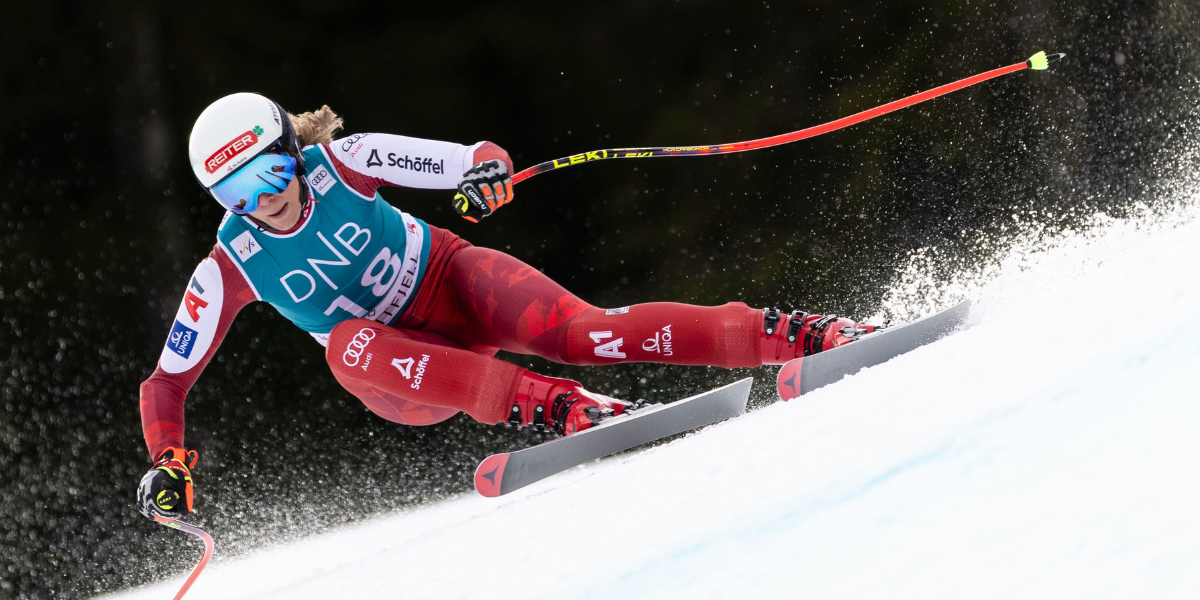
Jackie Wiles: filling the need for speed
When Jackie Wiles started skiing at age two, in the Powderhound Program at Timberline on Mt. Hood, it was “like daycare” for her and her older brother Steele. “It was great because it was a way for our family to go to the mountain without breaking the bank.” Their parents, David and Jennifer, grew up skiing, but only occasionally. “It was a big treat for them,” says Jackie. As their own kids got older, they found that having them in the local weekend racing programs around Mt. Hood was a cost-effective way to learn the fundamentals in the sport.
They joined up with other families and rented a place in Government Camp, then later bought a cabin of their own. In 2002 they made a trip to watch the Salt Lake City Olympics, and watching 17-year-old Julia Mancuso perform inspired young Jackie to pursue her ski racing dreams.
During her freshman year at Canby High School, south of Portland, Wiles raced both high school and FIS, but found it an impossible combination. By then, she had already gotten a taste for speed through U14 super G training at the Multnomah Athletic Club — “The MAC” — based in Mt. Hood Meadows. As she switched around different local programs, they all offered some amount of speed skiing, and with a sponsorship from Rossignol the pursuit remained affordable.
After graduating from high school in 2010, she was not a clear candidate for the US Ski Team, but her love for speed events ruled out college racing (and scholarships) as a path. Her parents knew she wanted to keep fighting for it, and supported her joining the FIS program at White Pass Ski Club. “They do more speed than other programs,” says Wiles (she remembers showing up her first day and seeing two older men “ripping” down the slopes. It was Phil and Steve Mahre). In addition to Christmas camps, White Pass runs their own speed camps on the back of the mountain late into the spring, then on Mt Hood’s wide open lower slopes in June.
With some fundraising through Rally Me, help from sponsors, and working some jobs on the side — like transcribing trials for her mom, who was a court reporter — Wiles stuck with it. In 2013, she made her breakthrough, winning the US Nationals. As an invitee that season she paid her own way and qualified for the US Ski Team (and the 2014 Olympic team) the following year.
Still, she had to pay, and like many athletes felt guilty for the burden it put on her parents. The USST partnership with RallyMe helped, but by 2015 she was on the B Team and still paying $10,000. Many of her teammates on that speed juggernaut of Nations Cup Champs were not only making good money, but also had never paid to be on the USST. Among them was Lindsey Vonn, who learned about Wiles’s team dues at a training camp.
“She was beside herself,” remembers Wiles. “She took it upon herself to pay my fees and made me ambassador of the Lindsey Vonn Foundation.” In 2017 Wiles scored her first podium, and in 2018 she shared the Cortina downhill podium with Vonn. “Lindsey was so instrumental for many years,” says Jackie. “She would help me on the hill and off the hill. Even now she will still reach out when she is watching races.”
Vonn has also helped counsel Wiles through injuries that have plagued her since her devastating accident just before the 2018 Olympics. Wiles understands the rollercoaster that is ski racing. In years where she is skiing fast, fully-funded and making money, she has not needed much help. In other years, she’s found ways to make it work, and relied on many sources, including family, coaching jobs, Vonn’s foundation, a host family in Park City while training or rehabbing, and others.
She hopes she has many years ahead. “Look at the guys,” she says, referring to the number of them on the World Cup in their 30s. “I just turned 29. I’m going to do this as long as I can.”
Stay tuned for more stories about “Breaking through without breaking the bank.” Have some thoughts on cost? Send a letter to the editor. If it’s good, we’ll publish it.
About the Author: Edie Thys Morgan