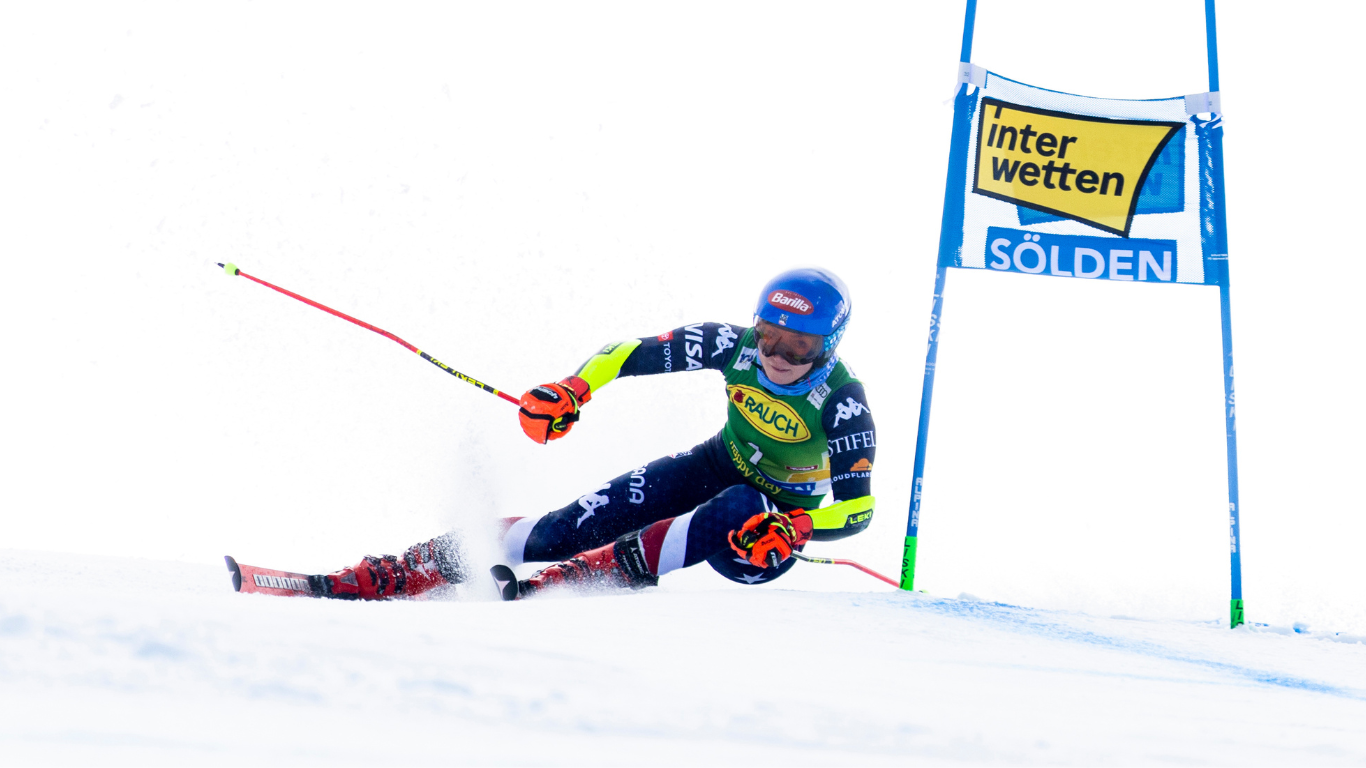
Mikaela Shiffrin Sölden 2024: GEPA pictures
Stance
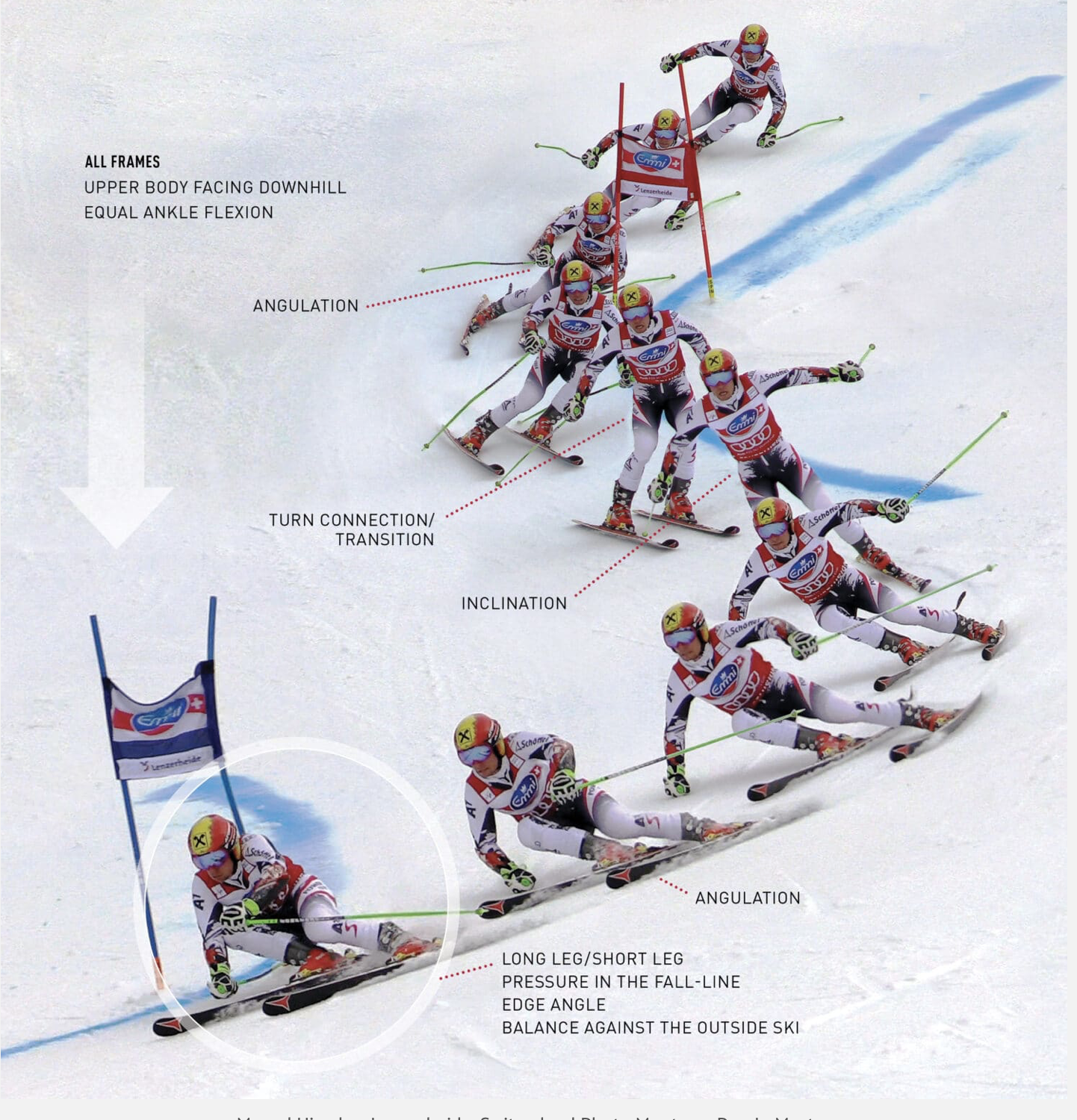
The starting point is the balanced athletic stance. The concept of how much the upper body faces downhill depends on the ankles having equal angles.
The body facing downhill allows rotation of the lower body to turn against the upper body. While the upper body appears in space, the lower body rotates in an opposite direction relative to the upper body. During a hop turn, rotation occurs in the femurs turning in the pelvis. During arc-to-arc turns, the pelvis turns over the femurs. In both, the upper body rotates relative to the lower body, or the lower body rotates relative to the upper body. The upper body faces downhill as a result. Balance occurs when opposing rotations match in timing, torque and tempo.
The degree the upper body faces downhill results from equal ankle angles. When the skis are between turns, the upper ski is farther forward on the slope relative to the lower ski. We call this “lead.” The upper ski will become the lower ski during the turn, resulting in a lead change. When matched with the knees, hips, and shoulders, this lead change is the degree the upper body faces downhill.
The concept of the upper body facing downhill is closely linked with equal ankle angles.
Transition
Transition is the connection between one turn and the next, which means un-edging and re-edging. The skier has several choices between turns when the skis are flat against the snow. One is the arc-to-arc turn, when the skis go from un-edging immediately to the new edges linking turns. Another option is a slight redirect before edging, and lastly, the stivot. The stivot is where the skis have significant redirection before arcing. Each transition has an essential moment when the ski is flat against the snow.
Going into new edges requires movement of the center-of-mass (CoM). Inclination moves the CoM inside the new turn. The greater the inclination, the more the CoM can tip the ski up. Angulation comes after inclination, which is the angle between the pelvis and legs. Efficient angulation creates an impulse of pressure by lining up or directing pressure to the base of support. Ideally, this is in the fall-line at the gate passage. Since inclination has the most effect on the path and distance of the CoM, it should precede angulation.
Turn
The turn concepts don’t necessarily happen in a prescribed order. However, they all need to be present for a fast run. The CoM movement into the new turn achieves the new edge angle during the transition. After that, effective angulation only occurs if there is a long-leg/short-leg relationship. The long leg withstands high forces best when balanced on the outside ski, which is crucial for creating and maintaining pressure in the fall line.
Conclusion
It begins with stance, which is an efficient transition as a foundation for building the turn.

How to use the FWDI material
There are two documents: an Athlete Manual and a Coaches Pocket Guide. These will help the athlete understand and facilitate more efficient coaching.
The Athlete’s Manual establishes an easy, workable, and efficient way to view technique. The FWDI objective is to make the technique simple, concise, efficient and time-effective.
Both documents state concepts that seem simple, but they allow coaches and athletes to stay on the same page.
There are nine concepts. If there were more, ski racing technique would become overly cumbersome. If there were fewer, critical features of the technique would be missing. If coaches use a common vocabulary, athletes will not have to learn a new language whenever they train with a new coach. Also, the concepts allow coaches to communicate efficiently and effectively among themselves.
Athletes must cultivate the nine concepts presented in the Athlete Manual and Coaches Guide. Over time, coaches should continuously highlight these “essential basics.”
Ron LeMaster filled the Athlete Manual and Coaches Guide with high-quality photo montages featuring slalom and GS shots of both male and female ski racers with the intent that athletes would adopt the ski racer image and meld their physiology into the techniques and then re-create the “technique” their coaches connect with the concepts.
Many photo montages include a QR code for videos to enhance the visualization. This allows the coach and athlete to experience ski racing at a different level. The video clips play at half speed to improve retention and deepen understanding.
There is more in the Athlete Manual and Coaches Pocket guide
In the Athlete Manual, you will also find an athlete’s corner, with a section on goals, focus, taking responsibility, off-snow activities and gratitude.
Parents who explore the Athlete Manual will find the Parent Corner, which offers advice on “how to support your athlete,” along with equipment considerations and specifics on “ski tuning” and, of course, “boots.”
The nine concepts are the backbone of this project. But we also know that athletes, coaches, and parents will encounter other common terms in ski racing. Both forms of the document include these in the back.
The organizational scope of U.S. ski racing can be daunting. The documents present U.S. Ski & Snowboard Divisions and Regions graphically. The FWDI hopes that with education, we can bring a worthwhile and unified message to athletes, coaches and parents.
Ski Racing Media will provide a link to purchase the next edition of The Young Skier’s Guide to Fundamentals of Ski Racing at a low cost as soon as it’s available.
About the Author: Ron Kipp