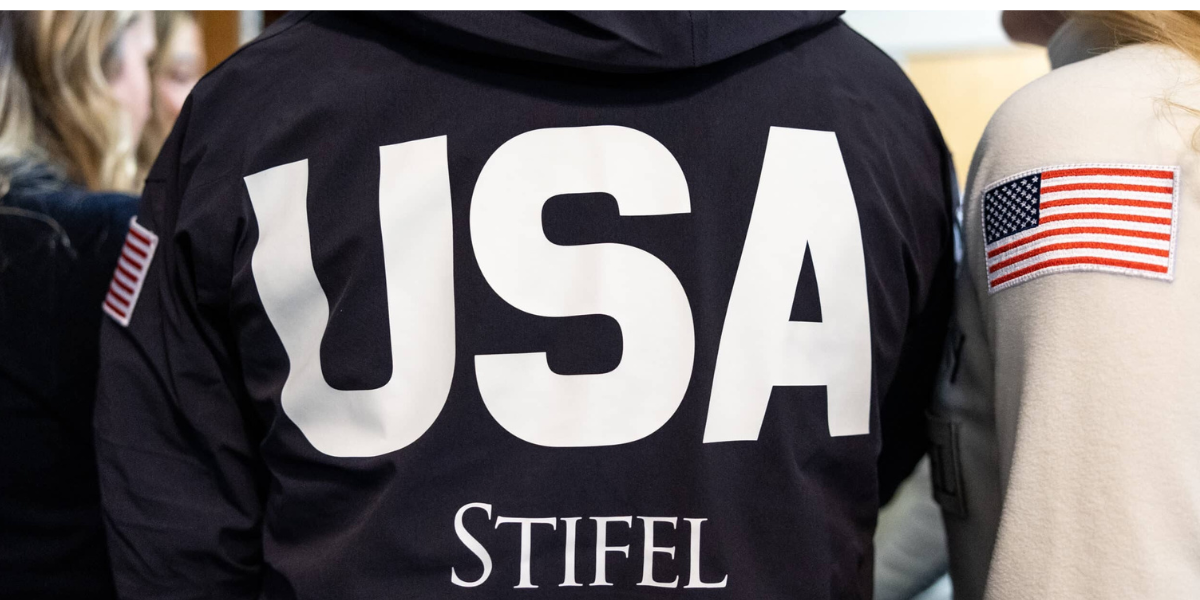
Featured Image: Stifel US Ski Team jacket. Credit: Dustin Satloff @dustinsatloff / U.S. Ski & Snowboard
Shaping a Path: Anouk Patty’s Vision for the Stifel US Ski Team
The U.S. Ski & Snowboard team, led by Chief of Sport Anouk Patty, has unveiled a new approach to team selection criteria that aims to broaden the athlete base, promote multi-discipline skills, prioritize club and regional collaboration, and align with the realities of American alpine skiing. Through countless hours of research, discussions with clubs, in-depth analysis and personal experience, Patty and her team have crafted a set of criteria to balance long-term athlete development with immediate performance goals.
“It’s a puzzle,” Patty acknowledges. “No criteria will ever be perfect, but we owe it to the athletes to try.”
A New Approach: Shifting the D and NDG Teams into the Regions
One significant change in this year’s criteria is eliminating the D Team from the National Team. Historically, the D Team has been a developmental pathway, but Patty’s team has decided to redirect those resources, along with the NDG’s, into regional programs. By investing in the regions, the U.S. Ski & Snowboard team hopes to provide a broader pool of athletes with access to high-level coaching and training while keeping them rooted in their home environments.
“We’re not cutting development resources—we’re redistributing them with the intent to invest in them further,” Patty emphasized. “Instead of funding a small number of D Team athletes, we’re putting that investment into regional programs where it can impact more athletes.”
This shift recognizes that many athletes develop at different rates and ages and emphasizes keeping them in their clubs and communities longer. Patty’s team hopes that broadening the base will see more young athletes emerge as top competitors over time.
Embracing Multi-Discipline Development
A core goal of the new criteria is to encourage athletes to develop skills across multiple disciplines. Patty’s team believes that versatility in events like Giant Slalom (GS), Slalom, and Super-G will improve performance and increase the likelihood of success at the highest levels. This approach is common among powerhouse ski nations like Switzerland and Austria, and Patty’s team sees it as essential to closing the competitive gap.
“We want to encourage multi-discipline skills,” said Patty. “If you have strong GS fundamentals, you can excel in multiple disciplines. This versatility is key to competing internationally, where top athletes are podiuming in more than one event.”
To incentivize this, the new criteria reward consistency across different events rather than single standout results.
Club and Regional Responsibility
The new criteria also strongly emphasize collaboration between the clubs, regions, USSS and Stifel USST. Patty highlighted the need for clubs and regional programs to embrace their role in developing young athletes. The goal is to create a cohesive system where regions connect local clubs and the national team.
“We’re moving toward a national system that truly includes and relies on the regions,” said Patty. “Our regional programs are now part of the pathway to the U.S. Ski Team, and they need to be as robust and performance-oriented as possible.”
Goals of the New Criteria
In defining the new criteria, Patty’s team focused on several key goals: developing a higher quantity of top-ranked juniors, increasing NCAA podiums, expanding the number of athletes involved in elite programming, and, crucially, encouraging athletes to pursue multiple disciplines. To achieve these, the team set benchmarks that promote versatility and season-long consistency.
“We want to be performance-focused at every level,” Patty explained. “Our changes are about fostering faster young athletes and creating a larger pool of talent in the junior ranks.”
Patty and her team believe that nurturing talent within regions and clubs will also make the sport more accessible and sustainable. By reducing the need for young athletes to relocate or travel extensively, they hope to relieve some of the financial burden associated with competitive skiing.
Supporting Regions with Staff and Financial Resources
The Stifel US Ski Team is committed to providing staff and financial support to the regions to help them reach new levels of performance and collaboration. By placing experienced coaches and increasing resources within the regions, Patty’s team is strengthening the sport’s foundational levels, ensuring young athletes can develop without needing to relocate prematurely.
“We’re creating a system where our best coaches are working within the regions,” Patty said. “This way, athletes can stay home longer, access elite coaching, and experience high-level training without leaving home. Let’s remember, these athletes are young, and home life with friends and family is key in their personal development at this age. But we have to give them the elite programming they deserve too.”
B Team and C Team Selection: Refining Pathways
The 2025-26 criteria update B and C Team selection to support athlete progression at different stages. With age-sensitive benchmarks and multiple qualification paths, the criteria aim to meet athletes’ development needs.
B Team Selection: Tailoring Requirements by Age
The B Team criteria for 2025-26 maintain a high standard, with Europa Cup and World Cup performances as key benchmarks. However, the requirements are now more refined based on age, allowing younger athletes to qualify with slightly lower expectations while challenging older athletes to meet higher standards.
Result-Based Qualification: For the 2025-26 season, athletes can qualify for the B Team with age-specific results:
- YOB 1995-1996: Requires three Europa Cup Top three finishes or World Cup top 20 results.
- YOB 1997-1998: Requires three Europa Cup Top five finishes or World Cup top 25 results.
- YOB 1999 or younger: Requires three Europa Cup Top 10 finishes or World Cup top 30 results.
WCSL Rank Qualification: The World Cup Start List (WCSL) rank qualifications are similarly adjusted by age:
- YOB 1995-1996: Requires a WCSL rank of ≤ 30.
- YOB 1997-1998: Requires a WCSL rank of ≤ 35.
- YOB 1999 or younger: Requires a WCSL rank of ≤ 40.
These adjustments allow younger athletes to enter the B Team with performance levels that suit their developmental stage, while older athletes are held to a higher standard, reflecting their experience and time in the sport.
C Team Selection: Broadening Pathways Post-D Team
With the D Team removed, the C Team criteria have expanded to include more pathways, offering opportunities for Continental Cup performance, FIS World Ranking, and NCAA results. This broader approach provides talented athletes with additional ways to qualify for elite programming and represents a more inclusive system.
Continental Cup Performance: The 2025-26 criteria allow athletes to qualify through NorAm and Europa Cup standings, with different age-specific requirements:
- YOB 2001-2002: Top two in final NorAm Cup standings in one discipline, plus high rankings in another.
- YOB 2003 & younger: Requires Europa Cup top 20 finishes or top NorAm standings.
- YOB 2004 & younger: Allows for top 10 at World Juniors or podiums in NorAm or Europa Cup events.
FIS World Ranking: The new criteria incorporate FIS World Ranking requirements, specifically prioritizing technical disciplines to align with the team’s push for multi-discipline competency.
- YOB 2001 men, for example, must achieve a World Rank of ≤ 75 in one discipline or ≤ 125 in two disciplines, with at least one being a tech discipline.
NCAA Performance (New): Recognizing the value of collegiate skiing, the 2025-26 C Team criteria now allow athletes born in 2002 or later to qualify based on NCAA achievements. Athletes who place in the top three at the NCAA Championships and also perform well in the NorAm Cup can now access the C Team.
This expanded C Team pathway accommodates a broader group of athletes and provides them with the support and training resources they need as they develop. It also acknowledges the NCAA as a legitimate pathway to the U.S. Ski Team, creating a bridge for college athletes to enter elite ranks.
Key Differences Between the 2024 and 2025 B and C Team Criteria
The updates to the B and C Team criteria reflect a thoughtful approach to development, with each team targeting different stages of athlete progression:
B Team: Designed for athletes already competing at a high level, with stringent Europa Cup and World Cup result requirements. The age-based benchmarks allow for younger athletes to qualify without needing immediate podium finishes while demanding top performances from older athletes.
C Team: By eliminating the D Team, the C Team now serves as the primary entry point to elite development. The expanded pathways allow athletes to qualify through Continental Cup results, FIS World Rankings, and NCAA performance, making the C Team accessible to a broader talent pool. This approach encourages athletes to stay with their clubs or regions longer, leveraging regional support and minimizing relocation costs.
Moving Forward: A System That Evolves with the Sport
The 2025-26 criteria changes for the B and C Teams mark a significant shift in U.S. alpine skiing’s approach to athlete development. By creating age-sensitive benchmarks, encouraging multi-discipline skills, and broadening pathways through Continental Cup and NCAA qualifications, the U.S. Ski & Snowboard team is building a more inclusive, adaptable, and performance-oriented system.
“It’s about finding the right balance,” Patty noted. “We’re creating pathways that reward performance and commitment across multiple levels, from clubs and regions to the national team. This is about developing faster athletes that are more versatile, well-rounded competitors.”
The team acknowledges that adjustments may still be needed as they move forward. However, they remain focused on building a national program that supports young athletes at every stage, from the grassroots to the global stage. The Stifel US Ski Team is committed to strengthening the pathway from local clubs to the world’s biggest stages by providing staff and financial support to the regions.
For full details of the criteria, click this link.
About the Author: Peter Lange