
GEPA pictures
I wrote about the death of two ski racers almost seven years ago, David Poisson, a French downhiller, and, closer to home, Max Burkhart, a German athlete who attended Sugar Bowl Academy, where my daughters used to participate and where I was a long-time member of its Board of Trustees. And it was only two years before that ski racing mourned the losses of US Ski team members, Ronnie Berlack and Bryce Astle.
Our ski racing family mourns the loss of another family member with profound sadness, 19-year-old Matilde Lorenzi, a rising star from Italy, who sustained injuries from a training accident.
Racers and parents involved in ski racing understand and accept the risks of our sport. In recent years, we’ve frequently seen these risks in the form of serious injuries.. Yet, many who succumb to those injuries show remarkable resilience and an insurmountable spirit. They fight against injury through patience and hard work and return to the top of our sport.
As I noted in my 2017 article, “Injuries are understandable, and they usually heal. Death is inexplicable and final.”
As with my last article about ski racing, the mother of a young ski racer who inspired this article didn’t know what to say to her daughter upon learning of Matilde’s death. Knowing this news was talked about among her fellow racers, and this mom emailed me asking for advice on what she could say to her daughter to make this loss and the potential discomfort a little more palatable. This article expands on the ideas I shared with her in this difficult conversation.
- Before you talk, listen. Please find out how much your child knows about Matilde’s death and what has been talked about among their peers and within their ski program. Unfortunately, few details about her death have appeared in reports, so what your child has heard or what is being talked about might not be accurate.
- Observe. Watch how your child reacts to the news. Of course, you should look for overt signs of negative emotions, like crying. But you should also stay tuned to more subtle signs of distress, like mood swings, social withdrawal, a sudden loss of motivation, difficulty sleeping, changes in eating habits, and strong negative emotions that are out of proportion to a particular situation.
- Give your child permission to grieve. This is your top priority! Our culture doesn’t encourage emotional experience or expression; many people view it as a sign of weakness. But I believe the opposite is true. It takes courage to feel profound negative emotions and particularly to share those feelings with others.
Parents tend to distract, assuage, and placate painful feelings their children experience. But that doesn’t help and actually does a disservice to children in the moment and in their long-term development. Your child will inevitably experience loss, and healthy grieving will be a good emotional foundation for future losses (whether a broken heart or the death of a loved one). - Just be there for them. As part of the “Mama bear or Papa bear” instinct to protect your child, you’ll want to say something that will make them feel better. Unfortunately, there is likely nothing you can say to ease their pain. So, don’t feel the need to say anything to your child. In times like these, there isn’t much to be said. Just be there and encourage them to feel their sadness and share it with you, if they choose to.
- Express your love. At its most basic level, news of a death makes kids feel unsafe. One of the most powerful things you can do to support your child is to express your love and support for them. Communicating these two messages to your child can make them feel safer and make them feel other powerful emotions, such as love, empathy, and compassion, that can ease the pain of their grief.
- Provide some perspective…maybe. If If your child asks questions, like why and how, try to answer, even if you can’t provide tangible answers. One of my saddest but favorite sayings I share with the racers I work with is: “—it happens in ski racing (and life).” I usually use this in the case of a DNF or injury, but it applies far more painfully to the inevitable losses in life that we all experience. Helping your child understand that life can be seemingly random and harsh can help them be a little less shocked when bad things happen.
- Reach out to others. As the news of Matilde’s death will impact all ski racers, I encourage you to contact the head of your child’s school, if your child attends a ski academy, or the director of the race team they are a member of. Importantly, ensure that the school or program provides professional support to the students (and staff) who might need it. This “it takes a village” approach creates a cocoon of caring and support for young racers that can help them manage their sadness and feel supported through this difficult time.
Finally, I want to express my sincere condolences to Matilde Lorenzi’s parents, family, and friends. She was an exceptional young ski racer and a fine young woman. I also want to express my respect for Matilde’s parents, who, though experiencing hell in the loss of their daughter, are also taking steps to protect other ski racers (and their families) from a similar fate.
The Lorenzi family has established a fund to develop ways to make skiing safer so their daughter’s fate doesn’t happen again. As Adolfo Lorenzi stated, “We believe that what happened to Matilde must be an opportunity,” a profoundly courageous thing to say that brings tears to my eyes.
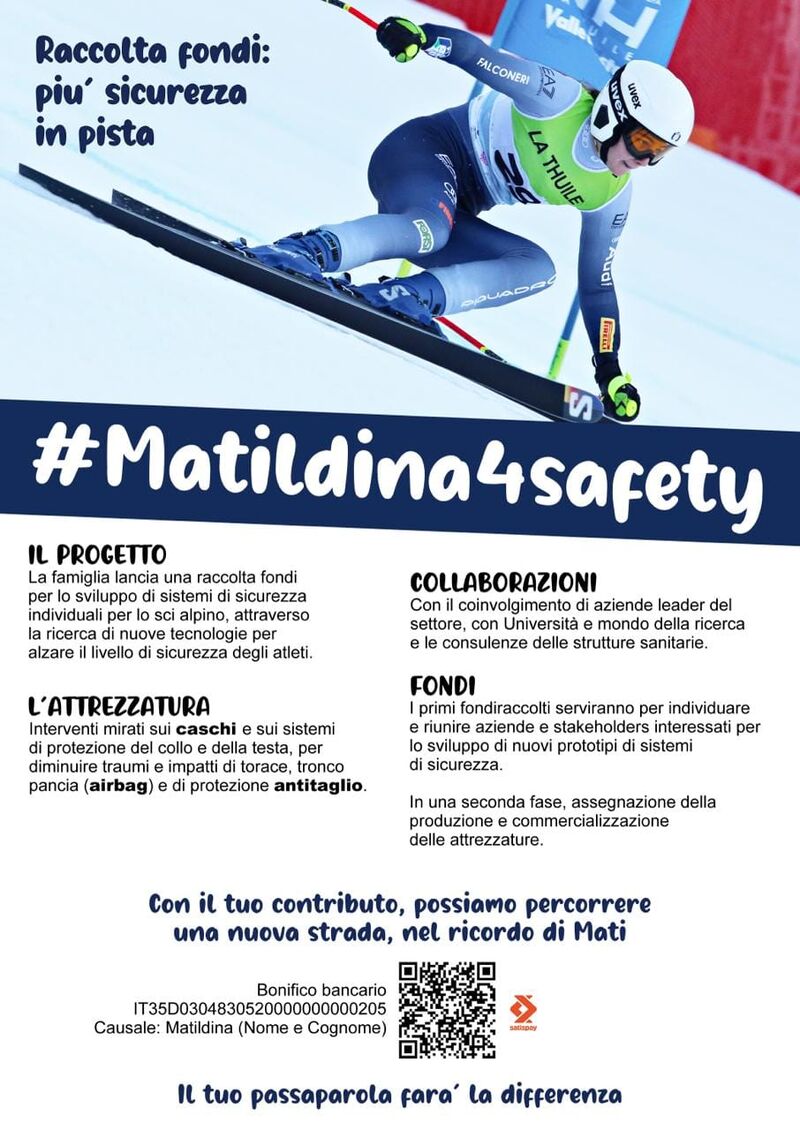
Fundraising: More Safety on the Slopes
#Matildina4safety
The Project The family is launching a fundraising campaign for the development of individual safety systems for alpine skiing through research into new technologies to increase the level of safety for athletes.
The Equipment Focused interventions on helmets and protection systems for the neck and head to reduce trauma and impact to the chest, abdomen (airbag), and anti-cut protection.
Collaborations Involving leading companies in the sector, universities, research organizations, and health care consultancies.
Funds The initial funds raised will be used to identify and bring together companies and stakeholders interested in developing new prototypes of safety systems.
In a second phase, funds will be allocated for the production and commercialization of the equipment.
With your contribution, we can pave a new path in memory of Mati.
Bank transfer:
IT35D0304830520000000000205
Reason: Matildina (First and Last Name)
About the Author: Dr. Jim Taylor